
7 Reasons Lens Replacement Surgery Can Outperform Laser Eye Surgery in Your 40s
- Posted
- Medically Reviewed by: Mr Mfazo Hove, Consultant Ophthalmic Surgeon
- Author: Mr Mfazo Hove
- Published: August 12, 2025
- Last Updated: September 11, 2026
TL;DR: This is the affirmative case: seven specific reasons lens replacement surgery can outperform laser eye surgery once you are past 45, each argued properly rather than asserted.
It is deliberately one-sided, so read it alongside the balanced framework, table and patient archetypes in Lens Replacement vs Laser Eye Surgery in Your 40s. Remember that laser, including PRESBYOND® laser blended vision, remains the better answer for some 40-something eyes, and the ICL for others.
The word in the title is “can”, and your measurements are the judge.
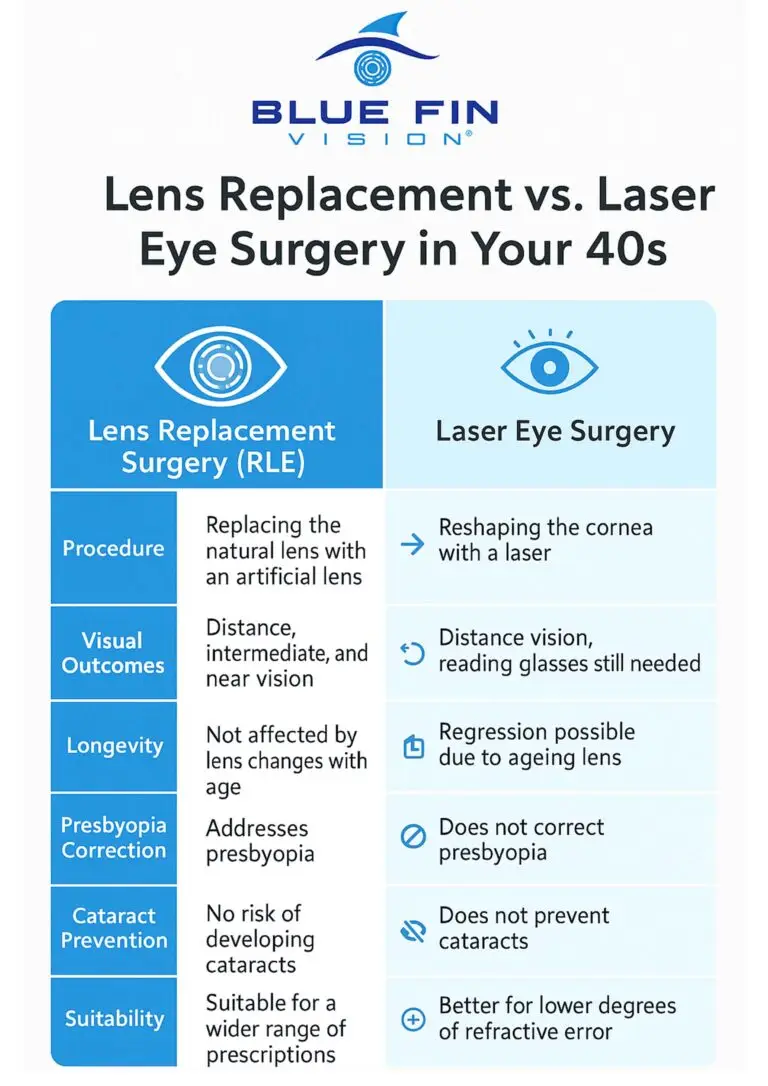
Infographic: Lens Replacement vs. Laser Eye Surgery in Your 40s
1. Lens Replacement Surgery Treats the Part That Is Actually Ageing
Reading glasses in your 40s are a lens problem, not a corneal one. The natural lens has lost some of its ability to refocus, and every other intervention works around that fact: readers magnify, varifocals zone, and monovision and blended vision divide labour between the eyes.
All of them are intelligent accommodations of a failing part.
Lens replacement is the only option whose answer to presbyopia is structural: the failing part is removed and replaced with an optic designed for the life you actually lead.
When the problem is the lens, treating the lens is not one option among many; it is the only causal treatment on the menu, and everything else on this page follows from that.
2. The Correction Is Intended to Last
A laser result in your 40s is delivered onto an eye whose lens keeps ageing behind it. The cornea holds its new shape admirably, while accommodation continues to fade and the lens drifts towards opacity. This is why 40-something laser patients often return years later, asking why the reading problem came back.
It never left; it was postponed.
An artificial intraocular lens does not age that way. Fine-tuning is occasionally needed and capsule haze can be treated, but the optic itself is a settled fact. The correction it creates is intended to be lasting rather than to be revisited by the structure behind it.
3. Cataract Comes Off Your Life’s Schedule
Age-related lens opacity becomes increasingly common as we get older, so many patients considering refractive surgery in their 40s will eventually face a cataract decision later in life.
Laser leaves that appointment standing and adds a complication to it: a laser-shaped cornea makes the eventual lens power calculation genuinely more demanding. This problem is discussed at length in our page about lens replacement after previous laser.
Lens replacement uses the same core surgical procedure as cataract surgery and the same type of intraocular lens. It is performed once, calmly, on your schedule, with the full choice of optics made with a clear head rather than around deteriorating vision.
For patients who would eventually need lens surgery, which is statistically most people, this reason alone reframes the decision from whether to when and on whose terms.
4. Some Prescriptions Make a Lens-Based Solution More Logical
Not all big prescriptions are the same, and the honest version of this reason distinguishes them.
High hyperopia is genuinely lens-shaped territory. Plus corrections sit uncomfortably on a cornea, tissue and screening limits bite early,¹ and the hyperopic eye meets presbyopia hardest and earliest. From the late 40s, the lens is often the honest first option.
High myopia is different. The eye is long, retinal considerations after lens removal are genuinely greater, and while the natural lens remains clear and functional, preserving it, with the ICL carrying the correction, deserves serious discussion before lens replacement is assumed.
Contemporary guidance on refractive lens exchange specifically emphasises selection at the extremes.²
So the reason, stated precisely, is that certain prescriptions, high hyperopia above all, make the lens-based road more logical than the corneal one. A practice offering all three operations can tell you honestly which category your eye is in.
5. Astigmatism, Distance and Near in One Calculated Plan
A 40-something eye often carries three optical problems at once: a distance prescription, astigmatism and advancing presbyopia.
On the cornea, these are addressed in a single ablation profile with the lens still ageing behind it. At the lens plane, they are solved in one calculated implant.
Toric platforms correct astigmatism within the lens itself, with meta-analysis confirming better uncorrected vision than non-toric lenses in astigmatic eyes.³ Trifocal or extended depth of focus optics address distance, intermediate and near together, with Cochrane-level evidence of substantially greater spectacle independence than monofocals at the recognised cost of more glare and haloes.⁴
One operation, one plan, one settled optical answer, rather than a corneal fix now and a lens conversation later.
6. The Optical Strategy Moves From the Cornea to the Lens
Every optical solution has compromises. The honest claim is about where the compromises are chosen and how many tools you choose among.
Laser approaches to presbyopia work at the corneal plane, principally by dividing labour between the eyes. This is an elegant strategy with its own adaptation demands and limits as presbyopia deepens.
Lens replacement moves the optical strategy to the lens plane, where the toolkit is broader: monofocal for maximal night-time purity, toric for astigmatism, extended depth of focus for range with gentler optics, and trifocal for fullest independence.
The compromises do not vanish. Haloes, contrast and adaptation are real and are argued honestly in our lens replacement surgery pros and cons guide. However, they are selected for each patient from a wider set of instruments and matched to your measurements and your life.
That breadth of choice at the lens plane is a genuine, defensible advantage.
7. I Have Lived the Result
I have carried trifocal intraocular lenses in both eyes since my own lens surgery for cataracts in April 2024, approaching two and a half years. Laser was never an option for the problem I had.
What I can report is a continuous range of vision, from horizon to phone, with very strong distance vision. The honest drawbacks are tolerable night-time haloes and a few minutes of morning blur while my tear film wakes up before I do.
When I tell a 48-year-old what trifocal vision is like while dining at a restaurant, using a phone or driving at night, I am reporting, not marketing. Living with the trade-offs has made me more selective about recommending these lenses, not less.
Few of the clinics competing for this search can say the same in the first person.

When These Seven Reasons Do Not Win
When Laser Eye Surgery, Including LASIK or SMILE, Remains Preferable
A stable, corneal-sized prescription in an eye that still accommodates, with corneal measurements that pass rigorous screening, is laser’s home ground.
Replacing a lens that is still doing its refocusing job spends something the patient has not yet lost, and well-selected laser’s satisfaction record⁵ is not an accident.
When PRESBYOND® Is Preferable
For suitable early-presbyopic patients, laser blended vision extends useful near function by tuning how the two eyes share the range, preserving the natural lens entirely.
It is a genuine middle road for the late 40s where lens change has not begun and expectations fit a binocular strategy.
When the ICL Is Preferable
For a long, highly myopic eye with a clear, functioning lens, retinal considerations after lens removal are greater.
Preserving the natural lens while the ICL carries the correction is often the more conservative first move, with the lens decision held for the decade when the lens itself declines.
When Monofocal Beats Trifocal
Even when lens surgery wins, the trifocal does not always.
Night-critical occupations, corneas with significant irregularity, certain retinal findings and low tolerance for haloes can all make the monofocal, with readers accepted knowingly, the happier outcome.
Choosing the operation and choosing the optic are two decisions, not one.
When No Surgery Is Preferable
Unstable refractions, active surface disease, expectations no optic can meet, or a motivation the size of a single frustration can each be a reason for a good consultation to end in advice rather than a booking.
A credible assessment must be capable of exactly that.
What Blue Fin Vision® Measures Before Deciding Which Side Wins
The verdict between these seven reasons and their counterarguments is delivered by measurement, not persuasion.
One assessment examines:
- Your refraction and its stability.
- Your corneal topography and thickness.
- Your biometry, including axial length.
- The state of your natural lens.
- Your retina.
- Your ocular surface.
- Your expectations.
The assessment keeps all three operations, and the option of no surgery, available at the end of the process.

Choosing Between Lens Replacement Surgery and Laser Eye Surgery
Seven reasons are not a verdict, and the section above is where they lose. The deciding evidence is your own biometry.
Bring the Lens Replacement Surgery Checklist and let the measurements pick the winner.
Book a paid consultation with Blue Fin Vision® to discuss your options with a consultant and access Harley Street standards across London, Hertfordshire and Essex.
References
- Randleman JB, Woodward M, Lynn MJ, Stulting RD. Risk assessment for ectasia after corneal refractive surgery. Ophthalmology. 2008;115(1):37-50. PMID: 17624434.
- Maldonado MJ, de Salazar Campos A, Castro Machado A. Indications and risk factors in refractive lens exchange: outcomes and special cases (extremes hyperopes and myopes). Arch Soc Esp Oftalmol (Engl Ed). 2026 Jul 20:502616. doi: 10.1016/j.oftale.2026.502616. Online ahead of print. PMID: 42476410.
- Kessel L, Andresen J, Tendal B, Erngaard D, Flesner P, Hjortdal J. Toric intraocular lenses in the correction of astigmatism during cataract surgery: a systematic review and meta-analysis. Ophthalmology. 2016;123(2):275-286. PMID: 26601819.
- de Silva SR, Evans JR, Kirthi V, Ziaei M, Leyland M. Multifocal versus monofocal intraocular lenses after cataract extraction. Cochrane Database Syst Rev. 2016;12:CD003169. PMID: 27943250.
- Solomon KD, Fernández de Castro LE, Sandoval HP, Biber JM, Groat B, Neff KD, Ying MS, French JW, Donnenfeld ED, Lindstrom RL; Joint LASIK Study Task Force. LASIK world literature review: quality of life and patient satisfaction. Ophthalmology. 2009;116(4):691-701. PMID: 19344821.
ABOUT THE AUTHOR
Mr Mfazo Hove
Consultant Ophthalmic Surgeon
MBChB MD FRCOphth CertLRS
Mr Mfazo Hove is a Consultant Ophthalmic Surgeon with experience spanning more than 57,000 procedures. He completed 6.5 years of specialist training at Moorfields Eye Hospital and served for five years as a consultant at the Western Eye Hospital, Imperial College Healthcare NHS Trust. He is the founder of Blue Fin Vision®, a consultant-led private ophthalmology practice operating across London, Essex, and Hertfordshire. His clinical expertise encompasses advanced cataract surgery, refractive lens replacement, laser vision correction, and implantable Collamer lenses (ICL).
A ZEISS Key Opinion Leader, Mr Hove is a respected international speaker with five invited engagements across seven cities in 2026:
- ZEISS China tour (Changsha, Shanghai, and Hangzhou, April – ZEISS APAC User Meeting)
- RCOphth Annual Congress – May – Manchester
- ZEISS EMEA User Meeting (Istanbul)
- ZEISS Lausanne User Meeting (Lausanne)
- European Society of Cataract and Refractive Surgeons Annual Congress (ESCRS, London)