



Patient Experience
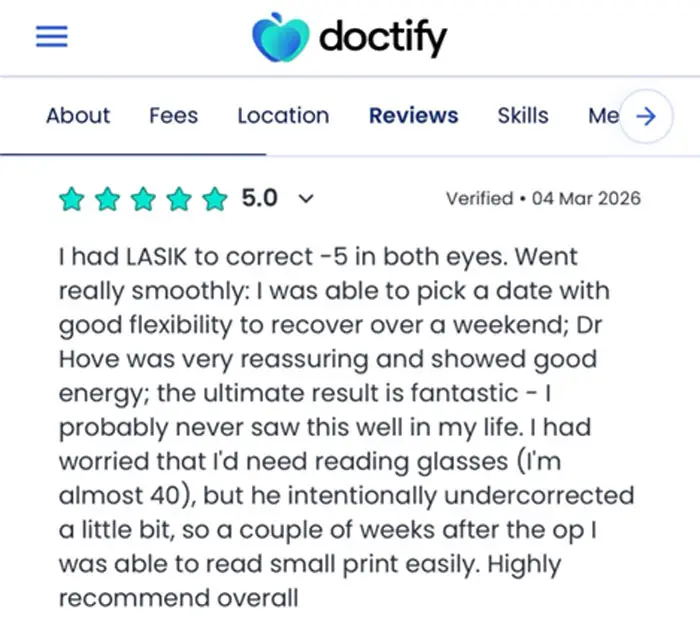
‘I had LASIK to correct -5 in both eyes. Went really smoothly. Dr Hove was very reassuring and showed good energy; the ultimate result is fantastic, I probably never saw this well in my life. I had worried that I’d need reading glasses (I’m almost 40), but he intentionally undercorrected a little bit, so a couple of weeks after the op I was able to read small print easily. Highly recommend overall.’
This page is for patients approaching 40 who are considering LASIK (laser in situ keratomileusis) and want to understand the relationship between distance correction and reading ability, and what intentional undercorrection offers as a strategy.
Why the Near-40 Consultation Is Different
Patients approaching 40 face a nuanced LASIK decision that patients in their late 20s do not. The question is not simply “can the prescription be corrected”, it is “how should the correction be targeted to account for the natural reading vision decline coming in the next five to ten years.”¹ This is the conversation most patients coming in near 40 were not expecting to have.
Three Options and Their Trade-Offs
- Full correction to plano: 20/20 unaided distance vision; reading glasses typically needed from around age 45; best for patients prioritising distance clarity.
- Intentional undercorrection (approximately -0.75D): functional but not 20/20 distance vision; near reading preserved for longer; best for near-40 patients who value near vision.
- Monovision: one eye corrected for distance, one for near; near vision without glasses; best for patients who adapt well, and should be trialled with contact lenses first.²
Who This Is Not For
Intentional undercorrection is not appropriate for patients who require precise unaided distance vision, certain occupational or aviation requirements. It is also not appropriate for patients in their early 30s where presbyopia is still a decade away, the distance compromise delivers no meaningful benefit at that stage. This strategy applies specifically to the 37 to 45 age window where presbyopia is approaching and near vision is worth preserving.
Clinical Perspective
At Blue Fin Vision®, Mr Mfazo Hove provides every patient approaching 40 with a specific consultation discussion on the presbyopia question before any correction target is agreed, a conversation that is often entirely absent at standard laser consultations elsewhere. Prescription level, dominant eye, current near vision, and lifestyle demands all inform the target. In our 2024 to 2025 series, 91% of patients who elected intentional undercorrection in the 38 to 45 age group reported no need for reading glasses at the six-week review. The patient in this review came in with a specific worry about reading glasses, the surgical plan addressed that worry directly, and the result confirmed the planning. Dry eye considerations are managed alongside the refractive target.³ The LASIK ablation itself is permanent.⁴
Clinical Takeaway
LASIK at 40 is a different decision to LASIK at 30. Full correction gives sharpest distance now but reading glasses from the mid-40s. Intentional undercorrection preserves reading ability for longer at the cost of some distance clarity. Monovision is a third option that should be trialled before surgery. The right choice depends on lifestyle, dominant eye, and prescription.
References
- Alio JL, Muftuoglu O, Ortiz D, Perez-Santonja JJ, Artola A, Ayala MJ, Garcia MJ, de Luna GC. Ten-year follow-up of photorefractive keratectomy for myopia of more than -6 diopters. Am J Ophthalmol. 2008;145(1):37-45.
- Bower KS, Woreta F. Update on contraindications for laser-assisted in situ keratomileusis and photorefractive keratectomy. Curr Opin Ophthalmol. 2014;25(4):251-257.
- Toda I, Asano-Kato N, Komai-Hori Y, Tsubota K. Dry eye after laser in situ keratomileusis. Am J Ophthalmol. 2001;132(1):1-7.
- Hersh PS, Brint SF, Maloney RK, Durrie DS, Gordon M, Michelson MA, Thompson VM, Berkeley RBG, Schein OD, Steinert RF. Photorefractive keratectomy versus laser in situ keratomileusis for moderate to high myopia: a randomized prospective study. Ophthalmology. 1998;105(8):1512-1523.


