



Patient Experience
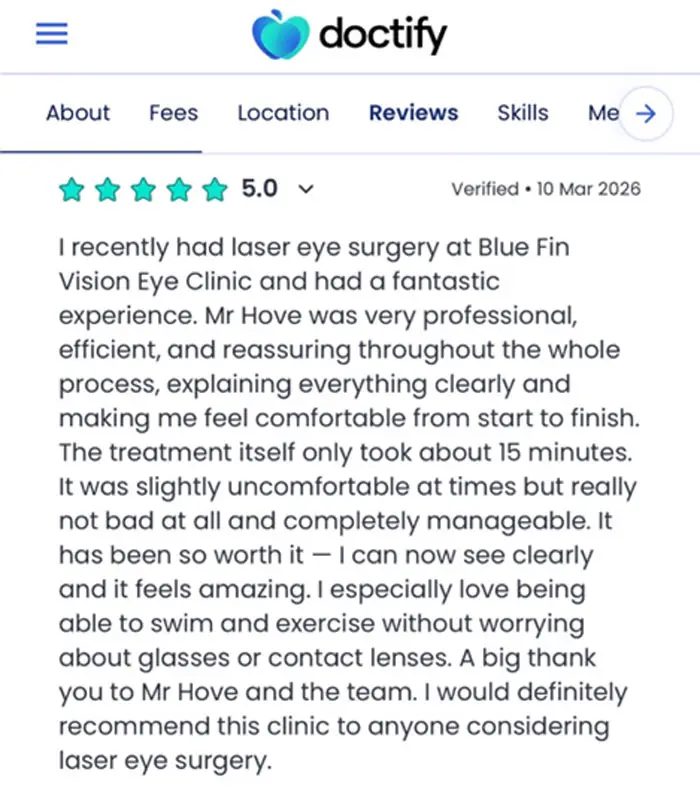
‘It has been so worth it, I can now see clearly and it feels amazing. I especially love being able to swim and exercise without worrying about glasses or contact lenses. A big thank you to Mr Hove and the team.’
This page is for patients with active lifestyles who want to understand return-to-sport timelines after LASIK (laser in situ keratomileusis) and Trans-Epi PRK (photorefractive keratectomy), and why procedure choice matters for contact sport athletes.
Why Activity Return Timelines Differ Between LASIK and PRK
Post-operative restrictions are not arbitrary, they reflect specific healing processes.¹ For LASIK, the primary concern in the first two to four weeks is the flap interface.⁴ For Trans-Epi PRK, the concern is the healing epithelial surface.² Understanding what each restriction protects against makes the timeline meaningful rather than frustrating.
Return to Sport: LASIK vs Trans-Epi PRK
- Light gym exercise: LASIK 48 hours; Trans-Epi PRK 1 week.
- Swimming (pool): LASIK 2 weeks; Trans-Epi PRK 4 weeks.
- Open water swimming: LASIK 4 weeks; Trans-Epi PRK 4 weeks.
- Contact sports (rugby, boxing): LASIK 4 weeks; Trans-Epi PRK 6 weeks.
- Long-term flap risk: LASIK carries a low but persistent risk of flap dislocation; Trans-Epi PRK carries no flap risk.³
The Contact Sport Decision
For patients who participate in contact sports long-term, Trans-Epi PRK removes the permanent flap dislocation risk that LASIK carries, even after the healing window has closed, a significant enough direct blow can dislodge a LASIK flap.³ For many contact sport athletes, PRK is the better lifetime choice even when LASIK would otherwise be technically suitable. This is rarely discussed proactively at volume laser providers, it is a significant omission for anyone who plays rugby, martial arts, or similar sports. At Blue Fin Vision®, Mr Hove raises this at every consultation for patients in these sports.
Who This Is Not For
This page is not a substitute for specific activity guidance given at your post-operative review. Return timelines are affected by healing progress, prescription level, and individual factors assessed at Day 1 and six-week reviews. If you have specific sport commitments, these should be discussed at the pre-operative consultation, not after surgery.
Clinical Perspective
The ability to swim freely, exercise without glasses, and train without contact lens management is exactly the functional outcome laser surgery is designed to deliver. At Blue Fin Vision®, Mr Mfazo Hove discusses sport and activity plans at every laser consultation as a standard part of procedure selection, not an afterthought. In our 2024 to 2025 series, no patient who followed the prescribed return-to-sport timeline experienced a flap-related complication. For contact sport athletes, Mr Hove typically recommends Trans-Epi PRK regardless of corneal thickness, eliminating the lifetime flap risk entirely.
Clinical Takeaway
Gym activity resumes within 48 hours of LASIK (1 week for PRK). Swimming requires 2 weeks for LASIK, 4 weeks for PRK. Contact sports require 4 weeks for LASIK, 6 weeks for PRK. For long-term contact sport athletes, Trans-Epi PRK eliminates permanent flap dislocation risk, worth discussing before choosing between procedures.
References
- Schallhorn SC, Venter JA. One-month outcomes of wavefront-guided LASIK for low to moderate myopia with the VISX STAR S4 laser in 32,569 eyes. J Refract Surg. 2006;22(9 Suppl):S921-926.
- Taneri S, Weisberg M, Azar DT. Surface ablation techniques. J Cataract Refract Surg. 2011;37(2):392-408.
- Bower KS, Woreta F. Update on contraindications for laser-assisted in situ keratomileusis and photorefractive keratectomy. Curr Opin Ophthalmol. 2014;25(4):251-257.
- Randleman JB, Russell B, Ward MA, Thompson KP, Stulting RD. Risk factors and prognosis for corneal ectasia after LASIK. Ophthalmology. 2003;110(2):267-275.


