



For suitable patients, trifocal lenses substantially reduce or remove dependence on glasses for distance, computer and reading vision. This is well evidenced: pooled study data place complete spectacle independence at around 92%, roughly nine patients in ten. Suitability depends on the cornea, macula, optic nerve and realistic expectations, and glare or haloes can occur early and usually settle as the brain adapts.
Spectacle independence is one of the most common reasons patients choose a premium lens. It is achievable for the great majority of suitable patients, and the trifocal evidence base is now large enough to say so with confidence, but the honest answer still depends on the lens, the eye, and how the brain adapts. This page reproduces the patient’s account, then sets her outcome against the published spectacle-independence data so you can see how typical it is.
Patient Experience
This verified 5-star Google review is reproduced verbatim with permission. The clinical commentary below interprets the patient’s experience through one specific question.
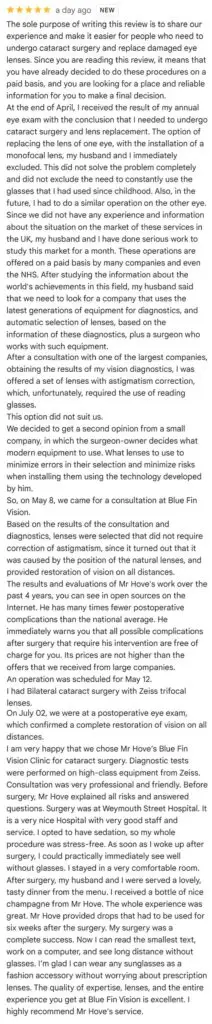
“The sole purpose of writing this review is to share our experience and make it easier for people who need to undergo cataract surgery and replace damaged eye lenses. Since you are reading this review, it means that you have already decided to do these procedures on a paid basis, and you are looking for a place and reliable information for you to make a final decision.
At the end of April, I received the result of my annual eye exam with the conclusion that I needed to undergo cataract surgery and lens replacement. The option of replacing the lens of one eye, with the installation of a monofocal lens, my husband and I immediately excluded. This did not solve the problem completely and did not exclude the need to constantly use the glasses that I had used since childhood. Also, in the future, I had to do a similar operation on the other eye.
Since we did not have any experience and information about the situation on the market of these services in the UK, my husband and I have done serious work to study this market for a month. These operations are offered on a paid basis by many companies and even the NHS. After studying the information about the world’s achievements in this field, my husband said that we need to look for a company that uses the latest generations of equipment for diagnostics, and automatic selection of lenses, based on the information of these diagnostics, plus a surgeon who works with such equipment.
After a consultation with one of the largest companies, obtaining the results of my vision diagnostics, I was offered a set of lenses with astigmatism correction, which, unfortunately, required the use of reading glasses.
This option did not suit us. We decided to get a second opinion from a small company, in which the surgeon-owner decides what modern equipment to use. What lenses to use to minimize errors in their selection and minimize risks when installing them using the technology developed by him.
So, on May 8, we came for a consultation at Blue Fin Vision. Based on the results of the consultation and diagnostics, lenses were selected that did not require correction of astigmatism, since it turned out that it was caused by the position of the natural lenses, and provided restoration of vision on all distances.
The results and evaluations of Mr Hove’s work over the past 4 years, you can see in open sources on the Internet. He has many times fewer postoperative complications than the national average. He immediately warns you that all possible complications after surgery that require his intervention are free of charge for you. Its prices are not higher than the offers that we received from large companies.
An operation was scheduled for May 12. I had Bilateral cataract surgery with Zeiss trifocal lenses.
On July 02, we were at a postoperative eye exam, which confirmed a complete restoration of vision on all distances.
I am very happy that we chose Mr Hove’s Blue Fin Vision Clinic for cataract surgery. Diagnostic tests were performed on high-class equipment from Zeiss. Consultation was very professional and friendly. Before surgery, Mr Hove explained all risks and answered questions. Surgery was at Weymouth Street Hospital. It is a very nice Hospital with very good staff and service. I opted to have sedation, so my whole procedure was stress-free. As soon as I woke up after surgery, I could practically immediately see well without glasses. I stayed in a very comfortable room. After surgery, my husband and I were served a lovely, tasty dinner from the menu. I received a bottle of nice champagne from Mr Hove. The whole experience was great. Mr Hove provided drops that had to be used for six weeks after the surgery.
My surgery was a complete success. Now I can read the smallest text, work on a computer, and see long distance without glasses. I’m glad I can wear any sunglasses as a fashion accessory without worrying about prescription lenses. The quality of expertise, lenses, and the entire experience you get at Blue Fin Vision is excellent. I highly recommend Mr Hove’s service.”
The outcome that anchors this page is her closing description: reading the smallest text, working on a computer, and seeing long distance, all without glasses, after bilateral trifocal implantation.
Clinical Explanation
Different lenses serve different goals. A monofocal lens optimises a single distance, usually far, so reading glasses are still needed. A toric lens corrects corneal astigmatism but does not, by itself, provide a range of focus. A trifocal lens is specifically designed to reduce dependence on glasses across near, intermediate, and distance vision at once. It does this with a diffractive surface that divides incoming light into three focal points, which is why the patient can read small text (near), use a computer (intermediate), and see into the distance (far) without correction.
That same light-splitting design carries a recognised trade-off. Dividing light between three foci can slightly reduce contrast and can produce visual side effects such as glare and haloes around lights, particularly at night and particularly in the early weeks. For most patients these diminish over time through neuroadaptation, the process by which the brain learns to interpret the new optical input, but they should be discussed honestly before surgery rather than discovered afterwards.¹ ²
Structured Context
This applies to patients considering cataract surgery or lens replacement surgery who hope to reduce or eliminate their need for glasses. Trifocal lenses are not suitable for everyone. A healthy ocular surface, macula and optic nerve, a regular cornea, and realistic expectations are all prerequisites, and an eye that fails any of these may do better with a different lens. The visual system also needs time: near clarity typically continues to improve over the first three to six months, and patients counselled to expect that adaptation are more satisfied than those who are not.³
Published Evidence
The patient’s outcome is representative, not exceptional. A 2023 systematic review and meta-analysis of 13 studies (513 patients) found a pooled complete spectacle-independence rate of 91.6% after bilateral trifocal implantation, with rates of 89.6% at near, 96.3% at intermediate, and 95.9% at distance.⁴ Her three reported activities, small text, computer work, and distance vision, map directly onto those three focal points, each of which the evidence shows trifocal lenses serve in more than nine patients in ten.
A 2024 network meta-analysis of presbyopia-correcting IOLs ranked the ZEISS AT LISA tri 839MP, the lens this patient received, highest for spectacle independence at distance.⁵ Trifocal lenses deliver higher spectacle independence than earlier bifocal designs,⁶ and independent series confirm high uncorrected acuity across distances with modern trifocal optics.⁷ Near and intermediate vision improve progressively over roughly the first six months,⁸ while the recognised risk of glare and haloes is precisely why balanced counselling matters,¹ and imaging studies confirm the brain measurably adapts to multifocal optics over time, which is the mechanism behind that improvement.²
Surgeon Interpretation
Mr Mfazo Hove, Consultant Ophthalmic Surgeon at Blue Fin Vision®: The result this patient describes, reading, screen work, and distance all without glasses, is exactly what a well-selected trifocal lens is built to achieve, and the data show it is what most trifocal patients achieve. I still counsel every patient that spectacle independence is a high probability, not a guarantee, and that some people notice haloes at night in the early weeks before the brain adapts. Quoting the figure honestly, roughly nine in ten reach complete spectacle independence, sets a truthful expectation that the outcome usually meets. The patients who understand both the high probability and the genuine trade-off before surgery are the ones who are delighted afterwards.
Clinical Takeaway
For suitable patients, trifocal lenses substantially reduce or remove the need for glasses across all distances, with published complete spectacle independence around nine patients in ten and the AT LISA tri 839MP ranking highest for distance. Glare and haloes are possible early on and usually settle, so careful diagnostics and honest counselling remain essential to matching this well-evidenced outcome to the individual eye.
Next Step
Hoping to leave glasses behind? Book an assessment to find out whether a trifocal lens suits your cornea, macula and visual goals, with an honest discussion of what is realistic for your eyes.
Frequently Asked Questions
Can trifocal lenses remove the need for glasses?
For suitable patients, trifocal lenses substantially reduce or remove the need for glasses across distance, intermediate and near vision. In pooled study data around nine patients in ten achieve complete spectacle independence, though the result depends on the health of the eye and realistic expectations.
How likely is spectacle independence with a trifocal lens?
A 2023 meta-analysis found complete spectacle independence in about 92% of trifocal patients, with the highest rate at intermediate distance. Individual results vary with eye health and expectations, which is why a full assessment comes first.
Are haloes normal after trifocal lens surgery?
Some glare or haloes around lights, especially at night, are common in the early weeks after trifocal lens surgery. For most patients these diminish over time through a natural adaptation process called neuroadaptation. Persistent or troublesome symptoms should always be reviewed.
Who is not suitable for trifocal lenses?
Trifocal lenses may not suit eyes with significant macular, optic nerve or corneal disease, an unstable ocular surface, or patients whose expectations cannot realistically be met. A full diagnostic assessment before surgery identifies who is likely to do well.
How long does it take to adjust to trifocal lenses?
Many patients see well quickly, but the brain typically takes three to six months to fully adapt, with near vision sharpening over that period. Good counselling before surgery helps patients understand this as a normal recalibration.
References
- de Vries NE, Nuijts RMMA. Multifocal intraocular lenses in cataract surgery: literature review of benefits and side effects. Journal of Cataract and Refractive Surgery. 2013;39(2):268-278.
- Rosa AM, Miranda AC, Patricio MM, McAlinden C, Silva FL, Castelo-Branco M, Murta JN. Functional magnetic resonance imaging to assess neuroadaptation to multifocal intraocular lenses. Journal of Cataract and Refractive Surgery. 2017;43(10):1287-1296.
- Pager CK. Randomised controlled trial of preoperative information to improve satisfaction with cataract surgery. British Journal of Ophthalmology. 2005;89(1):10-13.
- Zhu D, Ren S, Mills K, Hull J, Dhariwal M. Rate of complete spectacle independence with a trifocal intraocular lens: a systematic literature review and meta-analysis. Ophthalmology and Therapy. 2023;12(2):1157-1171.
- Li J, Sun B, Zhang Y, Hao Y, Wang Z, Liu C, Jiang S. Comparative efficacy and safety of all kinds of intraocular lenses in presbyopia-correcting cataract surgery: a systematic review and meta-analysis. BMC Ophthalmology. 2024;24(1):172.
- Jonker SMR, Bauer NJC, Makhotkina NY, Berendschot TTJM, van den Biggelaar FJHM, Nuijts RMMA. Comparison of a trifocal intraocular lens with a bifocal intraocular lens. Journal of Cataract and Refractive Surgery. 2015;41(6):1350-1357.
- Mojzis P, Pena-Garcia P, Liehneova I, Ziak P, Alio JL. Outcomes of a new diffractive trifocal intraocular lens. Journal of Cataract and Refractive Surgery. 2014;40(1):60-69.
- Cochener B, Boutillier G, Lamard M, Auberger-Zagnoli C. A comparative evaluation of a new generation of trifocal diffractive intraocular lens. Journal of Refractive Surgery. 2018;34(8):507-514.


