



Patient Experience
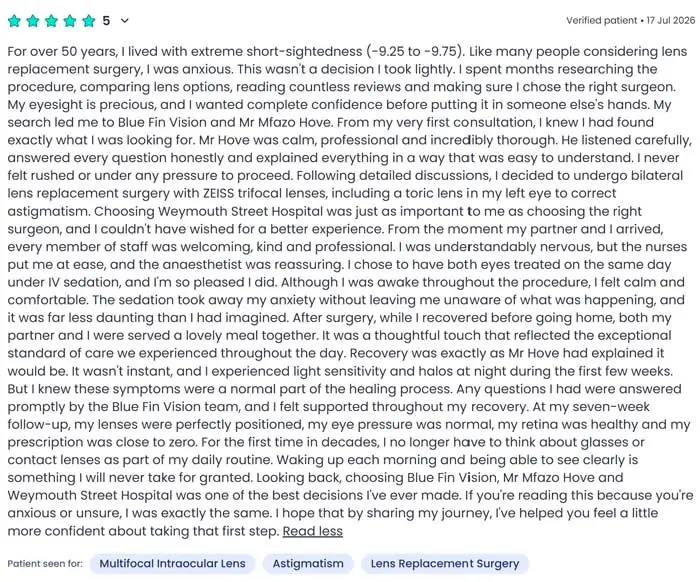
“For over 50 years, I lived with extreme short-sightedness (-9.25 to -9.75). Like many people considering lens replacement surgery, I was anxious. This wasn’t a decision I took lightly. I spent months researching the procedure, comparing lens options, reading countless reviews and making sure I chose the right surgeon. My eyesight is precious, and I wanted complete confidence before putting it in someone else’s hands.
My search led me to Blue Fin Vision® and Mr Mfazo Hove. From my very first consultation, I knew I had found exactly what I was looking for. Mr Hove was calm, professional and incredibly thorough. He listened carefully, answered every question honestly and explained everything in a way that was easy to understand. I never felt rushed or under any pressure to proceed.
Following detailed discussions, I decided to undergo bilateral lens replacement surgery with ZEISS trifocal lenses, including a toric lens in my left eye to correct astigmatism.
Choosing Weymouth Street Hospital was just as important to me as choosing the right surgeon, and I couldn’t have wished for a better experience. From the moment my partner and I arrived, every member of staff was welcoming, kind and professional. I was understandably nervous, but the nurses put me at ease, and the anaesthetist was reassuring.
I chose to have both eyes treated on the same day under IV sedation, and I’m so pleased I did. Although I was awake throughout the procedure, I felt calm and comfortable. The sedation took away my anxiety without leaving me unaware of what was happening, and it was far less daunting than I had imagined.
After surgery, while I recovered before going home, both my partner and I were served a lovely meal together. It was a thoughtful touch that reflected the exceptional standard of care we experienced throughout the day.
Recovery was exactly as Mr Hove had explained it would be. It wasn’t instant, and I experienced light sensitivity and halos at night during the first few weeks. But I knew these symptoms were a normal part of the healing process. Any questions I had were answered promptly by the Blue Fin Vision® team, and I felt supported throughout my recovery.
At my seven-week follow-up, my lenses were perfectly positioned, my eye pressure was normal, my retina was healthy and my prescription was close to zero.
For the first time in decades, I no longer have to think about glasses or contact lenses as part of my daily routine. Waking up each morning and being able to see clearly is something I will never take for granted.”
Looking back, choosing Blue Fin Vision®, Mr Mfazo Hove and Weymouth Street Hospital was one of the best decisions I’ve ever made. If you’re reading this because you’re anxious or unsure, I was exactly the same. I hope that by sharing my journey, I’ve helped you feel a little more confident about taking that first step.”
Clinical Explanation
Vision after lens replacement surgery does not arrive all at once. Over the first days and weeks the eye heals, the refraction settles, and the brain adapts to the new optics. The final follow-up, typically around six to eight weeks, is the appointment where these strands come together and the result can be called final rather than provisional.
At this visit the surgeon confirms four things: that the lens is correctly positioned, that intraocular pressure is normal, that the retina is healthy, and that the refraction has stabilised close to the intended target. For a patient with a trifocal lens, it is also the point at which the brain has largely adapted, so any early haloes or fluctuation have usually faded into the background.
This is why patients often describe the final follow-up as the moment they stop thinking about their eyes at all. The measurements confirm objectively what the patient is already experiencing: a stable, settled result they can rely on.
Structured Context
This applies to patients who have had lens replacement or cataract surgery, particularly bilateral surgery with premium lenses, and want to understand when the final result is reached and what is checked. It is most relevant from around six weeks onwards.
It answers the questions patients actually ask during recovery: when will my vision be stable, what happens at my final appointment, and how will I know the result is final.
It does not describe the first days after surgery, when vision is still fluctuating and early symptoms are a normal part of healing. Individual adaptation times vary, so some patients reach their settled result sooner and a minority take a little longer, which is why the timing of the final check is judged for the individual rather than fixed rigidly.
Published Evidence
The visual performance of modern trifocal lenses is well documented, with high rates of spectacle independence across distance, intermediate and near when patients are well selected ¹ ³ ⁴ ⁵. These outcomes are typically assessed once the refraction has stabilised, which underpins the value of a defined final follow-up.
Neuroadaptation to multifocal optics has been shown to progress over the weeks and months after surgery, which is why symptoms present early on tend to have resolved or greatly reduced by the time of the later follow-up ². The final check is therefore timed to fall after the bulk of this adaptation has taken place.
Confirming a stable, near-plano refraction with a healthy retina and normal pressure at this stage is the objective counterpart to the patient’s own experience of no longer depending on glasses ¹ ⁵. When the subjective account and the objective measurements agree, the result can be signed off with confidence.
Surgeon Interpretation, Mr Mfazo Hove
The final follow-up is where I like to draw a line and say, this is your result. By then the measurements are stable, the retina and pressure are confirmed, and any early haloes have usually faded into the background. I am not only checking numbers; I am checking that what the patient is experiencing matches what the eye is doing. When a patient tells me they have stopped thinking about glasses altogether, and the refraction reads close to plano with a healthy retina, those two things are telling me the same story from different directions. That agreement is what allows me to reassure a patient that the result is settled and reliable rather than still in flux. It is the moment the whole plan comes together, and it remains one of the most satisfying appointments I have.
Clinical Takeaway
The final follow-up, usually around six to eight weeks, is where healing, refraction and neuroadaptation have settled together, so it is the point at which the stable, final outcome of lens replacement surgery is confirmed.
References
- Mojzis P, Pena-Garcia P, Liehneova I, Ziak P, Alio JL. Outcomes of a new diffractive trifocal intraocular lens. J Cataract Refract Surg. 2014;40(1):60-69.
- Rosa AM, Miranda AC, Patricio MM, McAlinden C, Silva FL, Castelo-Branco M, Murta JN. Functional magnetic resonance imaging to assess neuroadaptation to multifocal intraocular lenses. J Cataract Refract Surg. 2017;43(10):1287-1296.
- Kohnen T, Herzog M, Hemkeppler E, Schonbrunn S, De Lorenzo N, Petermann K, Bohm M. Visual performance of a quadrifocal (trifocal) intraocular lens following removal of the crystalline lens. Am J Ophthalmol. 2017;184:52-62.
- Cochener B, Boutillier G, Lamard M, Auberger-Zagnoli C. A comparative evaluation of a new generation of diffractive trifocal and extended depth of focus intraocular lenses. J Refract Surg. 2018;34(8):507-514.
- Rosen E, Alio JL, Dick HB, Dell S, Slade S. Efficacy and safety of multifocal intraocular lenses following cataract and refractive lens exchange: metaanalysis of peer-reviewed publications. J Cataract Refract Surg. 2016;42(2):310-328.


