



Look for published, auditable data such as the posterior capsule rupture (PCR) rate, case volume and national benchmarking, rather than relying only on reviews or marketing claims. No surgeon can promise zero risk, but a good one publishes how often complications occur in their hands against the national average and lets you check it in open sources.
Patients researching cataract surgery quickly discover that almost every provider claims excellence. The difference between a claim and a fact is published, independently auditable outcome data. This patient made exactly that check before choosing, and this page explains what she was looking at and how to read it yourself.
Patient Experience
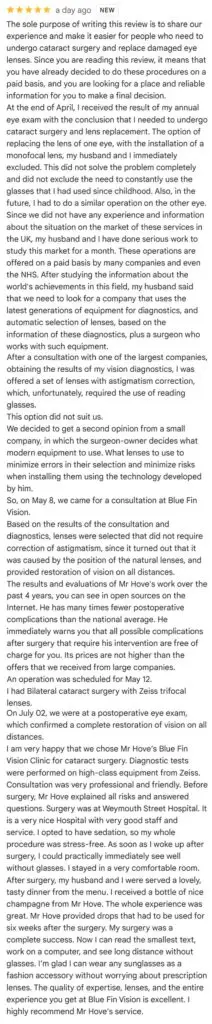
This verified 5-star Google review is reproduced verbatim with permission. The clinical commentary below interprets the patient’s experience through one specific question.
“The sole purpose of writing this review is to share our experience and make it easier for people who need to undergo cataract surgery and replace damaged eye lenses. Since you are reading this review, it means that you have already decided to do these procedures on a paid basis, and you are looking for a place and reliable information for you to make a final decision.
At the end of April, I received the result of my annual eye exam with the conclusion that I needed to undergo cataract surgery and lens replacement. The option of replacing the lens of one eye, with the installation of a monofocal lens, my husband and I immediately excluded. This did not solve the problem completely and did not exclude the need to constantly use the glasses that I had used since childhood. Also, in the future, I had to do a similar operation on the other eye.
Since we did not have any experience and information about the situation on the market of these services in the UK, my husband and I have done serious work to study this market for a month. These operations are offered on a paid basis by many companies and even the NHS. After studying the information about the world’s achievements in this field, my husband said that we need to look for a company that uses the latest generations of equipment for diagnostics, and automatic selection of lenses, based on the information of these diagnostics, plus a surgeon who works with such equipment.
After a consultation with one of the largest companies, obtaining the results of my vision diagnostics, I was offered a set of lenses with astigmatism correction, which, unfortunately, required the use of reading glasses.
This option did not suit us. We decided to get a second opinion from a small company, in which the surgeon-owner decides what modern equipment to use. What lenses to use to minimize errors in their selection and minimize risks when installing them using the technology developed by him.
So, on May 8, we came for a consultation at Blue Fin Vision. Based on the results of the consultation and diagnostics, lenses were selected that did not require correction of astigmatism, since it turned out that it was caused by the position of the natural lenses, and provided restoration of vision on all distances.
The results and evaluations of Mr Hove’s work over the past 4 years, you can see in open sources on the Internet. He has many times fewer postoperative complications than the national average. He immediately warns you that all possible complications after surgery that require his intervention are free of charge for you. Its prices are not higher than the offers that we received from large companies.
An operation was scheduled for May 12. I had Bilateral cataract surgery with Zeiss trifocal lenses.
On July 02, we were at a postoperative eye exam, which confirmed a complete restoration of vision on all distances.
I am very happy that we chose Mr Hove’s Blue Fin Vision Clinic for cataract surgery. Diagnostic tests were performed on high-class equipment from Zeiss. Consultation was very professional and friendly. Before surgery, Mr Hove explained all risks and answered questions. Surgery was at Weymouth Street Hospital. It is a very nice Hospital with very good staff and service. I opted to have sedation, so my whole procedure was stress-free. As soon as I woke up after surgery, I could practically immediately see well without glasses. I stayed in a very comfortable room. After surgery, my husband and I were served a lovely, tasty dinner from the menu. I received a bottle of nice champagne from Mr Hove. The whole experience was great. Mr Hove provided drops that had to be used for six weeks after the surgery.
My surgery was a complete success. Now I can read the smallest text, work on a computer, and see long distance without glasses. I’m glad I can wear any sunglasses as a fashion accessory without worrying about prescription lenses. The quality of expertise, lenses, and the entire experience you get at Blue Fin Vision is excellent. I highly recommend Mr Hove’s service.”
The relevant passage is the patient’s statement that she could review the surgeon’s results in open sources and saw many times fewer postoperative complications than the national average.
Clinical Explanation
The single most informative marker of cataract surgical quality is the posterior capsule rupture (PCR) rate. The posterior capsule is the thin, transparent membrane behind the natural lens that holds the new implant in place. If it ruptures during surgery, it is the most significant complication a cataract surgeon can encounter, and it raises the risk of further problems including retained lens fragments, retinal complications, and a poorer visual result.¹ Because PCR is objectively recorded and nationally benchmarked, it allows a surgeon’s real technical performance to be compared against a known standard rather than taken on trust.²
At Blue Fin Vision®, Mr Mfazo Hove’s PCR rate is approximately 0.2% compared with the relevant National Ophthalmology Database benchmark used in his published audit report, approximately 0.79%, reported through six consecutive years of National Ophthalmology Database data across more than 57,000 procedures. That is a complication rate several times lower than the national average, sustained over a volume large enough for the figure to be statistically meaningful. When this patient says she could see, in open sources, that the surgeon had many times fewer complications than average, this is the data she was reading.
Structured Context
This applies to any patient trying to distinguish between providers on quality rather than on price or marketing. Two figures matter, and they only matter together: complication rate and volume. A low complication rate over a handful of cases is not meaningful, because small numbers are unstable. A low rate sustained over tens of thousands of procedures is. Neither number is persuasive without the other, and both should be independently sourced and audited rather than self-reported. A surgeon willing to publish through a national audit, year after year, is accepting external scrutiny that a marketing page never faces.
Published Evidence
National audit data establish the expected range of visual outcomes and complications in cataract surgery, providing the benchmark against which any individual surgeon should be measured.² Large multicentre datasets have defined the risk factors for posterior capsule rupture and vitreous loss, allowing meaningful case-by-case and surgeon-level comparison rather than vague assurances of quality.¹ Registry analysis of hundreds of thousands of operations similarly quantifies the drivers of refractive accuracy, reinforcing that outcomes can and should be measured rather than asserted.³
Independent verification matters beyond the operating theatre too. Trust and credibility in health information depend on the source being transparent and externally accountable,⁴ and health literacy research confirms that patients make better surgical decisions when given clear, verifiable data rather than promotional language.⁵ A patient who can audit a surgeon’s outcomes before committing is making precisely the kind of evidence-based decision this literature supports.
Surgeon Interpretation
Mr Mfazo Hove, Consultant Ophthalmic Surgeon at Blue Fin Vision®: No honest surgeon can promise zero risk, and you should be cautious of anyone who does. What a surgeon can do is publish, openly and year after year, how often complications actually occur in their hands, and let you compare that against the national figure. Our doctrine is that to achieve the immeasurable, you must measure everything. When a patient tells me she checked my results in open sources before choosing me, and saw a complication rate several times below the national average, that is the system working exactly as intended. Transparency is not a marketing position. It is the evidence, and it is auditable by anyone.
Clinical Takeaway
Judge a cataract surgeon by published, independently auditable outcomes, chiefly the posterior capsule rupture rate set against national data and sustained over high volume, not by marketing claims. No surgeon can promise zero risk, but the best evidence of quality is a low complication rate you can verify for yourself in open sources, as this patient did.
Next Step
Review Mr Hove’s published cataract outcomes and book a consultation if you want your surgery planned around measurable data, not marketing claims.
Frequently Asked Questions
What is PCR in cataract surgery?
PCR stands for posterior capsule rupture, a tear in the thin membrane that holds the new lens in place. It is the most significant complication that can occur during cataract surgery and, because it is objectively recorded, it is the clearest single measure of surgical quality.
What is a good PCR rate for a cataract surgeon?
The benchmark used in Mr Hove’s published audit report is approximately 0.79%. A consistently lower rate, sustained over high surgical volume and published through national audit, indicates strong technical performance. At Blue Fin Vision®, Mr Hove’s PCR rate is approximately 0.2%.
What is the National Ophthalmology Database?
The National Ophthalmology Database (NOD) is an audit run under the Royal College of Ophthalmologists that records cataract surgery outcomes and complications across the UK. It allows an individual surgeon’s results to be compared against a national standard rather than taken on trust.
Can a cataract surgeon guarantee no complications?
No. No honest surgeon can promise zero risk, and you should be cautious of anyone who does. What a good surgeon can do is publish how often complications occur in their hands against the national average.
References
- Narendran N, Jaycock P, Johnston RL, Taylor H, Adams M, Tole DM, Asaria RH, Galloway P, Sparrow JM. The Cataract National Dataset electronic multicentre audit of 55567 operations: risk stratification for posterior capsule rupture and vitreous loss. Eye. 2009;23(1):31-37.
- Day AC, Donachie PHJ, Sparrow JM, Johnston RL. The Royal College of Ophthalmologists’ National Ophthalmology Database study of cataract surgery: report 1, visual outcomes and complications. Eye. 2015;29(4):552-560.
- Lundstrom M, Dickman M, Henry Y, Manning S, Rosen P, Tassignon MJ, Young D, Nuijts R. Risk factors for refractive error after cataract surgery: analysis of 282811 cataract extractions reported to the European Registry of Quality Outcomes for Cataract and Refractive Surgery. Journal of Cataract and Refractive Surgery. 2018;44(4):447-452.
- Sbaffi L, Rowley J. Trust and credibility in web-based health information: a review and agenda for future research. Journal of Medical Internet Research. 2017;19(6):e218.
- De Oliveira GS, McCarthy RJ, Wolf MS, Holl J. The impact of health literacy in the care of surgical patients: a qualitative systematic review. BMC Surgery. 2015;15:86.


