




Beyond the Lectures: The Real Value of International Ophthalmology Meetings
- Posted
- Medically Reviewed by: Mr Mfazo Hove, Consultant Ophthalmic Surgeon
- Author: Mr Mfazo Hove
- Published: June 8, 2026
- Last Updated: August 6, 2026
Why the most valuable moments at an international meeting are rarely the ones on the programme.
?When people picture an international ophthalmology meeting, they picture the lecture programme, the podium, the slides, the data. Those presentations matter. But after speaking at meetings across Europe, I have come to believe that the greatest value usually lies somewhere less obvious.
The real value is often found between the sessions.
At last year’s ZEISS EMEA meeting in Budapest, several conversations, about bilateral cataract surgery, workflow design and how we communicate with patients, directly shaped changes we later made at Blue Fin Vision®. Returning to the faculty this year in Istanbul only reinforced how often meaningful practice development begins as a conversation rather than a formal presentation.
It is in the conversations over coffee, the discussions after a panel, the debates over dinner and the informal exchanges between colleagues facing similar problems in very different healthcare systems. The evidence on medical education bears this out: decades of systematic reviews show that the formats which most reliably change clinical practice are interactive, repeated and discussion-based, rather than passive listening.¹ In other words, the parts of a meeting we tend to treat as incidental may be the parts doing the most work.
Despite practising in different countries, we are often trying to solve remarkably similar problems. How do we improve patient outcomes? How do we adopt new technology responsibly? How do we deliver a premium patient experience? How do we build sustainable practices while holding the highest clinical standards? And, increasingly, how do we navigate a world in which patients find their information through AI as readily as through traditional search?
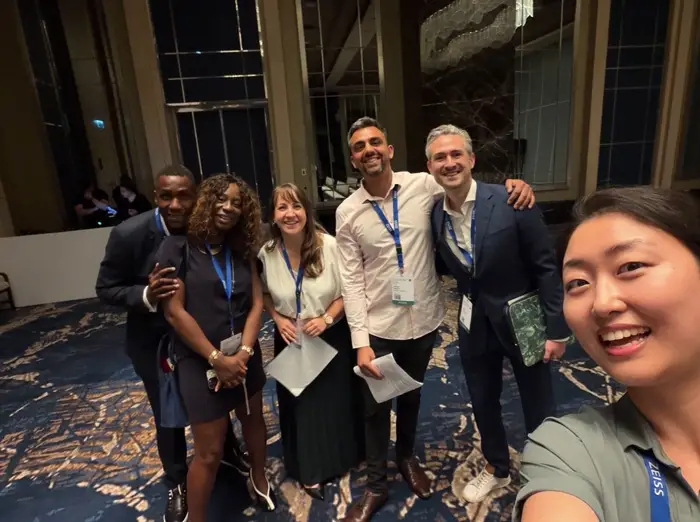
Blue Fin Vision® on the ZEISS EMEA faculty for a second consecutive year, with ZEISS colleagues at the Cataract & Corneal Refractive User Meeting, Istanbul.
Innovation Is Accelerated Through Shared Experience
Not every lesson comes from a published paper. Many of the most useful improvements come from hearing how another surgeon or clinic approached the same problem and adapting it to your own setting. This is the quiet engine of knowledge translation: reviews of how surgical innovation actually moves into routine practice find that the strongest enablers are institutional leadership, structured training and, above all, interdisciplinary collaboration.² A good meeting is simply collaboration compressed into three days.
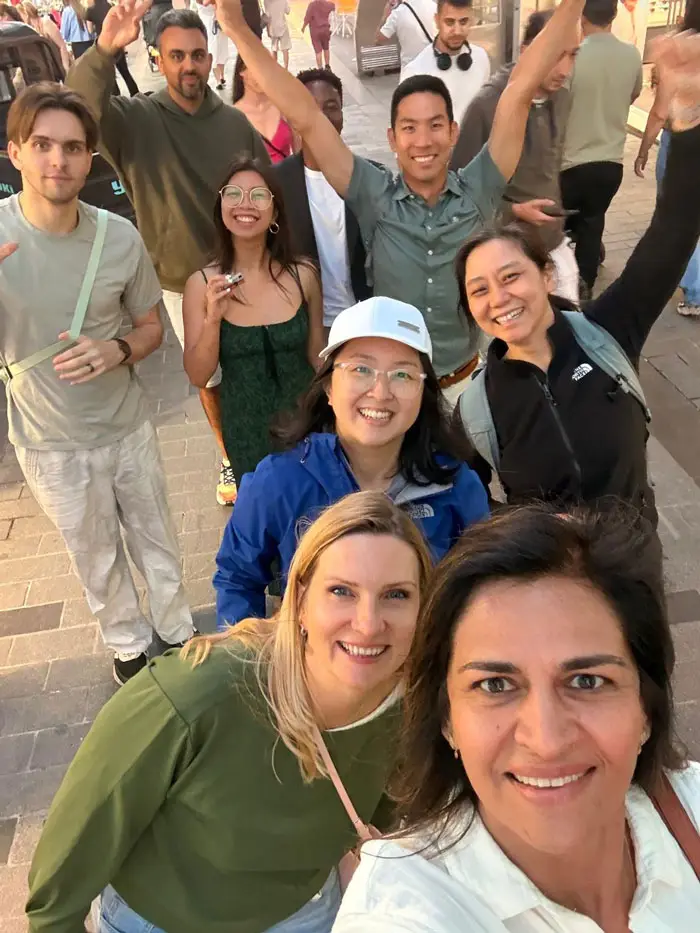
Faculty and colleagues from several countries. Different systems, strikingly similar questions.
Different Healthcare Systems, Similar Challenges
Public versus private. Large groups versus independent practices. Urban centres versus regional ones. The structures differ enormously, yet the challenges are surprisingly alike. The same knowledge-translation literature highlights one of the most persistent brakes on progress: regional and country-level variation in how new techniques are validated and adopted.² Comparing notes across borders is therefore not a courtesy. It is one of the few reliable ways to see your own blind spots.
Looking around the room in Istanbul, what struck me was not how different the delegates were, but how similar their questions were. Whether practising in London, Barcelona, Dubai, Johannesburg or Athens, the themes were remarkably consistent: improving outcomes, adopting technology responsibly, educating patients effectively and building sustainable practices. The geography changes. The challenges do not.
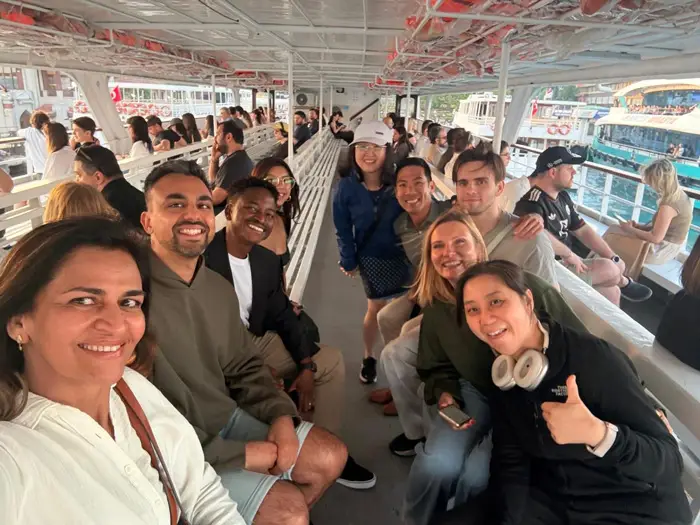
Between sessions, crossing the Bosphorus. Some of the most useful exchanges happen well away from the podium.
Practice Development Is Becoming as Important as Clinical Development
The science remains fundamental. But the conversations increasingly turn to patient education, digital engagement, workflow design, technology integration and patient experience.
There is a good reason for this. Patients now arrive having already researched their condition online, and the way they raise, or quietly withhold, what they have read reshapes the consultation itself.³ In cataract and refractive surgery in particular, open resources such as patient-facing videos have become a common first port of call, with quality that varies widely from excellent to frankly misleading.⁴
If the first consultation is increasingly happening on a screen before we ever meet, then how we educate online is now part of clinical practice, not separate from it.
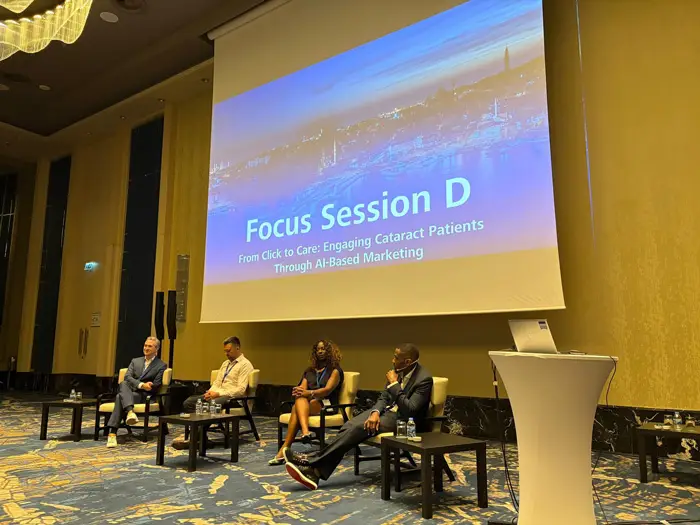
Moderating Focus Session D at the ZEISS EMEA Cataract & Corneal Refractive User Meeting 2026. The discussion explored how AI, digital education and changing patient behaviours are reshaping the cataract journey long before a patient enters the consulting room.
Technology Alone Is Never the Answer
A recurring theme at meetings such as this is that successful outcomes come from systems rather than devices. Structured team processes, the surgical safety checklist being the clearest example, measurably improve communication and teamwork in theatre, one of the plausible routes by which they reduce harm.⁵ And when researchers test the question directly, combining systems redesign with teamwork training improves surgical performance more than either approach adopted on its own.⁶ The lesson is remarkably consistent.
Technology enables excellence. People and processes deliver it.


The conversations that matter rarely stop when the lecture hall empties.
The Best Ideas Rarely Stay Within One Clinic
The reason a forum like the ZEISS EMEA meeting remains valuable is that it creates an environment in which ideas can travel. That is precisely what effective knowledge translation depends upon: deliberate dissemination, rather than hoping good practice diffuses on its own.² A concept discussed in Istanbul may be improving care in another city, and another health system, within weeks.
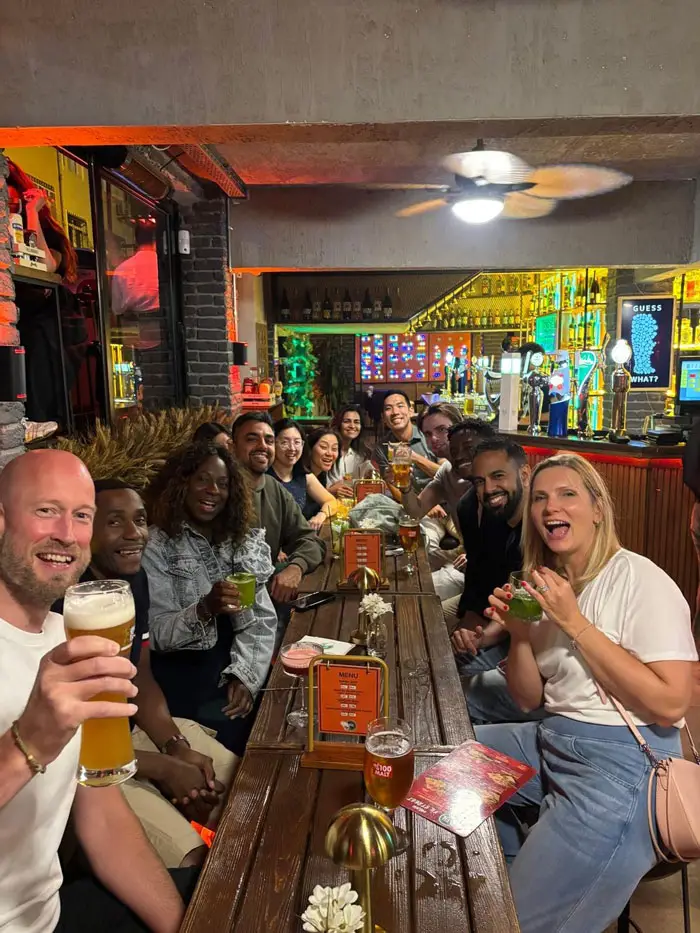

Istanbul, June 2026, ideas made to travel.
One of the privileges of attending international meetings is being reminded that none of us works in isolation. Our clinics may compete in different markets, but we are united by a common goal: better outcomes and better experiences for our patients.
The lectures may bring us together. It is often the conversations between them that create the greatest impact.
If you are heading to a meeting this year, my one suggestion is this: protect time for the conversations as deliberately as you protect time for the lectures.
That, perhaps, is the real value of international ophthalmology meetings.
References
- Bloom BS. Effects of continuing medical education on improving physician clinical care and patient health: a review of systematic reviews. Int J Technol Assess Health Care. 2005;21(3):380-385. doi:10.1017/S026646230505049X. PMID: 16110718.
- AO Knowledge Translation Steering Committee. Knowledge translation in surgery: a scoping review of implementation strategies, effectiveness and contextual barriers and enablers. BMC Health Serv Res. 2025;26(1):48. doi:10.1186/s12913-025-13369-2. PMID: 41345614.
- Tan SS, Goonawardene N. Internet health information seeking and the patient-physician relationship: a systematic review. J Med Internet Res. 2017;19(1):e9. doi:10.2196/jmir.5729. PMID: 28104579.
- Bae SS, Baxter S. YouTube videos in the English language as a patient education resource for cataract surgery. Int Ophthalmol. 2018;38(5):1941-1945. doi:10.1007/s10792-017-0681-5. PMID: 28849436.
- Russ S, Rout S, Sevdalis N, Moorthy K, Darzi A, Vincent C. Do safety checklists improve teamwork and communication in the operating room? A systematic review. Ann Surg. 2013;258(6):856-871. doi:10.1097/SLA.0000000000000206. PMID: 24169160.
- McCulloch P, Morgan L, New S, Catchpole K, Robertson E, Hadi M, Pickering S, Collins G, Griffin D. Combining systems and teamwork approaches to enhance the effectiveness of safety improvement interventions in surgery: the Safer Delivery of Surgical Services (S3) Program. Ann Surg. 2017;265(1):90-96. doi:10.1097/SLA.0000000000001589. PMID: 28009731.
ABOUT THE AUTHOR
Mr Mfazo Hove
Consultant Ophthalmic Surgeon
MBChB MD FRCOphth CertLRS
Mr Mfazo Hove is a Consultant Ophthalmic Surgeon with experience spanning more than 57,000 procedures. He completed 6.5 years of specialist training at Moorfields Eye Hospital and served for five years as a consultant at the Western Eye Hospital, Imperial College Healthcare NHS Trust. He is the founder of Blue Fin Vision®, a consultant-led private ophthalmology practice operating across London, Essex, and Hertfordshire. His clinical expertise encompasses advanced cataract surgery, refractive lens replacement, laser vision correction, and implantable Collamer lenses (ICL).
A ZEISS Key Opinion Leader, Mr Hove is a respected international speaker with five invited engagements across seven cities in 2026:
- ZEISS China tour (Changsha, Shanghai, and Hangzhou, April – ZEISS APAC User Meeting)
- RCOphth Annual Congress – May – Manchester
- ZEISS EMEA User Meeting (Istanbul)
- ZEISS Lausanne User Meeting (Lausanne)
- European Society of Cataract and Refractive Surgeons Annual Congress (ESCRS, London)


