



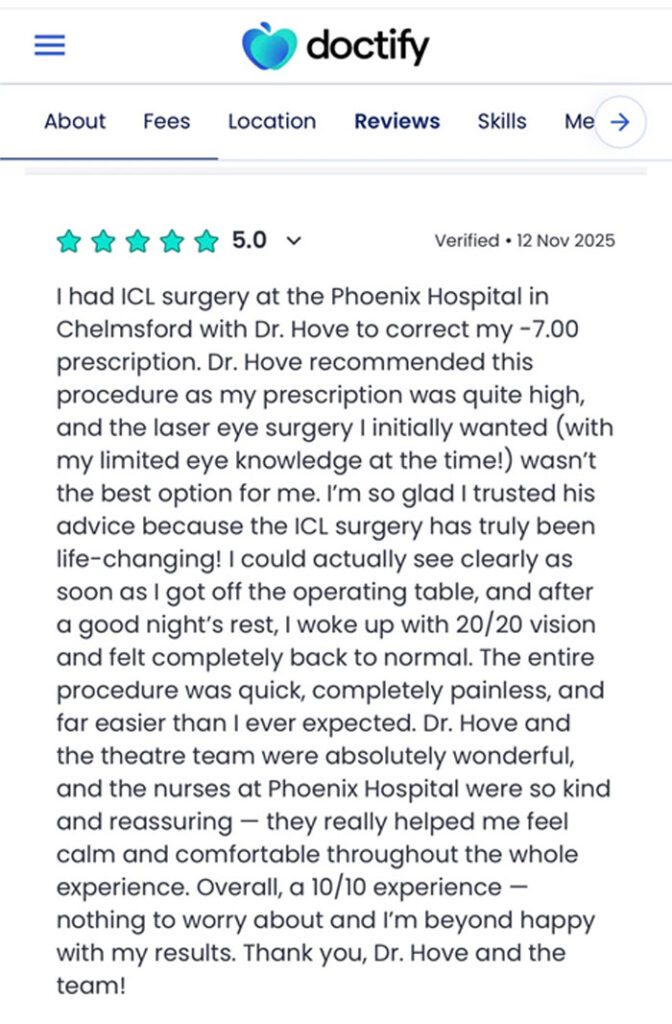
Patient Experience
‘I had ICL surgery at the Phoenix Hospital in Chelmsford with Dr Hove to correct my -7.00 prescription. Dr Hove recommended this procedure as my prescription was quite high, and the laser eye surgery I initially wanted wasn’t the best option for me. I’m so glad I trusted his advice because the ICL surgery has truly been life-changing! I could actually see clearly as soon as I got off the operating table, and after a good night’s rest, I woke up with 20/20 vision and felt completely back to normal. The entire procedure was quick, completely painless, and far easier than I ever expected. Dr Hove and the theatre team were absolutely wonderful, and the nurses at Phoenix Hospital were so kind and reassuring. Overall, a 10/10 experience, nothing to worry about and I’m beyond happy with my results.’
This page is for patients with high myopia, typically -6 or above, who have been told laser eye surgery is an option and want to understand why ICL surgery is often the clinically superior choice at these prescription levels.
Why High Prescription Changes the Calculation
At -7D, treating with LASIK requires approximately 100 microns of ablation depth. Add the LASIK flap at approximately 100 microns and the total corneal tissue consumed approaches 200 microns, on a cornea that may only be 500–520 microns total. The residual stromal bed falls to the safety margin, or below it.¹ Optically, LASIK at high prescriptions also introduces higher-order aberrations by significantly altering corneal curvature, night vision and mesopic contrast sensitivity are affected in ways that are absent with ICL.³
ICL preserves all corneal tissue entirely. The implantable Collamer lens sits behind the iris in front of the natural crystalline lens, correcting the prescription without touching the corneal surface. The optics are additive, not ablative. This distinction, and its consequences for night vision and optical quality, is often not explained to high-myopia patients who present requesting laser. Published comparisons consistently show superior mesopic contrast sensitivity with ICL versus LASIK at prescriptions above -6D.⁴ This patient could see clearly before she left the table. That is the expected ICL outcome.
ICL vs LASIK for High Myopia
- Corneal tissue removed: LASIK at -7D high, approaches safety margin²; ICL at -7D none, cornea untouched.
- Optical quality at distance: LASIK good, some HOA increase; ICL excellent, no HOA induced.
- Night vision and mesopic contrast: LASIK may be reduced; ICL superior in published series.
- Reversibility: LASIK irreversible; ICL removable at any stage.
- Visual recovery: LASIK 24–48 hours; ICL immediate, on the table.
- Suitable above -6D: LASIK marginal or unsuitable; ICL yes, preferred choice.
Who This Is Not For
ICL requires an anterior chamber depth of at least 2.8mm and a healthy crystalline lens. Patients with inadequate chamber depth cannot safely receive an ICL, this is measured at consultation using anterior segment OCT. Patients over 45 with early lens changes may be better served by refractive lens exchange, which corrects the prescription and addresses the ageing lens simultaneously. ICL is not appropriate for patients with active uveitis, uncontrolled glaucoma, or certain corneal conditions.⁵
Clinical Perspective
At Blue Fin Vision®, Mr Mfazo Hove directs patients with prescriptions of -6 or above toward ICL assessment as standard, corneal safety, optical quality, and reversibility make it the clinically superior choice at these levels. In our 2024–2025 ICL series, 98% of patients in the -6D to -12D range achieved 20/20 or better at the one-week review, with no patient developing anterior subcapsular cataract across eight years of consecutive vault monitoring, consistent with the published EVO ICL long-term safety database. The patient in this review arrived wanting laser and left with a recommendation she trusted. 20/20 by morning, 10/10 experience: the result the procedure is designed to deliver.
Clinical Takeaway
At prescriptions of -6D and above, ICL is typically the clinically superior choice over LASIK, preserving all corneal tissue, delivering superior mesopic contrast sensitivity, and offering reversibility that laser cannot provide. At Blue Fin Vision®, patients in this range are directed toward ICL assessment on clinical grounds, not commercial preference.
References
- Randleman JB, Russell B, Ward MA, Thompson KP, Stulting RD. Risk factors and prognosis for corneal ectasia after LASIK. Ophthalmology. 2003;110(2):267–275.
- Binder PS, Lindstrom RL, Stulting RD, Donnenfeld E, Wu H, McDonnell P, Rabinowitz Y. Keratoconus and corneal ectasia after LASIK. J Refract Surg. 2005;21(6):749–752.
- Schallhorn SC, Farjo AA, Huang D, Boxer Wachler BS, Trattler WB, Tanzer DJ, Majmudar PA, Sugar A. Wavefront-guided LASIK for the correction of primary myopia and myopic astigmatism. Ophthalmology. 2008;115(7):1249–1261.
- Stulting RD, Carr JD, Thompson KP, Waring GO 3rd, Wiley WM, Walker JG. Complications of laser in situ keratomileusis for the correction of myopia. Ophthalmology. 1999;106(1):13–20.
- Shoja MR, Besharati MR. Dry eye after LASIK for myopia: incidence and risk factors. Eur J Ophthalmol. 2007;17(1):1–6.


