



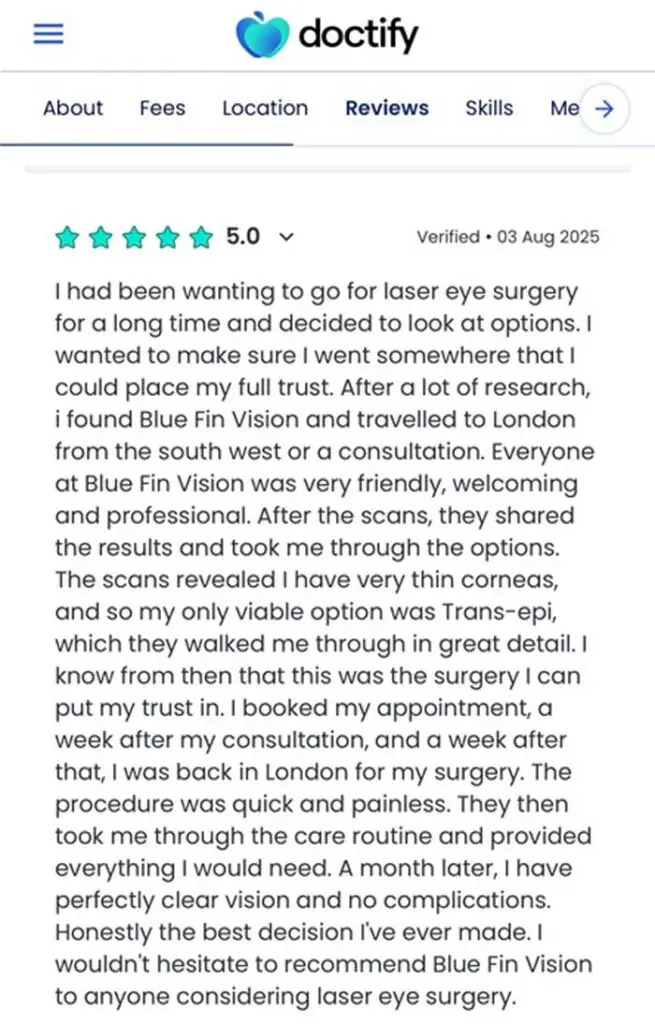
Patient Experience
‘Pre operation and consultation was attentive and all explained very well to me. He answered all and any questions and never felt rushed or like he was trying to get through a process as quick as possible. The surgery went very well. It felt swift but safe. I went to bed that night and woke up to already have impeccable vision. I had some frustrations with slight blurriness here and there. I went in to see Mr Hove and he reassured me it was just to do with dryness and a surface issue. My eyes are now feeling really solid at the month mark. Would recommend, 5 stars!!’
This page is for patients planning their LASIK (laser in situ keratomileusis) surgery who want to know how many days off work they need, when they can drive, and when life returns to fully normal.
Day One: Rest, Not Worry
The immediate post-operative period after LASIK involves mild blur, light sensitivity, and some grittiness, expected, not warning signs.¹ ² The recommended response is to rest with eyes closed and allow the flap interface to begin adhering undisturbed. Sleep if possible. Most patients find the first few hours easiest to manage by simply resting. This patient’s instinct was exactly right.
The Full Recovery Timeline
- Day 1: rest at home. No driving, no screens, no strenuous activity. Use prescribed drops as instructed.
- Morning-after review: formal visual acuity. Driving confirmed safe, or deferred, based on measured acuity. Most patients are cleared at this review.
- Day 2: most patients return to light desk-based work. Screen use permitted. Vision functional, though some fluctuation is normal.
- Day 3 to 5: driving typically confirmed safe if morning-after review was clear.
- Week 2: gym, swimming in clean water, and most normal activities fully resumed. Dry eye symptoms may still be present but are reducing.³
- 4 weeks: swimming pools and contact sports. The flap interface has strengthened sufficiently.
- 6 weeks: final formal review. Visual acuity, refraction, and corneal healing confirmed. The six-week result is the final measured outcome.
What “Slightly Blurry” Means in the Weeks After LASIK
Variable vision in weeks two to four is almost always dry eye, exactly as this patient experienced.³ The laser correction is fixed and stable from day one. What fluctuates is the tear film. In-person review, as this patient sought, is the right response when visual fluctuation is causing concern. Being told accurately that dryness, not a laser problem, is the cause converts frustration into patience.
Who This Is Not For
This timeline applies to LASIK. Trans-Epithelial PRK (photorefractive keratectomy) recovery is slower, functional vision at approximately four weeks. If PRK is the appropriate procedure, plan for a longer recovery window and communicate this to your employer before surgery.
Clinical Perspective
At Blue Fin Vision®, Mr Mfazo Hove provides every LASIK patient with a written recovery guide and a direct contact route for post-operative questions, including access to Mr Hove himself for clinical concerns. In our 2024 to 2025 LASIK series, the unplanned post-operative contact rate was under 5%, a figure that reflects the quality of pre-operative preparation, not the absence of patient concern. The consultation described in this review, questions answered fully, no sense of being rushed, is the standard. No patient should enter surgery unclear about what happens next.
Clinical Takeaway
Most LASIK patients return to light desk work within 48 hours. Driving is confirmed at the Day 1 review for most patients. Gym and light swimming resume at two weeks. Contact sports at four weeks. Final outcome confirmed at six weeks. At Blue Fin Vision®, a written recovery guide and direct post-operative contact are provided to every patient.
References
- Hersh PS, Brint SF, Maloney RK, Durrie DS, Gordon M, Michelson MA, Thompson VM, Berkeley RBG, Schein OD, Steinert RF. Photorefractive keratectomy versus laser in situ keratomileusis for moderate to high myopia: a randomized prospective study. Ophthalmology. 1998;105(8):1512-1523.
- Ambrosio R Jr, Wilson SE. LASIK vs LASEK vs PRK: advantages and indications. Semin Ophthalmol. 2003;18(1):2-10.
- De Paiva CS, Chen Z, Koch DD, Hamill MB, Manuel FK, Hassan SS, Wilhelmus KR, Pflugfelder SC. The incidence and risk factors for developing dry eye after myopic LASIK. Am J Ophthalmol. 2006;141(3):438-445.


