



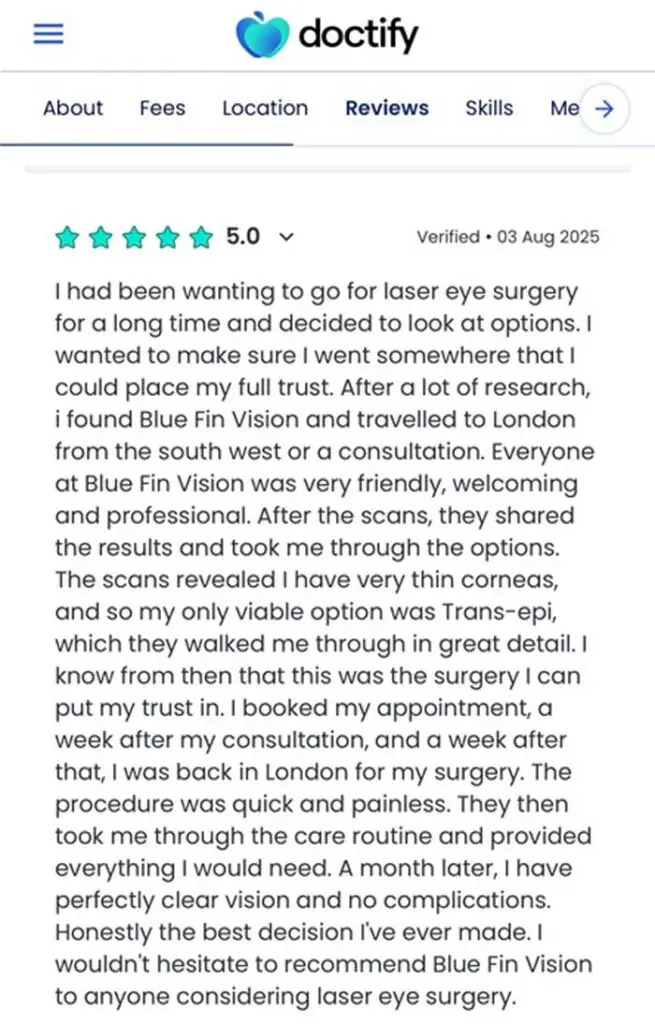
Patient Experience
‘He showed me a video which at the time I sort of thought I’d rather have not watched but on reflection I think it was valuable to really have me understand and know what’s going on. He answered all and any questions and never felt rushed or like he was trying to get through a process as quick as possible. He was confident and reassuring without pandering too much or giving too much weight to my nerves. It felt swift but safe. I was very nervous inside and the operation is certainly peculiar and a little uncomfortable conceptually but physically it was painless and at worst there was mild discomfort with your eye being held open. None of the laser or flap removal was painful.’
This page is for patients who are anxious about laser eye surgery and want to know what the experience actually involves, what they will feel, see, and hear.
The Three Universal Fears, and the Accurate Answers
- Fear 1: Will it hurt? The corneal surface is anaesthetised with drops before the procedure begins. Patients feel pressure from the speculum holding the eyelid open, this is the most consistently reported sensation. The laser itself produces no pain. Mild discomfort is common. Sharp pain is not. Physically painless, as this patient confirms.¹
- Fear 2: What if I move my eyes? Modern excimer laser platforms use high-speed eye-tracking technology that compensates for involuntary eye movement in real time.⁴ Patients do not need to keep their eyes perfectly still. The tracking system does that.
- Fear 3: Is there any real risk of going blind? Catastrophic vision loss from LASIK (laser in situ keratomileusis) is vanishingly rare, less than 0.1% in published series, and the majority involves recoverable complications. The procedure is one of the most extensively studied elective surgeries in the world.¹ Fear is understandable. The statistical reality is reassuring.
What the Experience Actually Involves
The speculum is positioned, mild pressure, eyelids held open. A fixation target, usually a blinking light, is focused on. The flap is created: a few seconds of darkening and pressure. The laser is applied: a quiet clicking sound, a faint smell, a brief visual blur. The flap is repositioned. The same sequence on the second eye. Peculiar, as this patient describes. Painful? No.
Why the Pre-Operative Video Matters
Mr Hove shows every LASIK patient a procedural video at consultation. This patient’s reaction, initially reluctant, retrospectively grateful, is the most common response.² The video converts vague anticipatory anxiety into accurate expectation.³ Patients who understand the speculum sensation, the tracking light, the flap creation darkening, and the laser click before they arrive are significantly less distressed during surgery than those who encounter these experiences without preparation.
Who This Is Not For
This page is for patients with normal pre-operative anxiety, the anxiety most surgical patients experience, which resolves with accurate information and direct communication. It is not for patients with extreme surgical phobia or anxiety disorders requiring clinical management before elective surgery. If anxiety is severe enough to affect decision-making, this should be raised explicitly at consultation, the pathway can be adapted.
Clinical Perspective
At Blue Fin Vision®, Mr Mfazo Hove treats the consultation as the first clinical intervention for anxiety, showing every patient a procedural video and answering every question before surgery is booked. In our 2024 to 2025 laser series, fewer than 3% of patients required additional pre-operative reassurance beyond the standard consultation, a figure that reflects accurate preparation rather than suppressed anxiety. The three fears most patients arrive with, pain, eye movement, and risk of blindness, are almost never addressed proactively at standard volume laser consultations. Mr Hove addresses all three directly, unprompted, at every consultation.
Clinical Takeaway
Laser eye surgery is physically painless. The speculum produces mild pressure; the laser produces no pain. Eye-tracking manages involuntary eye movement. At Blue Fin Vision®, every patient is shown a procedural video and given a full explanation of what to expect, anxiety is addressed with accurate information, not generic reassurance.
References
- Bailey MD, Mitchell GL, Dhaliwal DK, Boxer Wachler BS, Zadnik K. Patient satisfaction and visual symptoms after laser in situ keratomileusis. Ophthalmology. 2003;110(7):1371-1378.
- Nijkamp MD, Kenens CA, Dijker AJM, Ruiter RAC, Hiddema F, Nuijts RMMA. Determinants of surgery related anxiety in cataract patients. Br J Ophthalmol. 2004;88(10):1310-1314.
- Ang GS, Whyte IF. Effect and outcomes of sedation in cataract surgery. Eye. 2012;26(3):406-411.
- Schallhorn SC, Farjo AA, Huang D, Boxer Wachler BS, Trattler WB, Tanzer DJ, Majmudar PA, Sugar A. Wavefront-guided LASIK for the correction of primary myopia and myopic astigmatism. Ophthalmology. 2008;115(7):1249-1261.


