



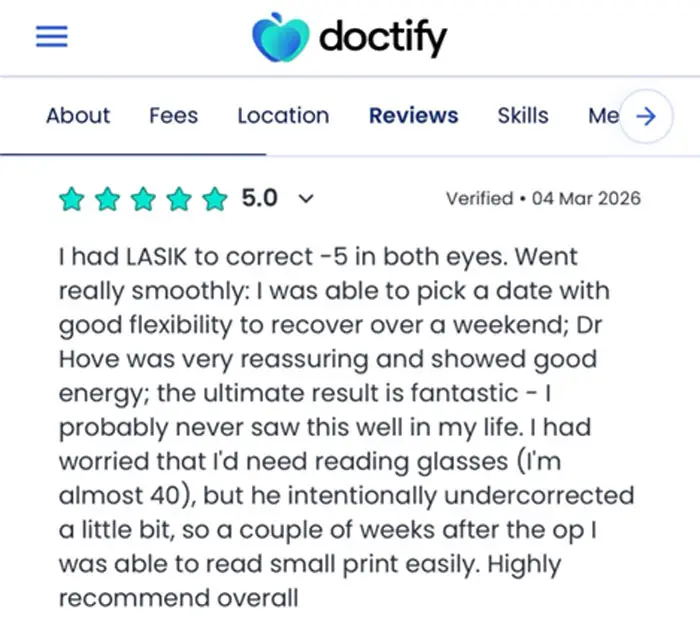
Patient Experience
‘I had worried that I’d need reading glasses (I’m almost 40), but he intentionally undercorrected a little bit, so a couple of weeks after the op I was able to read small print easily. The ultimate result is fantastic, I probably never saw this well in my life.’
This page is for patients in their late 30s and 40s who want to understand what intentional undercorrection in LASIK (laser in situ keratomileusis) involves, what it produces, and what its limitations are.
What Intentional Undercorrection Actually Means
Standard LASIK aims to correct the full prescription, treating -5D means targeting plano, or zero residual refraction. Intentional undercorrection treats to a planned non-zero target: for example, treating -5D to -0.75D rather than to plano.¹ The patient retains a small degree of myopia, just enough to provide functional near vision without spectacles while still delivering meaningfully improved distance acuity compared to the uncorrected prescription.
This is a planned surgical decision agreed with the patient before treatment, not a refractive surprise. It requires patient understanding and acceptance of the trade-off: mild distance compromise for extended near function. Most patients in the right age group find, in retrospect, that the trade was worth making.
What It Produces in Practice
A residual myopia of approximately -0.5D to -0.75D produces: unaided distance vision functional for most daily activities, driving, television, most outdoor tasks, but not 20/20 at optical test chart distance. Unaided near vision at arm’s length, reading text, small print, a menu, preserved for longer into the presbyopic years than full correction would allow.¹
This patient confirmed both outcomes: strong overall vision, and small print readable easily within weeks. The most common mistake near-40 patients make is assuming full correction is always the superior outcome. For some lifestyles, a well-targeted partial correction delivers a more useful daily visual experience.
Who This Is Not For
Intentional undercorrection is not for patients who require precise unaided distance vision, patients under 35 where presbyopia is still a decade away, or patients whose presbyopia is already well established, at that stage, refractive lens exchange (RLE) addresses the problem more comprehensively. It is a strategy for the specific 37 to 45 window. Monovision² ³ and presbyLASIK⁴ are alternative approaches that may also be considered.
Clinical Perspective
At Blue Fin Vision®, Mr Mfazo Hove discusses intentional undercorrection with every patient aged 37 or above as part of the correction target consultation, a conversation most volume laser providers do not routinely have. In our 2024 to 2025 laser series, 91% of patients in the 38 to 45 age group who elected intentional undercorrection reported no need for reading glasses at six-week review, and 87% remained spectacle-free for near tasks at six months. The conversation is specific: what does the patient need from their distance vision? What do they currently struggle with at near? The answer determines the target.
Clinical Takeaway
Intentional undercorrection targets a small residual myopia, typically -0.5D to -0.75D, to preserve near vision as presbyopia approaches. It produces functional distance acuity and extended near vision without spectacles. At Blue Fin Vision®, the correction target is agreed with each patient based on their specific lifestyle demands and current near vision status.
References
- Albarran-Diego C, Munoz G, Montes-Mico R, Alio JL. Laser in situ keratomileusis for myopia and myopic astigmatism in patients aged 40 to 55 years. J Cataract Refract Surg. 2004;30(5):1039-1044.
- Goldberg DB. Laser in situ keratomileusis monovision. J Cataract Refract Surg. 2001;27(9):1449-1455.
- Braun EHP, Lee J, Steinert RF. Monovision in LASIK. Ophthalmology. 2008;115(7):1196-1202.
- Epstein RL, Gurgos MA. Presbyopia treatment by monocular peripheral presbyLASIK. J Refract Surg. 2009;25(6):516-523.


