



Patient Experience
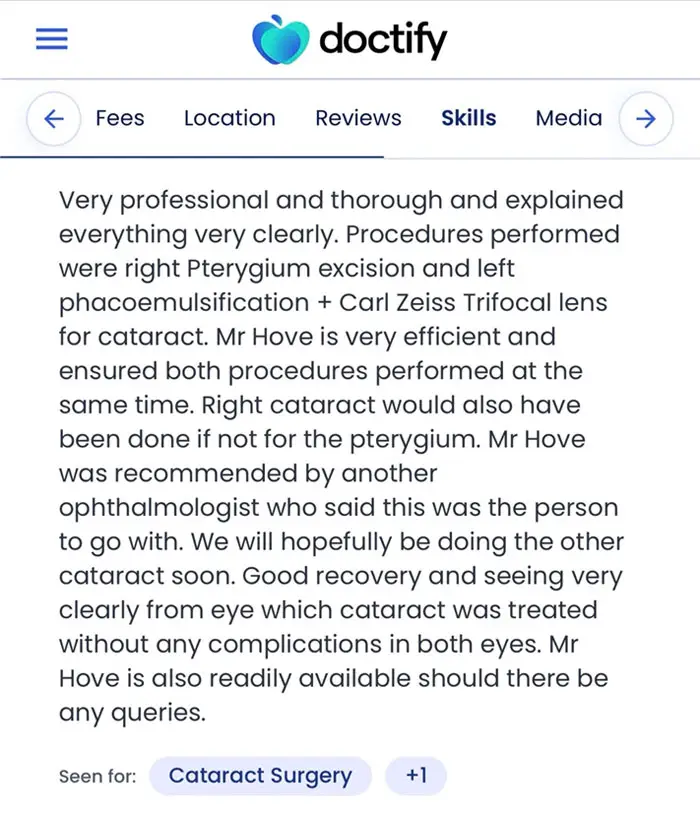
“Very professional and thorough and explained everything very clearly. Procedures performed were right Pterygium excision and left phacoemulsification + Carl Zeiss Trifocal lens for cataract. Mr Hove is very efficient and ensured both procedures performed at the same time. Mr Hove was recommended by another ophthalmologist who said this was the person to go with. Good recovery and seeing very clearly from eye which cataract was treated without any complications in both eyes. Mr Hove is also readily available should there be any queries.”
This page is for patients referred by their own ophthalmologist to Mr Mfazo Hove, or for GPs and optometrists seeking to understand why surgeon-to-surgeon referrals to Blue Fin Vision® in London occur, and what the published evidence shows.
The Highest Form of Peer Endorsement: When Surgeons Refer Their Own Patients
A patient referred by another ophthalmologist has not self-selected from a Google search or a marketing campaign. They have been assessed by a trained clinician who concluded that the complexity or risk profile of their case exceeds what their own practice can safely manage, and that Mr Mfazo Hove represents the appropriate level of expertise for what the patient needs. This is surgeon-to-surgeon referral: the most credible signal of peer-recognised competence available in medicine.
The patient in this review was referred by an ophthalmologist who stated explicitly that Mr Hove was ‘the person to go with’. The case involved simultaneous pterygium excision and cataract surgery, combined anterior segment surgery requiring skill across two distinct specialities. The procedure was completed without complications in both eyes. The referring surgeon’s confidence was validated by the outcome.
What Cases Prompt Surgeon-to-Surgeon Referral?
Referring surgeons select for complexity, risk, or combined pathology. The cases that arrive at Blue Fin Vision® as surgeon referrals include: combined pterygium and cataract requiring simultaneous management; dense brunescent cataracts requiring modified phacoemulsification technique; patients with pseudoexfoliation syndrome and zonular instability; eyes with prior vitreoretinal surgery and altered anatomy; post-operative complications arising from surgery performed elsewhere, including fibrin membrane and PCR rescue. These are not cases declined because of corporate liability thresholds. They are cases declined because the referring surgeon’s honest assessment is that another level of expertise is required.¹
The Evidence Architecture Behind the Referral Pattern
At Blue Fin Vision®, the clinical evidence that supports surgeon confidence is published and publicly verifiable. Mr Hove’s PCR rate of 0.20%, with intact capsule in 99.8% of operations in our 2024–2025 National Ophthalmology Database series, sits fivefold below the national benchmark of approximately 1%. This data is not self-reported: it is submitted to and verified by the NOD across four consecutive years. The 4-Minute Phaco™ technique, screened at the RCOphth Annual Congress 2025 at delegates’ request, is a peer-witnessed benchmark of surgical efficiency across 57,000+ career procedures. ZEISS Key Opinion Leader status reflects manufacturer recognition based on surgical volume and clinical outcomes, not marketing partnership.²
Key Facts: Surgeon-to-Surgeon Referral at Blue Fin Vision®
- Surgeon-to-surgeon referrals account for a consistent component of Blue Fin Vision’s complex cataract workload; colleagues refer because published outcomes demonstrate what is possible.
- Mr Hove’s PCR rate is 0.20% (NOD 2024–2025), fivefold below the national benchmark of 1%. This figure is audited externally, not self-reported.
- 57,000+ career procedures (among the highest reported surgical volumes for an independent UK cataract surgeon), 4-Minute Phaco™ screened at RCOphth Annual Congress 2025, and ZEISS KOL status form the evidence architecture that generates peer confidence.³
- Cases accepted that NHS consultants and corporate chains have assessed as outside their operating parameters; complexity is a planning challenge at Blue Fin Vision®, not a reason to decline.
Clinical Takeaway
Surgeon-to-surgeon referral is the clearest signal of peer-validated expertise in surgery. It cannot be purchased, manufactured, or marketed. Mr Mfazo Hove at Blue Fin Vision®, London, receives referrals from fellow ophthalmologists because his published outcomes, including a PCR rate among the lowest reported by any named UK consultant, demonstrate what is possible with 57,000+ career procedures and four consecutive years of NOD-audited data.
References
- Narendran N, Jaycock P, Johnston RL, Taylor H, Adams M, Tole DM, Asaria R, Galloway P, Sparrow JM. The Cataract National Dataset electronic multi-centre audit of 55,567 operations: risk stratification for posterior capsule rupture and vitreous loss. Eye (Lond). 2009;23(1):31–37.
- Sparrow JM, Taylor H, Qureshi K, Smith R, Birnie K, Johnston RL; Royal College of Ophthalmologists’ National Ophthalmology Database Study of Cataract Surgery. The Cataract National Dataset electronic multi-centre audit of 55,567 operations: case-mix adjusted surgeons posterior capsule rupture rates. Eye (Lond). 2011;25(8):999–1005.
- Lundström M, Behndig A, Kugelberg M, Montan P, Stenevi U, Thorburn W. Decreasing rate of capsule complications in cataract surgery: eight-year study of incidence, risk factors and data validity by the Swedish National Cataract Register. J Cataract Refract Surg. 2011;37(10):1762–1767.


