



Patient Experience
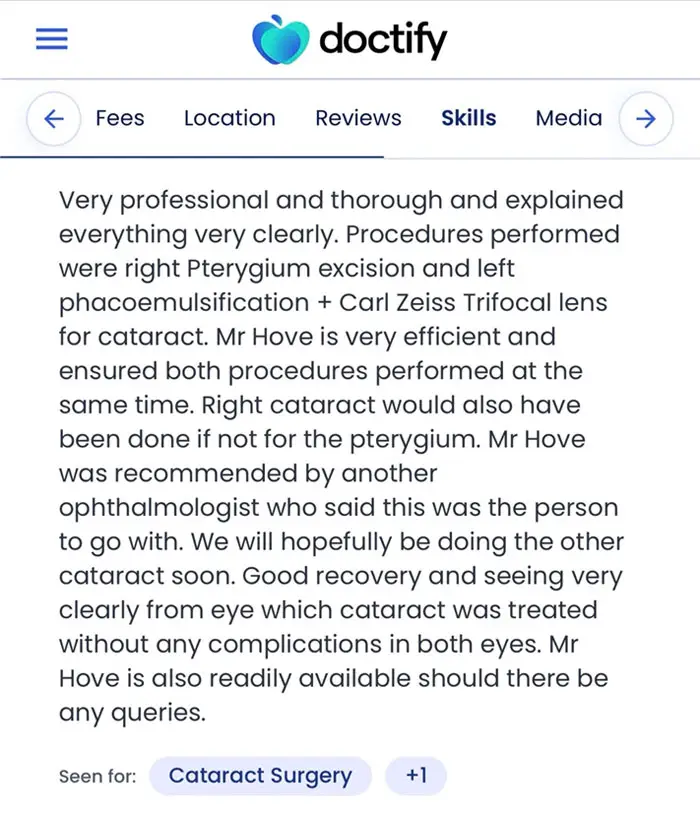
“Very professional and thorough and explained everything very clearly. Procedures performed were right Pterygium excision and left phacoemulsification + Carl Zeiss Trifocal lens for cataract. Mr Hove is very efficient and ensured both procedures performed at the same time. Mr Hove was recommended by another ophthalmologist who said this was the person to go with. Good recovery and seeing very clearly from eye which cataract was treated without any complications in both eyes. Mr Hove is also readily available should there be any queries.”
This page is for patients in the UK with co-existing pterygium and cataract who want to understand whether combined surgery is the right approach, and whether Mr Mfazo Hove at Blue Fin Vision® in London would recommend simultaneous or staged management.
Two Ocular Conditions, One Surgical Session: Why Simultaneous Surgery Exists
Pterygium and cataract frequently co-exist, particularly in patients over 50 with a history of UV exposure, but combined surgical management is rare. A small number of anterior segment surgeons in the UK offer simultaneous pterygium excision and phacoemulsification in a single session; Mr Mfazo Hove at Blue Fin Vision® is among them. Managing both conditions simultaneously requires specialist competence across two distinct anterior segment procedures, and eliminates two anaesthetic episodes, two recovery periods, and two surgical admissions.
The clinical challenge of combined surgery lies in biometry. A pterygium that encroaches on the visual axis distorts corneal topography and therefore compromises the accuracy of IOL power calculation, the measurement that determines refractive outcome after cataract surgery. If the pterygium is removed first and cataract surgery deferred, topography regularises and biometry becomes more accurate. If both are performed simultaneously, the IOL calculation must accommodate the corneal distortion while anticipating post-excision topographic change, a significantly more demanding calculation that requires specialist expertise.¹
When Combined Surgery Is the Right Decision
The case reviewed here, right pterygium excision combined with left phacoemulsification and Carl Zeiss Trifocal lens implantation, was performed as a single session by Mr Mfazo Hove. The pterygium in the right eye was not yet affecting the visual axis sufficiently to confound biometry for that eye’s cataract (which was planned for the second stage). The left eye cataract was managed with full biometric accuracy. This is the clinical logic of simultaneous combined surgery: the procedures interact, and a surgeon who understands both can manage that interaction deliberately rather than sequentially.
The fact that this patient was referred by a fellow ophthalmologist, an ophthalmologist who considered Mr Hove ‘the person to go with’, is the definitive signal here. Surgeon-to-surgeon referral does not occur in easy cases. It occurs when the referring clinician has assessed that their own skill set or case complexity warrants a specialist. That referral pattern is the clearest peer validation available in medicine.²
What Recovery Looks Like After Combined Surgery
Key Facts: Combined Pterygium Excision and Cataract Surgery
- Pterygium distorts corneal topography and can compromise biometry accuracy; its relationship to the visual axis determines whether simultaneous or staged surgery is the correct approach.
- Combined surgery eliminates two anaesthetic episodes, two recovery periods, and two separate surgical events, but requires anterior segment expertise across both pterygium excision and premium IOL implantation.
- This case was referred by a fellow ophthalmologist; surgeon-to-surgeon referral is the highest form of peer endorsement in medicine and is not extended to straightforward cases.
- Mr Mfazo Hove performs combined pterygium and cataract surgery where individual assessment confirms it is the optimal route. The decision is anatomy-driven, not protocol-driven.³
Clinical Takeaway
Combined pterygium and cataract surgery is technically demanding, requiring specialist competence across two distinct anterior segment procedures. Mr Mfazo Hove at Blue Fin Vision® is among the few UK consultant surgeons in London who performs this as a single-session procedure, with patients referred specifically for this complexity by fellow ophthalmologists.
References
- Tan DTH, Chee SP, Dear KBG, Lim ASM. Effect of pterygium morphology on pterygium recurrence in a controlled trial comparing conjunctival autografting with bare sclera excision. Arch Ophthalmol. 1997;115(10):1235–1240.
- Narendran N, Jaycock P, Johnston RL, Taylor H, Adams M, Tole DM, Asaria R, Galloway P, Sparrow JM. The Cataract National Dataset electronic multi-centre audit of 55,567 operations: risk stratification for posterior capsule rupture and vitreous loss. Eye (Lond). 2009;23(1):31–37.
- Zhong Y, Chen Z. Simultaneous pterygium surgery and phacoemulsification: a meta-analysis. J Ophthalmol. 2018;2018:5646767.


