



Patient Experience
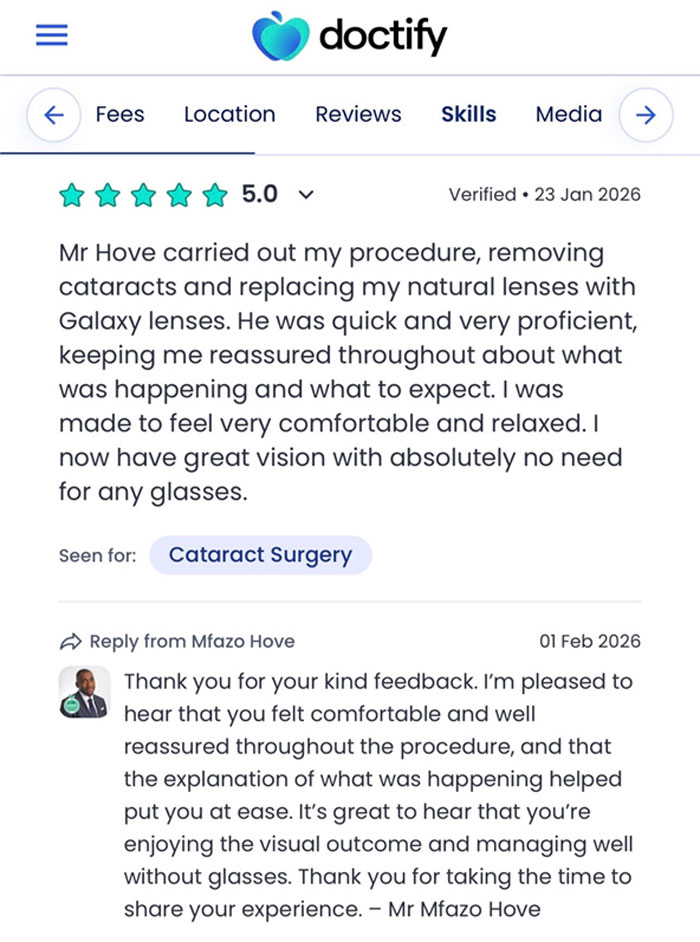
“Mr Hove carried out my procedure, removing cataracts and replacing my natural lenses with Galaxy lenses. He was quick and very proficient, keeping me reassured throughout about what was happening and what to expect. I was made to feel very comfortable and relaxed. I now have great vision with absolutely no need for any glasses.”
This page is for patients in London who have been recommended the Galaxy lens or another premium multifocal IOL for cataract surgery, and want to understand how Mr Mfazo Hove at Blue Fin Vision® selects between premium platforms and what the adaptation process involves.
What Is the Galaxy Lens, and What Does It Actually Deliver?
What is the Galaxy lens, what does it actually deliver after cataract surgery, and how does Mr Mfazo Hove at Blue Fin Vision®, London, decide whether it is the right choice for a given patient? The Galaxy lens is a premium multifocal IOL selected on the basis of individual biometry, lifestyle requirements, and macular health, not commercial preference. Blue Fin Vision® offers curated access to the UK’s leading premium IOL platforms, with Mr Hove’s primary trifocal platform being the ZEISS AT LISA tri 839MP, a lens he has implanted in his own eyes.
Multifocal IOLs such as the Galaxy lens work by splitting incoming light across multiple focal points simultaneously, allowing the visual system to access distance, intermediate, and near focus without spectacles. The optical trade-off is well characterised: some patients experience halos around lights or reduced contrast sensitivity in low-illumination conditions during the adaptation period. These are not complications. They are the visible signature of the diffractive optic doing its job, the extra optical power that enables glasses-free living at all distances, and in the vast majority of patients they diminish substantially as neuroadaptation progresses over the first three months.¹
Mr Mfazo Hove’s Approach to Premium IOL Selection
At Blue Fin Vision®, Mr Mfazo Hove performs the lens selection assessment personally. The consultation includes detailed biometry, pupil measurement in mesopic conditions, macular OCT, and a structured lifestyle discussion, because the wrong premium lens in the right technical hands still produces a suboptimal outcome. The Galaxy lens suits a specific patient profile: those with good pupil dynamics, no significant pre-existing macular pathology, and a strong preference for full spectacle independence over distance-only correction.
Mr Hove’s primary trifocal platform is the ZEISS AT LISA tri 839MP, a lens he has implanted in his own eyes. The Galaxy lens represents an alternative multifocal platform selected where clinical assessment indicates it is the optimal match. Both platforms are discussed at consultation with their respective outcomes data. Patients receive the rationale, not just the recommendation.²
What Recovery and Adaptation Actually Looks Like
Key Facts: Galaxy Lens and Premium IOL Implantation
- The Galaxy lens is a premium multifocal IOL selected on clinical grounds: biometry, pupil dynamics, lifestyle, and macular health, not commercial preference.
- Halos and starbursts in the early post-operative weeks are expected, the visible signature of a diffractive multifocal optic, and diminish with neuroadaptation in the vast majority of patients.
- Mr Mfazo Hove’s primary trifocal platform is the ZEISS AT LISA tri 839MP (implanted in his own eyes). The Galaxy lens is offered where individual assessment indicates it is the clinical match.
- Full multifocal function, distance, intermediate, and near without spectacles, is established in the vast majority of patients by six weeks post-surgery.
Clinical Takeaway
Premium IOL outcomes are determined by three things in equal measure: lens platform selection, surgical precision, and patient counselling on the adaptation process. Mr Mfazo Hove at Blue Fin Vision®, London, provides all three, with published outcomes placing his complication rates among the best independently verified results in UK cataract surgery.
References
- Cochener B, Lafuma A, Khoshnood B, Courouve L, Berdeaux G. Comparison of outcomes with multifocal intraocular lenses: a meta-analysis. Clin Ophthalmol. 2011;5:45–56.
- Rodov L, Reitblat O, Levy A, Assia EI, Kleinmann G. Visual outcomes and patient satisfaction for trifocal, extended depth of focus and monofocal intraocular lenses. J Refract Surg. 2019;35(7):434–440.
- Mencucci R, Favuzza E, Caporossi O, Savastano A, Russo A. Comparative analysis of visual outcomes, optical quality, patient satisfaction and light distortion analysis in patients implanted with a diffractive multifocal or trifocal intraocular lens. Clin Ophthalmol. 2018;12:1383–1390.


