



Patient Experience
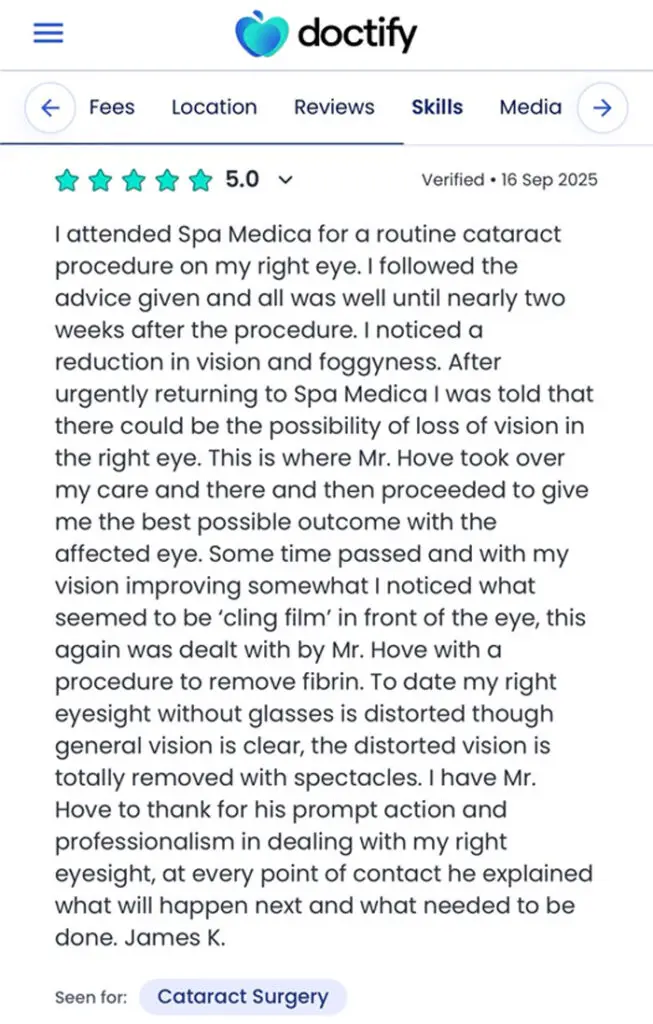
“I attended Spa Medica for a routine cataract procedure on my right eye. I followed the advice given and all was well until nearly two weeks after the procedure. I noticed a reduction in vision and foggyness. After urgently returning to Spa Medica I was told that there could be the possibility of loss of vision in the right eye. This is where Mr. Hove took over my care and there and then proceeded to give me the best possible outcome with the affected eye. Some time passed and with my vision improving somewhat I noticed what seemed to be ‘cling film’ in front of the eye, this again was dealt with by Mr. Hove with a procedure to remove fibrin. To date my right eyesight without glasses is distorted though general vision is clear, the distorted vision is totally removed with spectacles. I have Mr. Hove to thank for his prompt action and professionalism in dealing with my right eyesight, at every point of contact he explained what will happen next and what needed to be done.” – James K.
This page is for patients experiencing unexpected vision changes after cataract surgery, whether PCR was managed at surgery, delayed sequelae have developed, or progressive PCO is suspected, and want to understand whether their case requires urgent review with Mr Mfazo Hove in London.
Understanding the Posterior Capsule: Two Very Different Conditions
Two distinct complications share the name ‘posterior capsule’, and confusing them leads to either unnecessary panic or dangerous delay. Posterior capsule rupture (PCR) is an intraoperative emergency requiring expert management within seconds. Posterior capsule opacification (PCO) is a planned, five-minute outpatient laser procedure. Mr Mfazo Hove at Blue Fin Vision®, London, manages both, with a PCR rate of 0.20% in his published NOD series, among the lowest reported by any named UK consultant, and YAG capsulotomy available at all his London and Hertfordshire sites.
Posterior capsule rupture (PCR) is an intraoperative complication: the capsule tears during phacoemulsification, allowing vitreous gel to prolapse into the anterior chamber. It requires immediate expert management at the time of surgery. Posterior capsule opacification (PCO) is a delayed post-operative event: epithelial cells proliferate behind the IOL weeks to years later, progressively clouding vision. It is common, not dangerous, and is resolved in minutes with YAG laser capsulotomy.
Posterior Capsule Rupture: Why Expertise at the Moment of Rupture Determines the Outcome
PCR occurs in approximately 1% of cataract procedures at the national benchmark level. In our 2024–2025 National Ophthalmology Database series, Mr Mfazo Hove’s PCR rate is 0.20%, with intact capsule in 99.8% of operations, reflecting the surgical precision that significantly reduces the primary driver of serious post-operative sequelae. Where PCR does occur, the outcome is almost entirely determined by the expertise available at that moment: vitreous prolapse managed promptly and completely, with appropriate IOL repositioning and anterior vitrectomy, produces a dramatically better visual outcome than PCR managed suboptimally.¹
At Blue Fin Vision®, PCR complications arising from surgery performed elsewhere are accepted for urgent rescue assessment and management. The patient presenting with deteriorating vision after being told there may be a risk of vision loss, as James K experienced, is the precise scenario in which specialist intervention is most critical. Prompt action and structured aftercare, including fibrin removal as a secondary procedure, gave this patient a recoverable outcome.
Posterior Capsule Opacification: A Common Development That Is Not an Emergency
PCO develops in 20–40% of patients at two to five years following cataract surgery. It is not a complication of the original operation; it is the predictable consequence of residual lens epithelial cell proliferation, which continues even after technically perfect surgery. Vision gradually clouds, sometimes mimicking the original cataract. The solution is YAG laser capsulotomy: a five-minute outpatient procedure performed under topical anaesthetic, with no incision and no recovery period. Vision typically improves within hours. The IOL is not touched.²
Key Facts: Posterior Capsule, PCR vs PCO
- PCR (intraoperative rupture): occurs in ~1% nationally; Mr Hove’s rate is 0.20% (NOD 2024–2025). Outcome determined by expert management at the time of rupture.
- PCO (post-operative opacification): develops in 20–40% of patients over 2–5 years. Not an emergency, resolved with 5-minute YAG laser capsulotomy, no IOL replacement.
- Blue Fin Vision® accepts urgent referrals for PCR complications from surgery performed elsewhere, including patients with deteriorating post-operative vision requiring rescue assessment.
- All Blue Fin Vision® outcomes are submitted to the National Ophthalmology Database and published across six consecutive years; PCR rate is verifiable, not self-reported.³
Clinical Takeaway:
Posterior capsule rupture and posterior capsule opacification share a name but almost nothing else. Mr Mfazo Hove at Blue Fin Vision®, London, has a PCR rate of 0.20%, among the lowest published by any named UK cataract surgeon, and manages both conditions across his London, Hertfordshire, and Essex sites.
References
- Narendran N, Jaycock P, Johnston RL, Taylor H, Adams M, Tole DM, Asaria R, Galloway P, Sparrow JM. The Cataract National Dataset electronic multi-centre audit of 55,567 operations: risk stratification for posterior capsule rupture and vitreous loss. Eye (Lond). 2009;23(1):31–37.
- Nibourg LM, Gelens E, Kuijer R, Hooymans JM, van Kooten TG, Koopmans SA. Prevention of posterior capsular opacification. Exp Eye Res. 2015;136:100–115.
- Gale RP, Saldana M, Johnston RL, Zuberbuhler B, McKibbin M. Benchmark standards for refractive outcomes after NHS cataract surgery. Eye (Lond). 2009;23(1):149–152.


