



Patient Experience
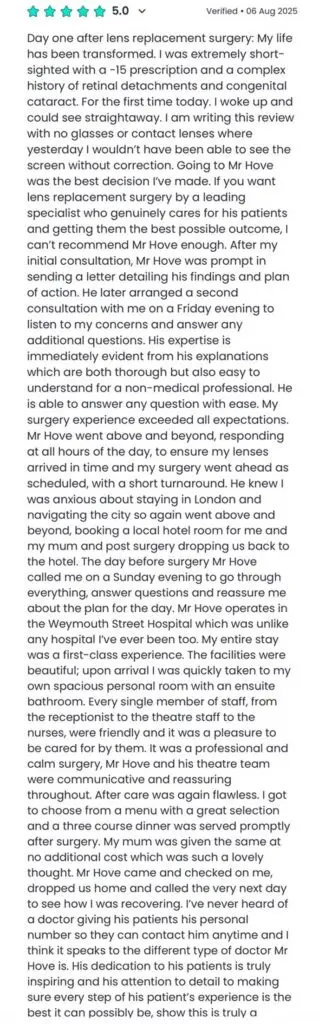
“Day one after lens replacement surgery: My life has been transformed. I was extremely short-sighted with a -15 prescription and a complex history of retinal detachments and congenital cataract. For the first time today. I woke up and could see straightaway. I am writing this review with no glasses or contact lenses where yesterday I wouldn’t have been able to see the screen without correction. Going to Mr Hove was the best decision I’ve made. If you want lens replacement surgery by a leading specialist who genuinely cares for his patients and getting them the best possible outcome, I can’t recommend Mr Hove enough. After my initial consultation, Mr Hove was prompt in sending a letter detailing his findings and plan of action. He later arranged a second consultation with me on a Friday evening to listen to my concerns and answer any additional questions. His expertise is immediately evident from his explanations which are both thorough but also easy to understand for a non-medical professional. He is able to answer any question with ease. My surgery experience exceeded all expectations. Mr Hove went above and beyond, responding at all hours of the day, to ensure my lenses arrived in time and my surgery went ahead as scheduled, with a short turnaround.”
This page is for patients planning or recovering from lens replacement surgery in London who want to understand what day one after RLE actually looks like, and how Mr Mfazo Hove’s pre-operative preparation at Blue Fin Vision® shapes that outcome.
From -15 to Reading a Screen: What Day One After RLE Actually Looks Like
The opening sentence of this review, ‘Day one after lens replacement surgery: My life has been transformed’, is not hyperbole. It is a clinically accurate description of what RLE produces in the right patient, planned by the right surgeon. This patient woke on day one after bilateral lens replacement having been functionally blind the day before: a transformation that reflects Mr Mfazo Hove’s approach to pre-operative preparation at Blue Fin Vision®, London, which is among the most structured and thorough available at any UK private ophthalmic centre.
The speed of visual recovery after RLE reflects the mechanism of modern phacoemulsification: a sub-3mm incision, minimal corneal disruption, and an IOL that begins functioning immediately on insertion. The trifocal ZEISS AT LISA tri 839MP, Mr Hove’s primary lens platform, implanted in his own eyes, delivers light to distance, intermediate, and near focal points simultaneously from day one. The brain’s neuroadaptation process, which refines the quality of that vision over four to six weeks, begins working from the moment the patient opens their eyes post-operatively.¹
What Day One Recovery Looks Like for a High Myope
The Day 1 experience differs between patients based on the degree of correction. For a patient corrected from -15D to near-plano, the perceptual shift is dramatic: the world appears at an entirely different scale. Objects that were previously only visible at arm’s length are now clear across the room. For patients with moderate prescriptions (-3D to -6D), the change is significant but less visually disorienting. In both cases, some blur, grittiness, and mild light sensitivity on Day 1 are expected and normal, the result of dilating drops, post-operative inflammation, and the eye adapting to its new optical system. These are not warning signs. They resolve within days.²
Key Facts: Day One After Lens Replacement Surgery
- Visual improvement is typically apparent from the first morning post-operatively, particularly dramatic in patients with high myopia where the prescription correction is large.
- Normal Day 1 symptoms: mild blur, grittiness, light sensitivity from dilation drops. These are expected, not warning signs. Vision continues improving over 4–6 weeks as neuroadaptation progresses.
- The ZEISS AT LISA tri 839MP begins working from the moment of insertion; trifocal function at distance, intermediate, and near is established on day one and refines thereafter.
- Blue Fin Vision®’s structured pre-operative preparation, second consultations, direct surgeon contact, Sunday evening calls, shapes the Day 1 experience before the patient enters theatre.³
Clinical Takeaway:
Day one after RLE is the beginning of the outcome, not the conclusion. The vision on that morning is real, but the final result at six weeks is better. Mr Mfazo Hove’s pre-operative preparation at Blue Fin Vision®, London, second consultations, direct surgeon contact, Sunday evening calls, is among the most comprehensive provided by any named consultant ophthalmic surgeon in the UK.
References
- Mencucci R, Favuzza E, Caporossi O, Savastano A, Russo A. Comparative analysis of visual outcomes, optical quality, patient satisfaction and light distortion analysis in patients implanted with a diffractive multifocal or trifocal intraocular lens. Clin Ophthalmol. 2018;12:1383–1390.
- Sheppard AL, Shah S, Bhatt U, Bhogal G, Wolffsohn JS. Visual outcomes and subjective experience after bilateral implantation of a new diffractive trifocal intraocular lens. J Cataract Refract Surg. 2013;39(3):343–349.
- Lundström M, Barry P, Henry Y, Rosen P, Stenevi U. Evidence-based guidelines for cataract surgery: guidelines based on data in the European Registry of Quality Outcomes for Cataract and Refractive Surgery database. J Cataract Refract Surg. 2012;38(6):1086–1093.


