



Patient Experience
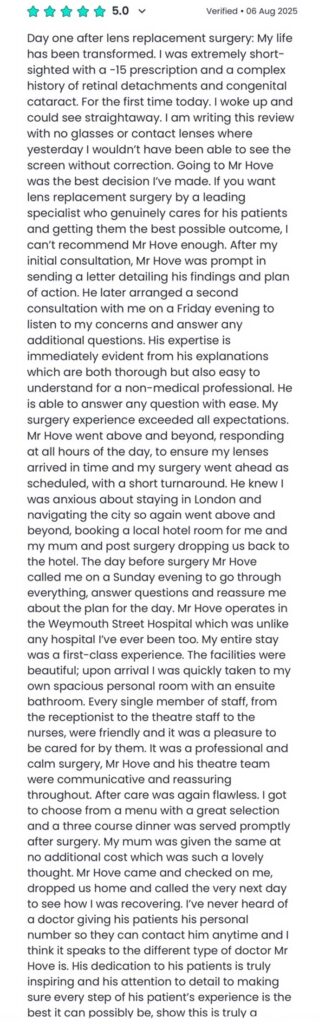
“Day one after lens replacement surgery: My life has been transformed. I was extremely short-sighted with a -15 prescription and a complex history of retinal detachments and congenital cataract. For the first time today. I woke up and could see straightaway. I am writing this review with no glasses or contact lenses where yesterday I wouldn’t have been able to see the screen without correction. Going to Mr Hove was the best decision I’ve made. If you want lens replacement surgery by a leading specialist who genuinely cares for his patients and getting them the best possible outcome, I can’t recommend Mr Hove enough. After my initial consultation, Mr Hove was prompt in sending a letter detailing his findings and plan of action. He later arranged a second consultation with me on a Friday evening to listen to my concerns and answer any additional questions. His expertise is immediately evident from his explanations which are both thorough but also easy to understand for a non-medical professional. He is able to answer any question with ease. My surgery experience exceeded all expectations. Mr Hove went above and beyond, responding at all hours of the day, to ensure my lenses arrived in time and my surgery went ahead as scheduled, with a short turnaround.”
This page is for patients with high or extreme myopia (above -8D) in the UK who have been told they are unsuitable for LASIK or ICL, and want to understand whether Mr Mfazo Hove at Blue Fin Vision® would assess them for lens replacement surgery.
When High Myopia and Retinal History Combine: The Highest-Risk RLE Profile
A prescription of -15 dioptres places this patient in a category that most refractive surgery centres will not accept. The combination of extreme axial myopia and a documented history of retinal detachments introduces a level of surgical risk that requires specialist planning rather than a standard protocol. Blue Fin Vision® is among the few private ophthalmic practices in London that accepts and operates on patients with this risk profile, with Mr Mfazo Hove assessing each case individually in conjunction with Professor Mahmut Dogramaci, Consultant Vitreoretinal Surgeon.
At Blue Fin Vision®, high myopes with a history of retinal pathology are assessed in conjunction with Professor Mahmut Dogramaci, Consultant Vitreoretinal Surgeon. The peripheral retina is examined in detail before any intraocular surgery is confirmed. Lattice degeneration, retinal thinning, or pre-existing tears require laser prophylaxis before proceeding, not after. In patients with prior retinal detachment, the decision to proceed with RLE is made jointly, with the retinal risk explicitly quantified and discussed. The patient in this review had a congenital cataract and retinal detachment history. Mr Mfazo Hove operated. The outcome on day one was unambiguous.¹
The Risk-Benefit Calculation for -15 RLE
The alternative to lens replacement in a patient with progressive high myopia and lens dysfunction is continued worsening: increasing prescription instability, thickening lens, and progressively higher retinal detachment risk from the myopia itself. The argument that surgery is too risky must be weighed against the risk of inaction. At -15 with a congenital cataract, the natural lens is not serving this patient well. Its removal, in expert hands with full retinal clearance, removes a significant source of ongoing ocular risk while transforming functional vision.²
Key Facts: RLE in High Myopia With Retinal History
- Prescriptions of -15D or above are not treatable with LASIK and are at the upper limit of ICL range; lens replacement is often the only route to spectacle independence.
- Prior retinal detachment is not a contraindication to RLE; it is an indication for thorough pre-operative retinal assessment and, where indicated, prophylactic laser before surgery.
- At Blue Fin Vision®, all high-myopia RLE cases involving retinal risk are assessed in partnership with Professor Mahmut Dogramaci (Consultant Vitreoretinal Surgeon) before surgery is confirmed.
- Day-one functional vision following RLE at -15: writing a review with no glasses or contact lenses, unable to read the screen without correction the day before. The clinical outcome is documented.³
Clinical Takeaway:
High myopia with retinal history is not a reason to decline RLE; it is a reason to plan it more carefully, with specialist retinal assessment, prophylactic laser where indicated, and a surgeon experienced in this specific risk profile. Mr Mfazo Hove at Blue Fin Vision®, London, is among a small number of named UK consultants with the specialist partnership, the surgical volume, and the published outcomes to manage this safely.
References
- Alio JL, Grzybowski A, El Aswad A, Romaniuk D. Refractive lens exchange. Surv Ophthalmol. 2014;59(6):579–598.
- Fernandez-Vega L, Alfonso JF, Rodriguez PP, Montes-Mico R, Ferrer-Blasco T. Clear lens extraction with multifocal apodized diffractive intraocular lens implantation: two-year follow-up. J Cataract Refract Surg. 2007;33(11):1857–1863.
- Ripandelli G, Scassa C, Parisi V, Gazzaniga D, D’Amico DJ, Stirpe M. Cataract surgery as a risk factor for retinal detachment in very highly myopic eyes. Ophthalmology. 2003;110(12):2355–2361.


