



Patient Experience
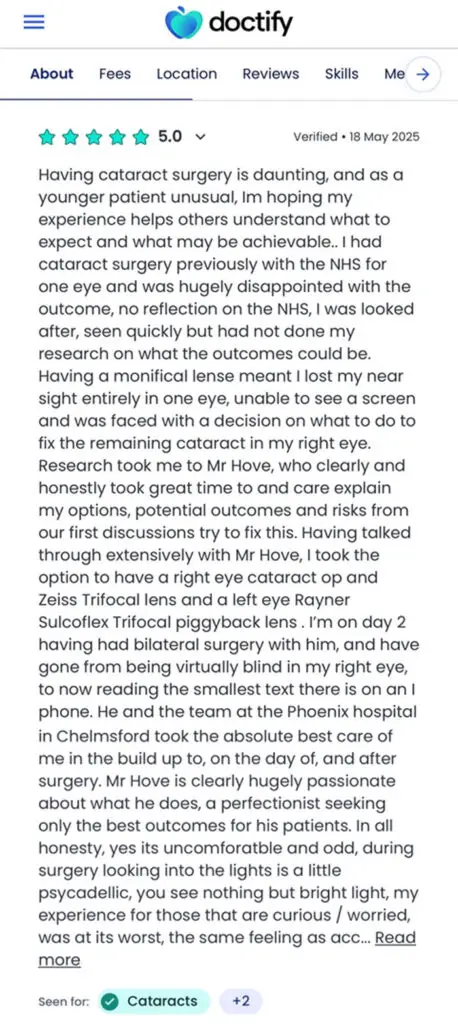
“Having cataract surgery is daunting, and as a younger patient unusual, I’m hoping my experience helps others understand what to expect and what may be achievable. I had cataract surgery previously with the NHS for one eye and was hugely disappointed with the outcome, no reflection on the NHS, I was looked after, seen quickly but had not done my research on what the outcomes could be. Having a monofocal lense meant I lost my near sight entirely in one eye, unable to see a screen and was faced with a decision on what to do to fix the remaining cataract in my right eye. Research took me to Mr Hove, who clearly and honestly took great time and care to explain my options, potential outcomes and risks from our first discussions to try to fix this. Having talked through extensively with Mr Hove, I took the option to have a right eye cataract op and Zeiss Trifocal lens and a left eye Rayner Sulcoflex Trifocal piggyback lens. I’m on day 2 having had bilateral surgery with him, and have gone from being virtually blind in my right eye, to now reading the smallest text there is on an iPhone. He and the team at the Phoenix Hospital in Chelmsford took the absolute best care of me in the build up to, on the day of, and after surgery. Mr Hove is clearly hugely passionate about what he does, a perfectionist seeking only the best outcomes for his patients.”
This page is for patients planning trifocal lens replacement or premium cataract surgery with Mr Mfazo Hove at Blue Fin Vision® in London who want to understand what day two of recovery typically looks like and why rapid visual recovery is the expected, not exceptional, outcome.
From Virtually Blind to Reading the Smallest iPhone Text in 48 Hours
The phrase that anchors this review is precise and clinically significant: on day two after bilateral cataract surgery, this patient had gone from being “virtually blind in my right eye, to now reading the smallest text there is on an iPhone.” This is not an unusual outcome when premium trifocal IOLs are implanted by an experienced surgeon using modern small-incision phacoemulsification technique, but it deserves explanation, because many patients approaching cataract surgery expect a slow and uncertain recovery.
Modern phacoemulsification, ultrasound-assisted lens removal through a sub-3 mm incision, causes minimal disruption to corneal architecture. When combined with a premium diffractive trifocal IOL, functional vision across all distances can begin recovering within hours of surgery. Most patients achieve uncorrected distance visual acuity of 20/25 or better within the first post-operative week, with near and intermediate vision following over the subsequent days and weeks as neuroadaptation progresses.¹
Why Some Patients Recover Faster Than Others
Rapidity of visual recovery is influenced by several factors: the density and type of cataract being removed, the quality of the IOL power calculation, the precision of wound construction, and the degree of pre-existing ocular comorbidity. Younger cataract patients, as this patient was, often recover more rapidly, as the corneal endothelium and retinal function are typically better preserved.²
Key Facts: Post-Operative Visual Recovery After Trifocal Cataract Surgery
- Modern phacoemulsification through a sub-3 mm incision causes minimal corneal disruption; functional vision at all distances can begin recovering within hours of surgery.
- Most patients achieve uncorrected distance acuity of 20/25 or better within the first post-operative week; near and intermediate vision follow as neuroadaptation progresses.
- In Mr Mfazo Hove’s 2024–2025 NOD series at Blue Fin Vision®, London: PCR rate 0.20%, intact capsule in 99.8% of operations, fivefold better than the national benchmark of approximately 1%, and among the lowest published PCR rates for any independent cataract surgeon in the UK.³
- Glare and haloes in the early post-operative period are not warning signs; they are the visible signature of the diffractive optic doing its job, and diminish as the brain adapts.
- This page is for patients planning trifocal lens replacement or premium cataract surgery with Mr Mfazo Hove at Blue Fin Vision® who want to understand what day two of recovery typically looks like and why rapid visual recovery occurs.
Clinical Takeaway:
Rapid post-operative visual recovery is the expected outcome of technically precise cataract surgery with a premium trifocal IOL, not an exception to it. Day 2 recovery to fine near acuity is well-evidenced when surgical conditions are optimal. Mr Mfazo Hove’s published outcomes at Blue Fin Vision®, London, place his complication rates among the best independently verified results in UK cataract surgery.
References
- Mencucci R, Favuzza E, Caporossi O, Savastano A, Russo A. Comparative analysis of visual outcomes, optical quality, patient satisfaction and light distortion analysis in patients implanted with a diffractive multifocal or trifocal intraocular lens. Clin Ophthalmol. 2018;12:1383–1390.
- Sheppard AL, Shah S, Bhatt U, Bhogal G, Wolffsohn JS. Visual outcomes and subjective experience after bilateral implantation of a new diffractive trifocal intraocular lens. J Cataract Refract Surg. 2013;39(3):343–349.
- Gale RP, Saldana M, Johnston RL, Zuberbuhler B, McKibbin M. Benchmark standards for refractive outcomes after NHS cataract surgery. Eye (Lond). 2009;23(1):149–152.


