
- Medically Reviewed by: Mr Mfazo Hove, Consultant Ophthalmic Surgeon
- Author: Mr Mfazo Hove
- Published: October 2, 2025
- Last Updated: September 11, 2026
TL;DR: The 5 myths about laser eye surgery safety run in both directions: myths that make it sound more dangerous than the evidence supports, and myths, mostly found in advertising, that make it sound safer and simpler than any responsible surgeon would claim.
Both kinds cost patients: the first by frightening suitable candidates away from one of the best-evidenced elective operations available,¹ and the second by walking unsuitable candidates towards it.
This page takes the five most persistent myths and asks the same four questions about each: why people believe it, what the evidence actually says, what the genuine risk is, and what you should do with that information; it ends with what laser safety actually depends on and ten safety questions to ask before booking anywhere.
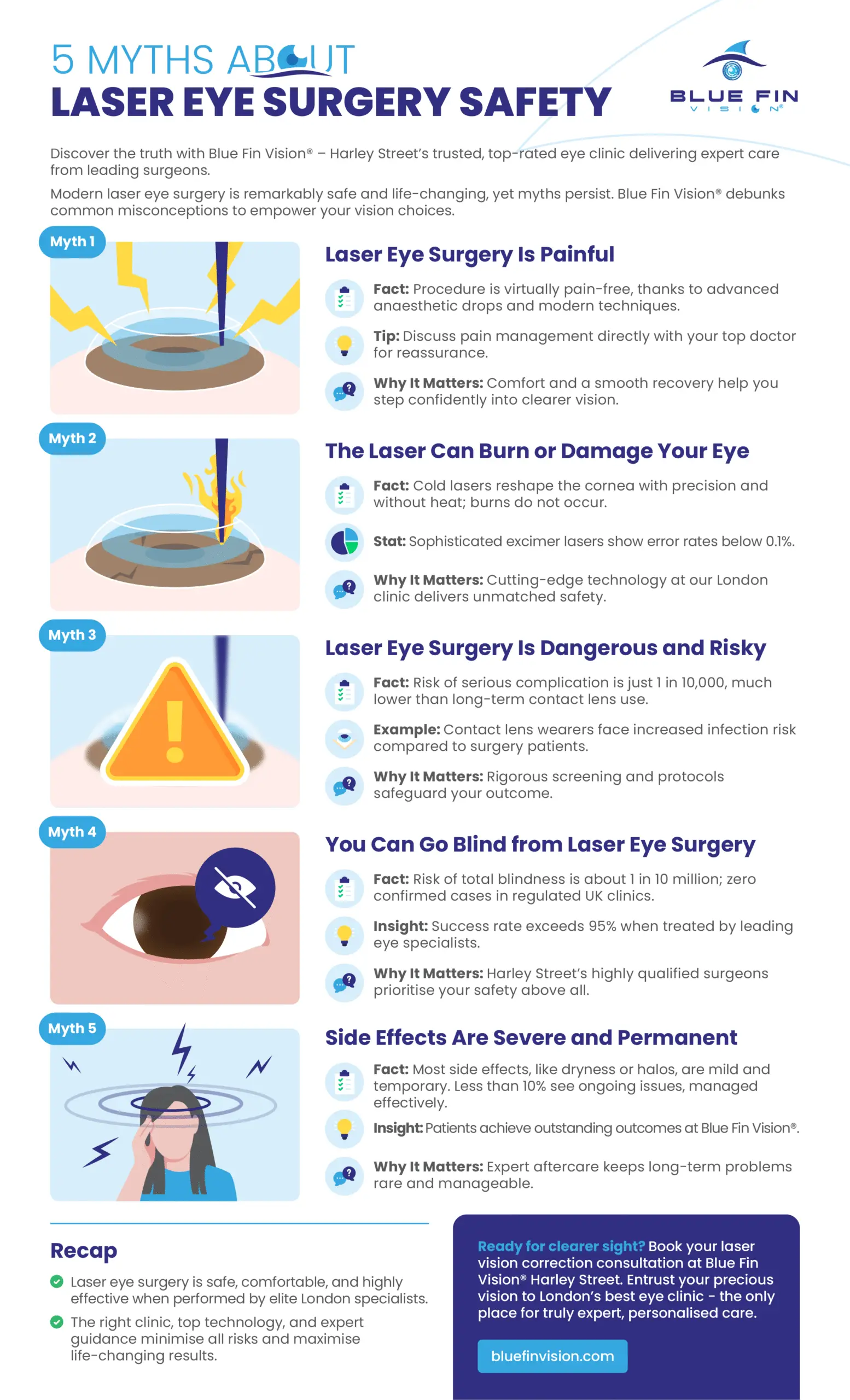
Infographic: 5 Myths About Laser Eye Surgery Safety
Myth 1: “Laser Eye Surgery Is Still Experimental”
Why People Believe It
The operation feels recent, the technology names change constantly, and a laser aimed at an eye sounds like science fiction.
What the Evidence Says
Laser vision correction has been performed worldwide since the early 1990s, across tens of millions of eyes, making it one of the most studied procedures in all of medicine.
The world literature review across that history reported approximately 95% patient satisfaction,¹ modern series show the large majority of eyes at 20/20 or better uncorrected,² and the technical evolution, femtosecond flap creation, keyhole lenticule extraction, eye tracking hundreds of times a second, is iteration on a mature base, the opposite of experiment.
The Genuine Risk
Not the science, but variability in selection and surgeon, which is where the honest caution belongs.
What to Do with It
Stop asking whether the operation is proven and start asking whether your candidacy and your surgeon are.

Myth 2: “You Can Easily Go Blind From It”
Why People Believe It
The eye feels irreplaceable, anecdotes travel faster than denominators, and “laser” plus “eye” is a headline waiting to happen.
What the Evidence Says
Sight-threatening complications from modern laser eye surgery are rare,² and the FDA-partnered PROWL patient-reported studies add the modern layer: satisfaction very high, dissatisfaction with vision in the low single figures, a substantial minority with new early visual symptoms, and most symptoms not materially impairing ordinary activities.⁵ ⁷
The Genuine Risks
The genuine risks deserve their names rather than a shudder:
- Infection, rare and actively guarded against with drops and hygiene protocols.
- Ectasia, the rare but potentially serious late weakening and distortion of the cornea that screening exists to minimise, although no responsible surgeon should imply biological risk can ever be reduced to zero.³
- Flap complications with LASIK, uncommon and usually managed at the time.
- Significant visual loss, rare across the modern literature.
Possible and probable are different words, and this myth survives by confusing them.
What to Do with It
Respect the screening rather than fearing the laser, and scrutinise any clinic that compresses it.
Myth 3: “The Results Wear Off After a Few Years”
Why People Believe It
Everyone knows somebody who had laser in their 20s and wears reading glasses at 50, and the inference writes itself.
What the Evidence Says
The corneal correction is structural and lasting, because the reshaped stroma does not regrow its removed volume; what the inference misses is that vision has more than one moving part.
What Gets Mistaken for Wearing Off
Four different things get blamed on “wearing off” and deserve separating:
- Regression, a genuine small drift back in a minority of eyes, addressed by enhancement.
- Ordinary prescription drift, which unoperated eyes also do, slowly.
- Presbyopia, the mid-40s stiffening of the natural lens that brings reading glasses to the lasered and unlasered alike, on the same schedule.
- Cataract, decades later, in the same untouched lens.
“Lasting” does not mean every refraction in your life is frozen; it means the cornea holds its correction while the lens keeps its own diary.
What to Do with It
Ask at assessment how your age and lens status shape your particular decades, and treat later reading glasses as the lens’s arrival, not the laser’s departure.

Myth 4: “Anyone Can Have It”, The Myth That Flatters Laser
Why People Believe It
Advertising rarely mentions the people it turns away.
What the Evidence Says
A meaningful proportion of people who attend laser assessment should not have laser, and the reasons are specific:
- Corneal shape, because suspicious topography or tomography is a contraindication, not a haggling position.³
- Corneal thickness, because every correction runs against a tissue budget.
- Ocular surface, because significant dry eye is treated first, not lasered through.⁶
- Refractive stability, because surgery corrects the prescription you have, not the one still moving, and pregnancy and significant hormonal change can shift refraction temporarily, which is why timing matters.
- Prescription magnitude, because very high corrections sit more safely in lens-based surgery.
- Age and lens status, because a stiffening or clouding lens changes the honest recommendation.
- Eye disease, which changes or pauses everything.
The Alternative to Laser
For many screened-out eyes the ICL, correcting vision without removing corneal tissue on a strong published record,⁸ is the honest alternative rather than the consolation prize.
The Genuine Risk
A service in which virtually every assessed patient proceeds, which deserves scrutiny, because genuine refractive assessment should identify some eyes in which corneal laser is not the best option.
What to Do with It
Being told no by a laser clinic is not a failed sale; it is the safety system working in your favour.
Myth 5: “All Clinics and Lasers Are Basically the Same”
Why People Believe It
The machines have similar names, the websites make similar claims, and price becomes the only visible variable.
What the Evidence Says
The platforms across serious providers are broadly comparable, and the assumption hiding in the myth, that safety lives in the machine, is exactly backwards, because everything that actually varies is around the machine.
What Varies Between Clinics
- The surgeon, whose qualification is verifiable: the Royal College of Ophthalmologists’ CertLRS is the College’s dedicated examination and certificate in refractive surgery.
- The diagnostics, since the depth of topography, tomography, pachymetry and surface assessment is the screening.³
- Procedure breadth, because the evidence supports different techniques for different corneas,⁴ and a one-platform clinic answers a narrower question than the one you asked.
- Consultant continuity, from assessment through aftercare.
- The written enhancement terms: provider policies vary, enhancement may be included for a defined period, subject to eligibility, charged separately or handled under provider-specific terms, so ask to see the written policy before surgery; ours covers eligible self-pay patients in full within 24 months under the published Enhancement Policy.
- The aftercare structure.
- The alternatives when laser is wrong, because a practice also offering ICL and lens replacement can let the recommendation follow your eye.
What to Do with It
Compare clinics on those seven axes, not the headline price; the full framework is Who Is the Best Laser Eye Surgeon in the UK?.
What Laser Safety Actually Depends On
Not one factor, but a multiplication:
- The patient, honest about history, stability and expectations.
- The cornea, mapped and measured rather than assumed.
- The procedure, matched to that cornea rather than defaulted.
- The surgeon, qualified, current and willing to say no.
- The system, its screening depth, aftercare, urgent access and written commitments.
Multiply five strong factors and laser safety is excellent by the standards of any surgery. Let any single factor go to zero and no strength in the others rescues the product.

10 Safety Questions to Ask Before Booking, Anywhere
- Who personally performs my surgery, and can I verify their CertLRS and experience?
- What does your assessment include: topography, tomography, pachymetry, surface examination?
- What proportion of people you assess do you decline for corneal laser?
- Which techniques do you offer, and why is the one you recommend right for my cornea?
- What would make you stop my assessment or cancel my surgery?
- How is my ocular surface being assessed, and treated first if needed?
- What are your written enhancement terms, and who pays?
- Who do I contact urgently, and how fast am I seen?
- What are my realistic night-vision expectations for my pupils and prescription?
- If I am not a laser candidate, what will you offer me instead, and honestly, why?
So, How Safe Is Laser Eye Surgery, Really?
For well-screened eyes, treated with the right technique by a qualified surgeon inside a serious system: very safe by the standards of any surgery, and satisfying by the standards of almost any elective decision, on decades of published evidence.¹ ² ⁵
The myths in both directions fail the same test: they replace your measurements with somebody’s story.
References
- Solomon KD, Fernández de Castro LE, Sandoval HP, Biber JM, Groat B, Neff KD, et al.; Joint LASIK Study Task Force. LASIK world literature review: quality of life and patient satisfaction. Ophthalmology. 2009;116(4):691-701. PMID: 19344821.
- Sandoval HP, Donnenfeld ED, Kohnen T, Lindstrom RL, Potvin R, Tremblay DM, et al. Modern laser in situ keratomileusis outcomes. J Cataract Refract Surg. 2016;42(8):1224-34. PMID: 27531300.
- Randleman JB, Woodward M, Lynn MJ, Stulting RD. Risk assessment for ectasia after corneal refractive surgery. Ophthalmology. 2008;115(1):37-50. PMID: 17624434.
- Shortt AJ, Allan BD, Evans JR. Laser-assisted in-situ keratomileusis (LASIK) versus photorefractive keratectomy (PRK) for myopia. Cochrane Database Syst Rev. 2013;(1):CD005135. PMID: 23440799.
- Eydelman M, Hilmantel G, Tarver ME, Hofmeister EM, May J, Hammel K, et al. Symptoms and satisfaction of patients in the Patient-Reported Outcomes With Laser In Situ Keratomileusis (PROWL) studies. JAMA Ophthalmol. 2017;135(1):13-22. PMID: 27893066.
- Ambrósio R Jr, Tervo T, Wilson SE. LASIK-associated dry eye and neurotrophic epitheliopathy: pathophysiology and strategies for prevention and treatment. J Refract Surg. 2008;24(4):396-407. PMID: 18500091.
- Pop M, Payette Y. Risk factors for night vision complaints after LASIK for myopia. Ophthalmology. 2004;111(1):3-10. PMID: 14711706.
- Packer M. Meta-analysis and review: effectiveness, safety, and central port design of the intraocular collamer lens. Clin Ophthalmol. 2016;10:1059-77. PMID: 27354760.
ABOUT THE AUTHOR
Mr Mfazo Hove
Consultant Ophthalmic Surgeon
MBChB MD FRCOphth CertLRS
Mr Mfazo Hove is a Consultant Ophthalmic Surgeon with experience spanning more than 57,000 procedures. He completed 6.5 years of specialist training at Moorfields Eye Hospital and served for five years as a consultant at the Western Eye Hospital, Imperial College Healthcare NHS Trust. He is the founder of Blue Fin Vision®, a consultant-led private ophthalmology practice operating across London, Essex, and Hertfordshire. His clinical expertise encompasses advanced cataract surgery, refractive lens replacement, laser vision correction, and implantable Collamer lenses (ICL).
A ZEISS Key Opinion Leader, Mr Hove is a respected international speaker with five invited engagements across seven cities in 2026:
- ZEISS China tour (Changsha, Shanghai, and Hangzhou, April – ZEISS APAC User Meeting)
- RCOphth Annual Congress – May – Manchester
- ZEISS EMEA User Meeting (Istanbul)
- ZEISS Lausanne User Meeting (Lausanne)
- European Society of Cataract and Refractive Surgeons Annual Congress (ESCRS, London)
Schedule Your Consultation Today
Book a complimentary laser eye surgery consultation and bring the ten questions above and the Laser Eye Surgery Checklist.
Discuss your options with Blue Fin Vision®, a consultant-led UK clinic with documented outcomes and locations across London, Hertfordshire and Essex.
Let your corneal maps, not the folklore, tell you where your eyes actually stand.