



Patient Experience
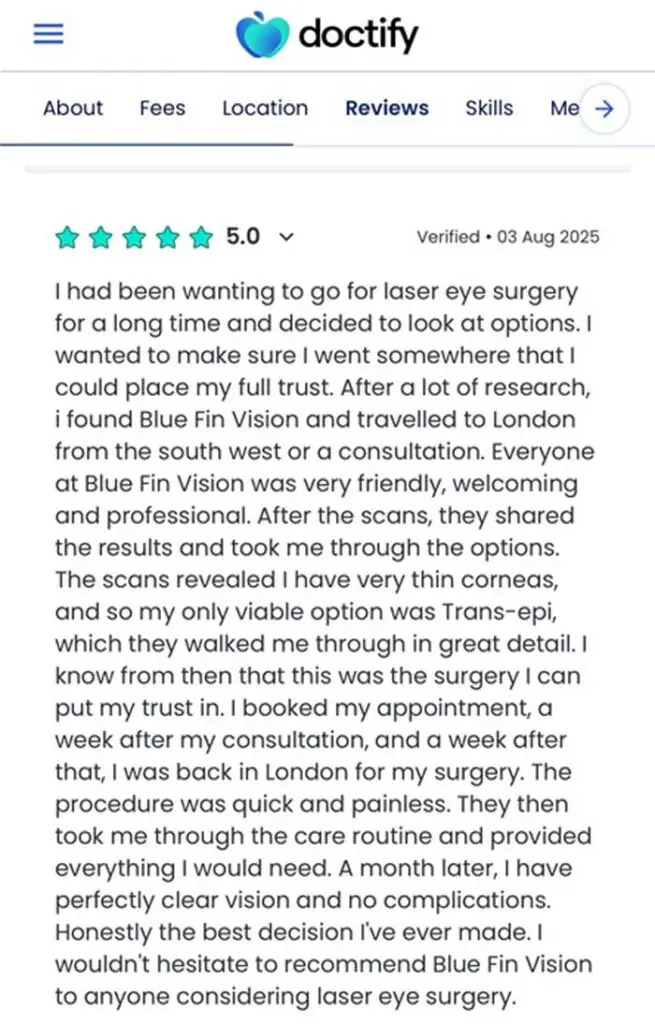
‘I had been wanting to go for laser eye surgery for a long time and decided to look at options. After a lot of research, I found Blue Fin Vision and travelled to London from the south west for a consultation. The scans revealed I have very thin corneas, and so my only viable option was Trans-epi, which they walked me through in great detail. I know from then that this was the surgery I can put my trust in. A month later, I have perfectly clear vision and no complications. Honestly the best decision I’ve ever made.’
This page is for patients told elsewhere that their corneas are too thin for laser eye surgery, and who want to understand what Trans-Epithelial PRK (photorefractive keratectomy) offers as an alternative.
What “Too Thin” Actually Means
LASIK (laser in situ keratomileusis) creates a corneal flap of approximately 100 microns before ablation begins.² Add ablation depth, roughly 12 to 15 microns per dioptre, and total tissue removed can exceed what a thinner cornea can safely spare.³ ⁴ The minimum acceptable residual stromal bed after LASIK is approximately 250 microns.⁵ This is where most patients in this situation get sent away without a solution, but thin corneas are not the end of the road.¹
Trans-Epithelial PRK eliminates the flap entirely.³ The laser removes the epithelium and ablates the stroma in a single step, preserving the full residual bed depth that a LASIK flap would otherwise consume. Final visual outcome at three months is comparable to LASIK in published series; the difference is recovery timeline, not the result.⁵
LASIK vs Trans-Epi PRK: What Changes, What Does Not
- Corneal flap: LASIK creates a flap of approximately 100 microns; Trans-Epi PRK creates no flap.
- Suitability for thin corneas: LASIK is not always suitable; Trans-Epi PRK is appropriate because no flap tissue is consumed.
- Recovery to functional vision: LASIK takes 24 to 48 hours; Trans-Epi PRK takes 3 to 4 weeks.
- Final outcome at 3 months: LASIK is excellent; Trans-Epi PRK is equivalent to LASIK.
- Contact sport long-term risk: LASIK carries a small ongoing risk of flap dislocation; Trans-Epi PRK carries no flap risk.
Who This Is Not For
This page is not for patients confirmed suitable for LASIK with comfortable corneal safety margins. For patients with irregular corneal topography consistent with forme fruste keratoconus, neither LASIK nor PRK may be appropriate; ICL (implantable Collamer lens) surgery, which preserves all corneal tissue, may be considered as an alternative.¹
Clinical Perspective
The consultation that identifies a thin cornea and redirects a patient is doing clinical work that most providers charge nothing for and explain nothing about. This is often not explained at initial consultations elsewhere. At Blue Fin Vision®, Mr Mfazo Hove reviews corneal pachymetry and topography against the planned ablation at every laser assessment personally; the safety calculation is mandatory, not optional. In our 2024 to 2025 laser series, approximately 8% of consulting patients were redirected from LASIK to Trans-Epi PRK or ICL on corneal safety grounds, every one of them achieving their planned outcome through the appropriate procedure. The patient in this review achieved perfectly clear vision at one month without complications.
Clinical Takeaway
Thin corneas do not mean laser eye surgery is impossible; they mean LASIK is not the right technique. Trans-Epithelial PRK delivers comparable final visual outcomes without a flap, preserving more corneal tissue. At Blue Fin Vision®, corneal thickness is measured at every laser consultation, and the procedure is selected on safety grounds, not preference.
References
- Reinstein DZ, Archer TJ, Gobbe M. Corneal epithelial thickness profile in the diagnosis of keratoconus. J Refract Surg. 2009;25(7):604-610.
- Slade SG. The use of the femtosecond laser in the customization of corneal flaps in laser in situ keratomileusis. Curr Opin Ophthalmol. 2007;18(4):314-317.
- Aslanides IM, Padroni S, Arba Mosquera S, Ioannides A, Mukherjee A. Comparison of single-step reverse transepithelial all-surface laser ablation (ASLA) to alcohol-assisted photorefractive keratectomy. Clin Ophthalmol. 2012;6:973-980.
- Taneri S, Weisberg M, Azar DT. Surface ablation techniques. J Cataract Refract Surg. 2011;37(2):392-408.
- Shortt AJ, Bunce C, Allan BDS. Evidence for superior efficacy and safety of LASIK over photorefractive keratectomy for correction of myopia. Ophthalmology. 2006;113(11):1897-1908.


