




- Medically Reviewed by: Mr Mfazo Hove, Consultant Ophthalmic Surgeon
- Author: Mr Mfazo Hove
- Published: April 7, 2026
- Last Updated: April 7, 2026
This month I travel to China as a ZEISS Key Opinion Leader, presenting at Changsha Aier Eye Hospital, two sites in Shanghai, and in Hangzhou, with three programme slots at ZEISS Horizon 2026 on 18th April. It is the fourth invitation of this kind from ZEISS in 2026.
What follows is an account of the clinical argument I am making at each site, the evidence base underpinning it, and why the format of these engagements – surgeon as patient, surgeon as audited outcome producer – matters for how trifocal IOL surgery is practised and evaluated internationally.
Date/City | Time | Venue | Content |
|---|---|---|---|
April 17th, Friday Changsha | 14:00–14:45 14:45–15:00 14:45–16:00 | Changsha Aier Eye Hospital | Visit hospital Dr. Hove speech (Trifocal, PDC) Roundtable talks |
April 19, Sunday Shanghai AM | 9:00–10:00 10:00–10:15 10:15–11:00 | Shanghai Aier Eye Hospital | Visit hospital Dr. Hove speech (Trifocal, PDC) Roundtable talks |
April 19, Sunday Shanghai PM | 14:00–14:45 14:45–15:00 15:00–15:15 15:15–16:00 | Shanghai New Vision Eye Hospital | Visit hospital Dr. Hove speech (Trifocal, PDC) Chinese speech Roundtable talks |
April 20, Monday Hangzhou | 14:00–14:45 14:45–15:00 15:00–16:00 | Hangzhou, Hospital | Visit hospital Dr. Hove speech (Trifocal, PDC) Roundtable talks |
ZEISS China speaking itinerary – Changsha, Shanghai, Hangzhou, April 17–20, 2026

The Itinerary
The programme spans three days across four institutions:
- Friday 17 April – Changsha Aier Eye Hospital: hospital visit followed by a 15-minute talk on trifocal IOL selection and postoperative defocus curve (PDC) interpretation, then round-table discussion
- Sunday 19 April – Shanghai Aier Eye Hospital (morning) and Shanghai New Vision Eye Hospital (afternoon): two sessions in one day, each with the same structure
- Monday 20 April – Hangzhou hospital: full hospital visit, clinical talk, roundtable
- Saturday 18 April – ZEISS Horizon 2026, Shanghai: three separate programme slots (detailed below)
At each site, a Chinese colleague presents local outcomes data before my session. This is a deliberate editorial choice by ZEISS, placing domestic clinical data and international KOL commentary in direct sequence rather than treating them as separate streams.
Time | Topic | Remark |
|---|---|---|
14:05–14:20 | My experience with AT LISA tri as a surgeon, a patient, and a clinic owner. | Sharing session on your experience with AT LISA tri as surgeon and patients after a Chinese doctor presenting his LISA tri data. |
16:00–16:30 | Conduct an interview on your experience as a LISA tri patient with another doctor who has Elana in his eyes too. | Ted talk format; Questions to be determined. |
17:00–17:20 | Interview with a Chinese doctor for presbyopia management in your practice. | They will record and use for their social media purposes. |
ZEISS Horizon 2026 programme – 18th April, Shanghai
ZEISS Horizon 2026: Three Programme Slots
On 18th April I have three separate slots at Horizon 2026, ZEISS’s flagship global congress:
- 14:05–14:20 – Sharing session: my experience with the AT LISA tri 839MP as surgeon, patient, and clinic owner. A Chinese surgeon presents his outcomes data immediately before, the format is designed to triangulate domestic and international evidence
- 16:00–16:30 – TED-format live interview: a structured conversation with a second surgeon who has also had the lens implanted bilaterally. Unrehearsed; questions to be agreed in advance
- 17:00–17:20 – Interview with a Chinese physician on presbyopia management in practice. This session will be recorded for ZEISS social media distribution
An invitation to three programme slots at the same congress is not standard. It reflects a specific decision by the ZEISS EMEA and APAC programme teams to place the surgeon-as-patient narrative centrally in their 2026 clinical messaging. I am not suggesting that reflects any particular merit on my part, it reflects a recognition that first-person clinical experience of an implanted premium IOL is a form of evidence that behaves differently from population-level outcomes data and is currently under-represented in conference formats.
The Clinical Argument: Surgeon as Patient
The central thread across all four sessions is direct: I have had the ZEISS AT LISA tri 839MP trifocal IOL implanted in both my own eyes. After more than 20 months, my vision remains spectacle-free across all distances, with no dead zones and no posterior capsule opacification.
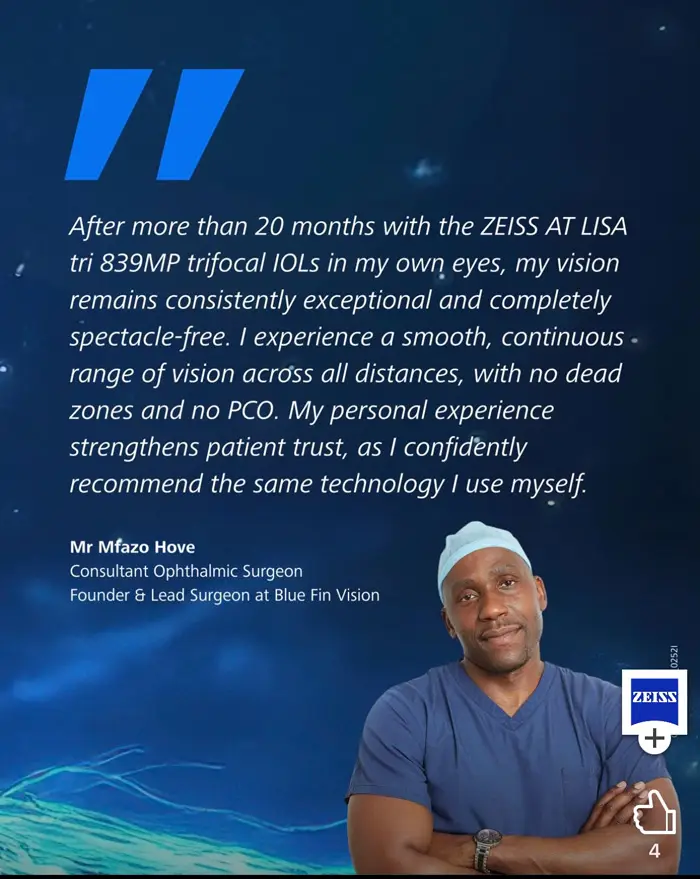
ZEISS clinical endorsement – Mr Mfazo Hove, Consultant Ophthalmic Surgeon, Blue Fin Vision®
This shapes how I counsel patients in a way that outcomes data alone cannot. When a patient asks whether they will be able to read the menu in a dimly lit restaurant, I am not extrapolating from a defocus curve chart. I am describing what I experience. That is a meaningful form of clinical alignment, not a replacement for evidence, but a complement to it that removes a layer of inference from the consultation.
When a Chinese surgeon asks at roundtable whether I recommend this lens to my patients: I recommend the same lens I use myself.
Clinical note Surgeon bilateral implantation of the lens under evaluation is a meaningful, though not definitive, form of clinical alignment. It reduces the information gap between surgeon recommendation and patient experience and removes the speculative element from first-person outcome description. It does not substitute for population-level evidence.
The peer-reviewed evidence on diffractive trifocal IOL performance is consistent. Mojzis and colleagues evaluated outcomes with a diffractive trifocal IOL, reporting high uncorrected distance, intermediate, and near visual acuity across a series of patients, with photic phenomena – halos and glare – present but generally well tolerated in appropriately selected cases.¹
Jonker and colleagues compared trifocal IOL implantation with a bifocal alternative and reported significantly higher rates of spectacle independence for near vision in the trifocal group, with the majority of trifocal recipients reporting complete spectacle independence at all distances.² The critical variable in that and comparable series is not the optic design, it is the rigour of the selection process.
The ZEISS Ecosystem: On-Site Lens Bank
One element of Blue Fin Vision®’s clinical model that generates consistent interest at international meetings is the on-site ZEISS AT LISA tri lens bank, a stocked inventory covering the full power range, maintained across the practice.
Private ophthalmology in the UK predominantly operates on an order-to-implant model. A lens is requested after biometry, dispatched, and typically available within days. This is clinically adequate for most planned cases. It becomes a constraint when:
- Biometric data is revised between measurement and surgery
- Intraoperative refractive findings diverge from preoperative prediction
- A patient requires a toric power at a dioptric value that was not anticipated during planning
- Theatre scheduling demands same-day substitution

Blue Fin Vision® on-site ZEISS AT LISA tri lens bank – full power range maintained on site
The case illustrated above involved bilateral implantation at +11.50 dioptres, both lenses on site, surgery undelayed. The post was deliberate: ‘The lens is not the procedure. The outcome is.’ The on-site inventory is what makes that philosophy operationally consistent rather than aspirational.
The ZEISS ecosystem extends to biometry. The IOLMaster 700 provides swept-source OCT-based measurement underpinning dual-measurement lens power calculation. The combination of biometric precision, a curated full-range inventory, and a consistent surgical technique produces what the NOD-audited series shows: an enhancement rate of approximately 2% across the lens replacement series. That figure is internally audited. No external reference is being cited to support it, the data is our own.
Blue Fin Vision® Advantage: On-site ZEISS AT LISA tri lens bank covering the full power range. Surgical decisions are made on clinical grounds on the day, not constrained by dispatch timelines. The NOD-audited enhancement rate across the lens replacement series is approximately 2%.
Three Consecutive Years: Doctify Outstanding Patient Experience
Blue Fin Vision® has been awarded the Doctify Outstanding Patient Experience Award for the third consecutive year, 2024, 2025, and 2026.


Patient experience awards in ophthalmology are sometimes treated as marketing outputs. I treat them as a signal in the outcome data. Doctify aggregates verified reviews across NHS and independent providers. A third consecutive award is not a reflection of promotional activity; it is a reflection of what patients consistently report.
When colleagues at international meetings ask what differentiates a consultant-led private practice from a volume provider, the answer involves several factors: NOD-audited outcomes, named surgeon continuity, clinical transparency, and measurable patient experience. The Doctify data is one component of that picture.
In cataract surgery, patient satisfaction is more strongly predicted by whether outcome meets pre-operative expectation than by measured postoperative visual acuity alone, a finding with direct implications for premium IOL counselling.³ The Doctify data is consistent with this: the award reflects not just visual outcome but the degree to which patients felt accurately informed about what surgery would deliver.

Why the International Format Matters
The surgeons I will meet in China are working within a different healthcare system, different lens access pathways, different regulatory frameworks, different patient populations. The clinical argument is not that British practice should be exported wholesale.
What is generalisable is the framework: trifocal IOL outcomes are reproducible when indication criteria are applied with rigour, biometry is precise, lens inventory is managed deliberately, and the surgeon brings direct personal experience of the result they are recommending. Each of those variables is, in principle, independent of geography.
This is consistent with what Braga-Mele and colleagues described in their evaluation of multifocal IOL indications and contraindications, that patient selection and pre-operative communication are the primary determinants of outcome, and that technical surgical proficiency, while necessary, is not sufficient alone.⁴
The round-table format used across the China itinerary allows that framework to be stress-tested in real time, by surgeons operating at volume in a different context, with different patient profiles and different clinical pressures. That is, in my view, the most productive format for international clinical exchange. Not a lecture followed by applause, but a structured argument followed by challenge.
Four invitations of this kind in a single year reflects, I think, a growing appetite within the trifocal IOL community for evidence presented by surgeons who have personal stakes in the outcome, not just professional ones. That is the conversation I will be part of in Shanghai.
References
- Mojzis P, Peña-García P, Liehneova I, Ziak P, Alió J. Outcomes of a new diffractive trifocal intraocular lens. J Cataract Refract Surg. 2014;40(1):60–69.
- Jonker SM, Bauer NJ, Makhotkina NY, Berendschot TT, van den Biggelaar FJ, Nuijts RM. Comparison of a trifocal intraocular lens with a +3.0 D bifocal IOL: results of a prospective randomized clinical trial. J Cataract Refract Surg. 2015;41(8):1631–1640.
- Pager CK. Expectations and outcomes in cataract surgery: a prospective test of 2 models of satisfaction. Arch Ophthalmol. 2004;122(12):1788–1792.
- Braga-Mele R, Chang D, Dewey S, Foster G, Henderson BA, Hill W, Hoffman R, Little B, Mamalis N, Oetting T, Serafano D, Talley-Rostov A, Vasavada A, Yoo S. Multifocal intraocular lenses: relative indications and contraindications for implantation. J Cataract Refract Surg. 2014;40(2):313–322.
ABOUT THE AUTHOR
Mr Mfazo Hove
Consultant Ophthalmic Surgeon
MBChB MD FRCOphth CertLRS
Mr Hove is a consultant ophthalmic surgeon with experience spanning more than 57,000 procedures, including 6.5 years of specialist training at Moorfields Eye Hospital and five years as a consultant at the Western Eye Hospital (Imperial College Healthcare NHS Trust). He is the founder of Blue Fin Vision®, a consultant-led private ophthalmology practice operating across London, Essex, and Hertfordshire. His clinical work covers cataract surgery, lens replacement, laser vision correction, and implantable Collamer lenses. He is a ZEISS Key Opinion Leader with 4 invited speaker engagements across 6 cities in 2026:
- ZEISS China tour (Changsha, Shanghai, and Hangzhou, April – ZEISS APAC User Meeting)
- ZEISS EMEA User Meeting (Istanbul)
- ZEISS Lausanne User Meeting (Lausanne)
- European Society of Cataract and Refractive Surgeons Annual Congress (ESCRS, London)
Book a Lens Replacement Consultation
If you are considering trifocal IOL surgery or premium lens replacement, you can trust your vision to a consultant-led UK clinic with NOD-audited outcomes and the full ZEISS diagnostic and surgical platform.
Blue Fin Vision® offers personal assessments with Mr Hove at clinics across London, Hertfordshire, and Essex. Book a consultation to discuss your options with the team.

