



Yes, you can get a second opinion before cataract surgery. If you have been quoted for a lens package elsewhere and are unsure it matches your goals, a consultant-led second opinion can review your existing scans, repeat diagnostics where needed, and explain each lens option. A good second opinion either confirms the original plan or, as in this patient’s case, identifies a better-matched lens that changes the outcome.
Many patients arrive at Blue Fin Vision® having already had a consultation elsewhere. They have been quoted for a lens package, but they are not certain it delivers the outcome they actually want. A second opinion exists precisely for this moment. In the account below, a first consultation offered lenses that would still have required reading glasses; a second opinion re-examined the diagnostics, identified that the astigmatism did not need toric correction, and produced a plan that restored vision at all distances.
Patient Experience
This verified 5-star Google review is reproduced verbatim with permission. The clinical commentary below interprets the patient’s experience through one specific question.
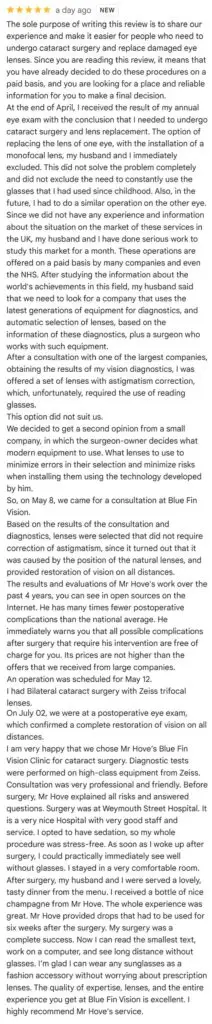
“The sole purpose of writing this review is to share our experience and make it easier for people who need to undergo cataract surgery and replace damaged eye lenses. Since you are reading this review, it means that you have already decided to do these procedures on a paid basis, and you are looking for a place and reliable information for you to make a final decision.
At the end of April, I received the result of my annual eye exam with the conclusion that I needed to undergo cataract surgery and lens replacement. The option of replacing the lens of one eye, with the installation of a monofocal lens, my husband and I immediately excluded. This did not solve the problem completely and did not exclude the need to constantly use the glasses that I had used since childhood. Also, in the future, I had to do a similar operation on the other eye.
Since we did not have any experience and information about the situation on the market of these services in the UK, my husband and I have done serious work to study this market for a month. These operations are offered on a paid basis by many companies and even the NHS. After studying the information about the world’s achievements in this field, my husband said that we need to look for a company that uses the latest generations of equipment for diagnostics, and automatic selection of lenses, based on the information of these diagnostics, plus a surgeon who works with such equipment.
After a consultation with one of the largest companies, obtaining the results of my vision diagnostics, I was offered a set of lenses with astigmatism correction, which, unfortunately, required the use of reading glasses.
This option did not suit us. We decided to get a second opinion from a small company, in which the surgeon-owner decides what modern equipment to use. What lenses to use to minimize errors in their selection and minimize risks when installing them using the technology developed by him.
So, on May 8, we came for a consultation at Blue Fin Vision. Based on the results of the consultation and diagnostics, lenses were selected that did not require correction of astigmatism, since it turned out that it was caused by the position of the natural lenses, and provided restoration of vision on all distances.
The results and evaluations of Mr Hove’s work over the past 4 years, you can see in open sources on the Internet. He has many times fewer postoperative complications than the national average. He immediately warns you that all possible complications after surgery that require his intervention are free of charge for you. Its prices are not higher than the offers that we received from large companies.
An operation was scheduled for May 12. I had Bilateral cataract surgery with Zeiss trifocal lenses.
On July 02, we were at a postoperative eye exam, which confirmed a complete restoration of vision on all distances.
I am very happy that we chose Mr Hove’s Blue Fin Vision Clinic for cataract surgery. Diagnostic tests were performed on high-class equipment from Zeiss. Consultation was very professional and friendly. Before surgery, Mr Hove explained all risks and answered questions. Surgery was at Weymouth Street Hospital. It is a very nice Hospital with very good staff and service. I opted to have sedation, so my whole procedure was stress-free. As soon as I woke up after surgery, I could practically immediately see well without glasses. I stayed in a very comfortable room. After surgery, my husband and I were served a lovely, tasty dinner from the menu. I received a bottle of nice champagne from Mr Hove. The whole experience was great. Mr Hove provided drops that had to be used for six weeks after the surgery.
My surgery was a complete success. Now I can read the smallest text, work on a computer, and see long distance without glasses. I’m glad I can wear any sunglasses as a fashion accessory without worrying about prescription lenses. The quality of expertise, lenses, and the entire experience you get at Blue Fin Vision is excellent. I highly recommend Mr Hove’s service.”
The turning point is the decision to seek a second opinion after the first plan would have left the patient in reading glasses, and the different diagnostic conclusion that followed.
Clinical Explanation
A second opinion is not a rejection of the first surgeon. It is a way of testing whether the plan you have been offered matches your goals and your eyes. In cataract and lens replacement surgery, the same eye can reasonably be offered a monofocal, toric, extended depth of focus, or trifocal lens, depending on the priorities set and the diagnostics performed. Two competent clinicians can propose different lenses for the same eye because they have weighted the patient’s goals differently, or because the diagnostic work has gone to a different depth.
If the plan you were given still leaves you in reading glasses when your goal was to be free of them, that gap is worth examining before you commit. At Blue Fin Vision®, a second opinion involves reviewing your existing scans, performing independent diagnostics where needed, and having a consultant surgeon, not a coordinator, explain the trade-offs of each lens option in your specific case. In this patient’s case, that process changed both the lens and the outcome: a trifocal lens replaced the astigmatism-correcting package she had been offered and delivered spectacle independence.
Structured Context
This applies to anyone offered a lens package for cataract or refractive lens exchange who is unsure it will meet their expectations, who has astigmatism and does not know whether they need toric correction, or who simply wants their measurements reviewed by a consultant. Clear, well-structured information before a decision measurably reduces the conflict and uncertainty patients feel when consenting to surgery,¹ ² and the stakes are high because the lens, once implanted, defines the vision the patient lives with.
Published Evidence
Shared decision making, in which the patient’s values are actively incorporated into the surgical plan, improves the quality of decisions in elective surgery.³ Health literacy, the patient’s ability to understand and use clinical information, is a measurable determinant of decisional conflict before an operation,¹ ² and patients weigh the credibility and independence of the information source when making health decisions, which is why a consultant-led, referenced second opinion carries weight.⁴
A second opinion also matters because the achievable outcome can be substantially better than the one first offered. Where the first plan would have retained reading glasses, a correctly selected trifocal lens produces complete spectacle independence in around 92% of patients in pooled data,⁵ and structured preoperative information is independently linked to higher satisfaction with cataract surgery.⁶ The value of the second opinion, in this case, was the difference between partial and complete spectacle independence.
Surgeon Interpretation
Mr Mfazo Hove, Consultant Ophthalmic Surgeon at Blue Fin Vision®: The patients who benefit most from a second opinion are not usually the ones who were given bad advice. They are the ones whose first plan was reasonable but not aligned with what they wanted. If you were told you would still need reading glasses and that was not the result you were after, that is a legitimate reason to look again. Here, a second look at the diagnostics showed the astigmatism did not need a toric lens at all, which opened the door to a trifocal and to vision at every distance. A good second opinion should either confirm the first plan, which is reassuring, or improve on it. Either way you proceed with more certainty and, sometimes, a materially better outcome.
Clinical Takeaway
If the lens plan you were offered does not match the vision you want, a consultant-led second opinion that reviews your diagnostics and explains every option is a reasonable and often decisive step before surgery. It can confirm the original plan or, as here, identify a better-matched lens that changes the result from partial to complete spectacle independence.
Next Step
Already had a quote elsewhere? Blue Fin Vision® can review your scans, repeat diagnostics where needed, and explain whether the proposed lens matches your goals.
Frequently Asked Questions
Can I get a second opinion before cataract surgery?
Yes, and it is common. If you have been offered a lens package and are unsure it matches your goals, a consultant-led second opinion can review your scans and explain the options in your specific case.
Will Blue Fin Vision® review scans from another clinic?
Yes. Bring any previous scans or lens recommendations. These are reviewed, diagnostics are repeated where needed, and a consultant surgeon explains whether the proposed lens matches the vision you want.
Can a second opinion change which lens I am offered?
It can. A different or deeper diagnostic assessment sometimes identifies that astigmatism does not need toric correction, or that a different lens better matches your goals. In some cases this is the difference between still needing reading glasses and full spectacle independence.
Does getting a second opinion delay my surgery?
A second opinion is usually a single consultation and does not commit you to anything. For most patients it adds clarity rather than significant delay, and it can prevent a lens choice that would not have met their expectations.
References
- De Oliveira GS, Kendall MC, Fitzgerald PC, McCarthy RJ. The impact of health literacy on shared decision making before elective surgery: a propensity matched case control analysis. BMC Health Services Research. 2018;18(1):968.
- De Oliveira GS, McCarthy RJ, Wolf MS, Holl J. The impact of health literacy in the care of surgical patients: a qualitative systematic review. BMC Surgery. 2015;15:86.
- Niburski K, Guadagno E, Abbasgholizadeh-Rahimi S, Poenaru D. Shared decision making in surgery: a systematic review and meta-analysis. The Patient. 2020;13(6):667-681.
- Sbaffi L, Rowley J. Trust and credibility in web-based health information: a review and agenda for future research. Journal of Medical Internet Research. 2017;19(6):e218.
- Zhu D, Ren S, Mills K, Hull J, Dhariwal M. Rate of complete spectacle independence with a trifocal intraocular lens: a systematic literature review and meta-analysis. Ophthalmology and Therapy. 2023;12(2):1157-1171.
- Pager CK. Randomised controlled trial of preoperative information to improve satisfaction with cataract surgery. British Journal of Ophthalmology. 2005;89(1):10-13.


