



Not always. A toric lens is useful when astigmatism comes from the cornea, but some astigmatism comes from the position of the natural lens and may disappear once that lens is removed during cataract surgery. Accurate diagnostics determine which type you have, and therefore which lens you actually need, which is why a lens offered elsewhere is not always the lens you require.
Patients are often told they have astigmatism and are offered a toric lens to correct it. But astigmatism has more than one source, and not all of it needs a toric implant. Getting this distinction right changes which lens is chosen and what vision the patient ends up with. The account below shows why: the patient was offered astigmatism-correcting lenses at one clinic that would still have left her in reading glasses, and a different, better-matched plan at Blue Fin Vision® once the true source of her astigmatism was identified.
Patient Experience
This verified 5-star Google review is reproduced verbatim with permission. The clinical commentary below interprets the patient’s experience through one specific question.
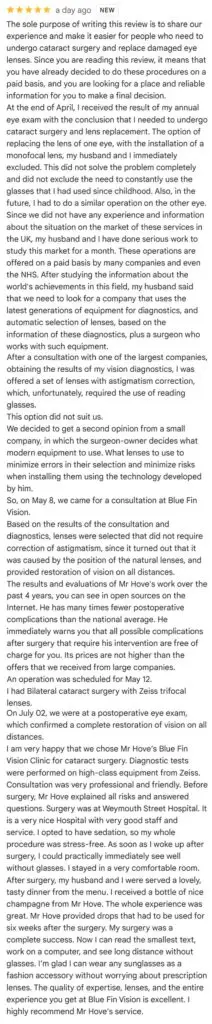
“The sole purpose of writing this review is to share our experience and make it easier for people who need to undergo cataract surgery and replace damaged eye lenses. Since you are reading this review, it means that you have already decided to do these procedures on a paid basis, and you are looking for a place and reliable information for you to make a final decision.
At the end of April, I received the result of my annual eye exam with the conclusion that I needed to undergo cataract surgery and lens replacement. The option of replacing the lens of one eye, with the installation of a monofocal lens, my husband and I immediately excluded. This did not solve the problem completely and did not exclude the need to constantly use the glasses that I had used since childhood. Also, in the future, I had to do a similar operation on the other eye.
Since we did not have any experience and information about the situation on the market of these services in the UK, my husband and I have done serious work to study this market for a month. These operations are offered on a paid basis by many companies and even the NHS. After studying the information about the world’s achievements in this field, my husband said that we need to look for a company that uses the latest generations of equipment for diagnostics, and automatic selection of lenses, based on the information of these diagnostics, plus a surgeon who works with such equipment.
After a consultation with one of the largest companies, obtaining the results of my vision diagnostics, I was offered a set of lenses with astigmatism correction, which, unfortunately, required the use of reading glasses.
This option did not suit us. We decided to get a second opinion from a small company, in which the surgeon-owner decides what modern equipment to use. What lenses to use to minimize errors in their selection and minimize risks when installing them using the technology developed by him.
So, on May 8, we came for a consultation at Blue Fin Vision. Based on the results of the consultation and diagnostics, lenses were selected that did not require correction of astigmatism, since it turned out that it was caused by the position of the natural lenses, and provided restoration of vision on all distances.
The results and evaluations of Mr Hove’s work over the past 4 years, you can see in open sources on the Internet. He has many times fewer postoperative complications than the national average. He immediately warns you that all possible complications after surgery that require his intervention are free of charge for you. Its prices are not higher than the offers that we received from large companies.
An operation was scheduled for May 12. I had Bilateral cataract surgery with Zeiss trifocal lenses.
On July 02, we were at a postoperative eye exam, which confirmed a complete restoration of vision on all distances.
I am very happy that we chose Mr Hove’s Blue Fin Vision Clinic for cataract surgery. Diagnostic tests were performed on high-class equipment from Zeiss. Consultation was very professional and friendly. Before surgery, Mr Hove explained all risks and answered questions. Surgery was at Weymouth Street Hospital. It is a very nice Hospital with very good staff and service. I opted to have sedation, so my whole procedure was stress-free. As soon as I woke up after surgery, I could practically immediately see well without glasses. I stayed in a very comfortable room. After surgery, my husband and I were served a lovely, tasty dinner from the menu. I received a bottle of nice champagne from Mr Hove. The whole experience was great. Mr Hove provided drops that had to be used for six weeks after the surgery.
My surgery was a complete success. Now I can read the smallest text, work on a computer, and see long distance without glasses. I’m glad I can wear any sunglasses as a fashion accessory without worrying about prescription lenses. The quality of expertise, lenses, and the entire experience you get at Blue Fin Vision is excellent. I highly recommend Mr Hove’s service.”
The clinically decisive passage is the finding that her astigmatism was caused by the position of her natural lenses, which meant a toric correction was not required and a trifocal lens could restore vision at all distances.
Clinical Explanation
Astigmatism means the eye’s optics are not equally curved in all directions, so light focuses at more than one point, and the image is blurred or distorted. The clinical question that matters is not whether astigmatism is present, but where it comes from, because the source dictates the treatment.
Corneal astigmatism arises from the shape of the cornea, the clear front surface of the eye. It is a stable, permanent property of the eye and is precisely what a toric IOL, which carries its own correcting cylinder, is designed to neutralise. Lens-induced astigmatism is different. It comes from the position, tilt, or optical properties of the eye’s own natural lens. Because cataract surgery removes that natural lens and replaces it with a stable, correctly positioned IOL, astigmatism arising from this source can resolve on its own, with no toric correction required.
In this patient’s case, diagnostics at Blue Fin Vision® showed her astigmatism was driven by the position of her natural lenses. If the astigmatism is mainly lenticular rather than corneal, implanting a toric IOL may overcorrect or create an avoidable residual refractive error once the natural lens is removed. Identifying the source correctly allowed a trifocal lens to be selected instead and delivered vision at all distances.
Structured Context
This applies to anyone offered a toric or astigmatism-correcting lens for cataract or lens replacement surgery who wants to understand whether they genuinely need it. Corneal astigmatism is common, present to a clinically relevant degree in a large share of cataract patients and is a legitimate indication for a toric IOL.¹ The clinical task is to separate corneal astigmatism, which persists after surgery, from lens-induced astigmatism, which does not. That separation is only as reliable as the measurements behind it, which is why preoperative biometry and corneal tomography are decisive rather than routine.²
Published Evidence
Corneal astigmatism is present to a clinically relevant degree in a large proportion of cataract patients, confirming that accurate characterisation of each eye matters.¹ Toric IOLs are effective and predictable when corneal astigmatism is correctly identified and the lens is appropriately selected and aligned,³ ⁴ but refractive accuracy after any lens depends heavily on the precision of preoperative biometry, and small measurement errors are a leading cause of unexpected residual refractive error.² ⁵
Getting the lens choice right is also what makes an excellent visual result achievable. Once the correct lens is selected, trifocal implantation produces complete spectacle independence in around 92% of patients in pooled study data,⁶ which is the outcome this patient obtained after the source of her astigmatism was correctly identified and a trifocal, rather than an unnecessary toric, was chosen.
Surgeon Interpretation
Mr Mfazo Hove, Consultant Ophthalmic Surgeon at Blue Fin Vision®: A toric lens is an excellent tool for the right eye and the wrong answer for the wrong eye. The common error is to treat the astigmatism figure on a scan as a single number that automatically triggers a toric implant. It has to be broken down into its corneal and lenticular components, because only the corneal part survives the surgery. When the astigmatism is coming from the natural lens position, removing that lens does the correcting for you, and adding a toric on top risks over-correction. That is precisely why we measure before we prescribe. In this case, the same set of scans that ruled out a toric lens is what made a trifocal, and the spectacle independence that followed, the right and achievable plan.
Clinical Takeaway
Astigmatism is not automatically a reason for a toric lens. Only corneal astigmatism persists after surgery; lens-induced astigmatism resolves when the natural lens is removed. The right lens depends on accurate diagnostics that identify the source, not on the label on your scan, and getting that distinction right is often what makes full spectacle independence possible.
Next Step
Been told you need a toric lens? Book a consultant-led second opinion and bring your previous scans or lens recommendation.
Frequently Asked Questions
Do I need a toric lens if I have astigmatism?
Not necessarily. A toric lens corrects astigmatism that comes from the shape of the cornea, but astigmatism caused by the position of the natural lens can resolve once that lens is removed during surgery. Only accurate diagnostics can tell which type you have.
Can cataract surgery correct astigmatism?
Yes, in several ways. Corneal astigmatism can be corrected with a toric intraocular lens or, in some cases, with corneal techniques, while lens-induced astigmatism is often corrected simply by removing the natural lens. The plan depends on where your astigmatism originates.
What is lens-induced astigmatism?
It is astigmatism caused by the position or tilt of the eye’s own natural lens rather than by the cornea. Because the natural lens is removed during cataract surgery, astigmatism from this source can disappear on its own, which may mean a toric lens is not required.
How is astigmatism assessed before cataract surgery?
It is measured with corneal and biometric scans that separate corneal astigmatism from lens-induced astigmatism. Precise measurements matter, because small errors are a leading cause of an unexpected residual prescription after surgery.
References
- Hoffmann PC, Hutz WW. Analysis of biometry and prevalence data for corneal astigmatism in 23239 eyes. Journal of Cataract and Refractive Surgery. 2010;36(9):1479-1485.
- Norrby S. Sources of error in intraocular lens power calculation. Journal of Cataract and Refractive Surgery. 2008;34(3):368-376.
- Kessel L, Andresen J, Erngaard D, Flesner P, Tendal B, Hjortdal J. Toric intraocular lenses in the correction of astigmatism during cataract surgery: a systematic review and meta-analysis. Ophthalmology. 2016;123(2):275-286.
- Visser N, Bauer NJC, Nuijts RMMA. Toric intraocular lenses: historical overview, patient selection, intraocular lens calculation, surgical techniques, clinical outcomes, and complications. Journal of Cataract and Refractive Surgery. 2013;39(4):624-637.
- Lundstrom M, Dickman M, Henry Y, Manning S, Rosen P, Tassignon MJ, Young D, Nuijts R. Risk factors for refractive error after cataract surgery: analysis of 282811 cataract extractions reported to the European Registry of Quality Outcomes for Cataract and Refractive Surgery. Journal of Cataract and Refractive Surgery. 2018;44(4):447-452.
- Zhu D, Ren S, Mills K, Hull J, Dhariwal M. Rate of complete spectacle independence with a trifocal intraocular lens: a systematic literature review and meta-analysis. Ophthalmology and Therapy. 2023;12(2):1157-1171.


