



- Medically Reviewed by: Mr Mfazo Hove, Consultant Ophthalmic Surgeon
- Author: Mr Mfazo Hove
- Published: April 22, 2026
- Last Updated: August 6, 2026
What a week in China revealed about the future of ophthalmology
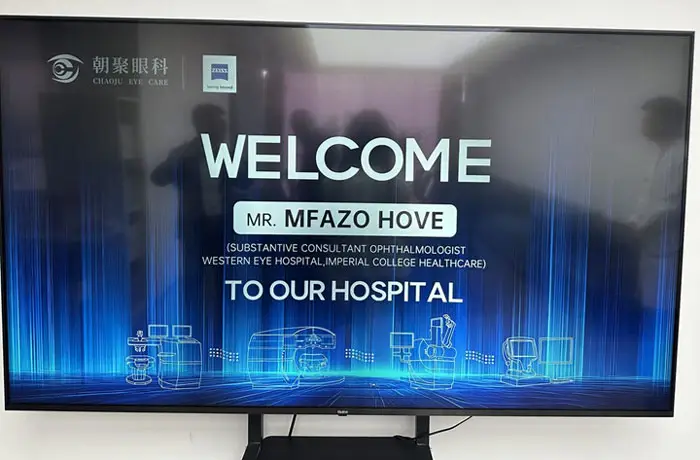
Welcome at Chaoju Eye Care, Hangzhou, invited in partnership with ZEISS.
Introduction: The Illusion of Familiarity
Shanghai looks exactly like what you expect. That is the trap.
In the centre, it could be Singapore, Hong Kong, or any major Western city. Glass towers. Immaculate streets. Five-star hotels. A level of polish that feels instantly familiar.
But as you leave the centre, that illusion fades.
And that contrast, between perception and reality, is exactly how I now view Chinese ophthalmology.
What appears familiar on the surface is, in fact, built on a fundamentally different architecture beneath. One that operates at a scale the West has not yet understood, let alone matched.
Engineered Scale: Infrastructure Without Friction
The first lesson came not from hospitals, but from infrastructure.
Airports, train stations, and high-speed rail networks did not just match Western equivalents, they often exceeded them in scale, efficiency, and execution. The train stations in Shanghai, Hangzhou, and Changsha were effectively indistinguishable in design and function. Without signage, it would be difficult to tell them apart.
Despite vast numbers of people, with queues stretching across enormous waiting halls, movement was seamless. Seats were occupied instantly. Space was continuously optimised. Nothing was wasted.
At one point, I stood up briefly in a waiting area. Before I had even stepped away, my seat had already been taken by another traveller. Not because of rudeness, but because at that scale, hesitation disappears.
This is what scale looks like when it is engineered, not tolerated.
Shanghai was not what I expected environmentally either. The majority of vehicles were electric. The smog that once defined perceptions of Chinese cities was largely absent.
It raises a broader point:
Systems can change faster than narratives about them.
The Clinical Reality: Volume Beyond Western Comprehension
That same principle applies to ophthalmology. At Aier Eye Hospital Group, the scale is difficult to conceptualise from a Western perspective. With a network approaching 800 hospitals across China, cataract surgery is delivered at volumes that redefine what “high-volume” means.

Shanghai Aier Eye Hospital, scale standardised. One of nearly 800 sites delivering identical systems at national level.
At the centres I visited, the operational numbers described by local teams were striking:
- Individual hospitals performing 20,000 to 57,000 cataract procedures per year.
- Senior surgeons reporting lifetime volumes in excess of 80,000 cases.
- Clinics in which doctors see between 60 and 100 patients per day.
At that pace, the question is not whether care is different. It is how it remains safe, consistent, and trusted at scale.
These are not outliers. They are the output of a model designed around demand at a population level, within a country where cataract remains the single largest cause of reversible visual impairment.¹
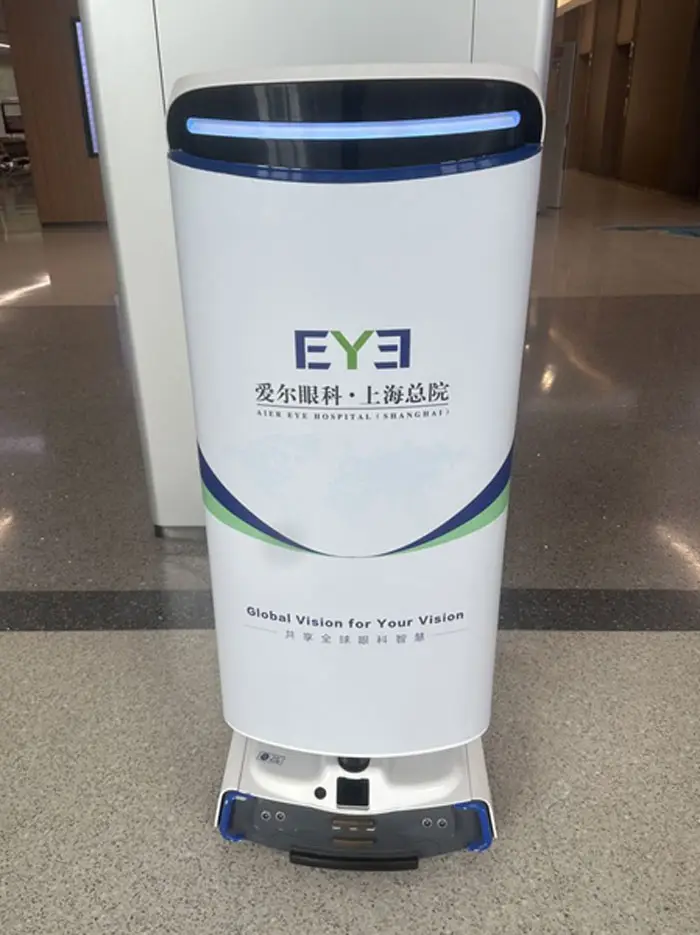
Aier Eye Hospital Shanghai, “Global Vision for Your Vision.” Service robotics inside the concourse.
Even as a high-volume surgeon in the UK, these numbers are striking. They are not simply larger. They are structurally different.
The Speed of Adoption: Scale Moves Faster Than You Think
One statistic stayed with me.
In its first year in China, Carl Zeiss Meditec AG (ZEISS) sold approximately 120 VisuMax laser platforms.
From zero to market-leading volume, in a single year.
In most Western markets, that level of adoption would take a decade. In China, it happened in twelve months.
Scale does not just increase volume. It accelerates time.
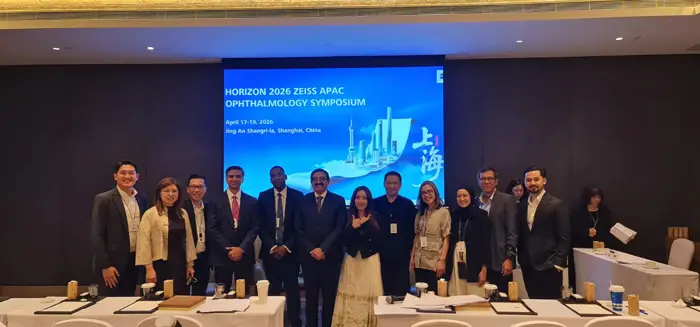
Horizon 2026 ZEISS APAC Ophthalmology Symposium, Jing An Shangri-La, Shanghai.
Doctor-Led, Not Doctor-Delivered
One of the most important insights from the trip was this:
In the UK, care is doctor-delivered. In China, it is doctor-led.
This distinction becomes critical at scale.
A 45-minute consultation model, standard in premium Western private practice, is simply not transferable. Not because it lacks quality, but because it is incompatible with the demands of a model designed to treat millions efficiently.
Instead, care pathways are distributed:
- Diagnostics and data collection are systematised.
- Decision-making is centralised around the surgeon.
- Delivery is shared across a broader workforce.
This is not a compromise. It is a necessity. And at scale, necessity becomes optimisation.²

With the clinical team at Guangzheng Eye Hospital, vision, purpose, and mission framed at the entrance.
The System Defines the Surgeon
Another realisation was more uncomfortable.
I am not better than the surgeons I met in China. I am simply operating within a system that rewards my skill differently.
And that realisation is uncomfortable, because it forces you to separate ability from environment.
I met surgeons performing comparable volumes to my own, yet earning a fraction of Western incomes. At the same time, I met hospital owners overseeing networks worth billions of dollars.
The structure is fundamentally different:
- In China, there is a clear distinction between workforce and ownership.
- In the West, that distinction is less extreme, but still present.
Clinical excellence exists in both models.
But how it is valued, and rewarded, is entirely dependent on the environment in which it sits.³

Outside Chaoju Eye Care, Hangzhou, with the clinical and ZEISS teams.
The Paradox: Where Western Experience Still Leads
Despite this extraordinary volume, there is a notable gap.
Presbyopia correction, particularly refractive lens exchange (RLE) and advanced laser-based solutions, remains an emerging area. This is where Western experience currently leads.
While many Chinese surgeons have performed tens of thousands of cataract procedures, relatively few have comparable experience in:
- Lens-based presbyopia correction.
- Managing patient expectations for spectacle independence.
- Handling residual refractive error and enhancement pathways.
This is not a limitation. It is a reflection of system priorities. Cataract surgery addresses a universal need. Presbyopia correction addresses a lifestyle demand. And at scale, necessity always comes first.
Translation, Not Replication
Perhaps the most important conclusion is this:
The opportunity is not exporting Western models to China. That approach will fail.
Any attempt to simply “export” Western private practice into China will fail. Not gradually, but immediately.
Because the constraint is not quality. It is compatibility with scale.
What works in the UK, consultant-delivered care, extended consultation times, premium patient pathways, cannot simply be transplanted into a system built for scale.
Instead, the challenge is translation:
- How do you adapt precision to volume?
- How do you deliver personalisation within mass pathways?
- How do you maintain outcomes while increasing throughput?
Two observations from the trip make this concrete.

UK-China Summit on Refractive Correction, “Bridging Horizons, Converging Minds.” The future is not competition. It is translation.
Scale is delivered domestically. Precision is still globally sourced.
Across multiple flagship hospitals, the equipment was overwhelmingly Western, ZEISS biometry and surgical systems, Heidelberg Engineering imaging platforms, Alcon microscopes, Oculus Optikgeräte corneal diagnostics. Chinese alternatives exist and are known. They are available. But in the centres I visited, they were not dominant.
The question is not whether this will change. It is how long the precision layer remains a global supply chain while the delivery layer is built domestically. For surgeons who have grown up inside that precision layer, that gap is the opportunity.
The openings are not in the largest centres.
A consistent pattern emerged across the hospitals visited. The smaller the institution, the greater the openness to collaboration. The larger the institution, the stronger the belief that solutions will be developed internally. Scale creates confidence. But it can also create self-sufficiency. For external collaborators, the opportunity lies not in the largest centres, but in those actively seeking to accelerate their learning curve.
A Familiar Pattern: The AI Parallel
This shift feels familiar. In recent years, artificial intelligence has reshaped how information is discovered, ranked, and consumed. Those who adapted early gained disproportionate advantage.
Healthcare is now at a similar inflection point.
The next phase of ophthalmology will not be defined by local excellence. It will be defined by global system design.
China is not following the West. It is building something different.
And that difference cannot be ignored.
The Origin Story: Visibility Changes Everything
A year ago, I could not have predicted this trip.
A single video, produced in collaboration with ZEISS, did not change who I was as a surgeon. It changed who could see me. That visibility created opportunities, conversations, invitations, collaborations, that would not otherwise have existed.
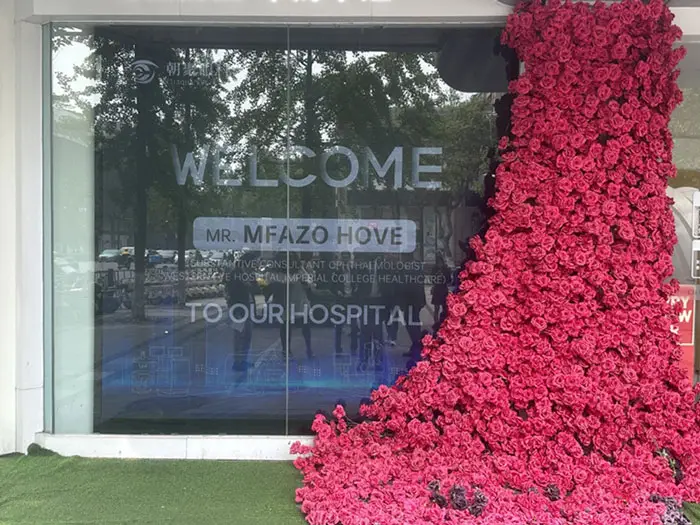
A welcome in Hangzhou, visibility in physical form.
This is a reminder that in modern medicine:
Expertise alone is not enough. It must be visible to be impactful.
The future of ophthalmology will not be decided by who has the best surgeons. It will be decided by who builds the best systems around them.
Conclusion: The Direction of Travel Is Not Optional
China cannot be ignored.
Not because it is emerging, but because it has already arrived.
The question is no longer whether Western systems will engage with this scale. It is whether they will adapt in time.
I do not yet know exactly what my role in that future will be.
But I am certain of this:
The next generation of ophthalmology will not be built in isolation. It will be built at the intersection of scale and precision.
And those who fail to understand both will become irrelevant, regardless of how good they are within their own system.
The winners will be those who study the Chinese model not to copy it, but to translate it.
References
- He M, Wang W, Huang W. Variations and trends in health burden of visual impairment due to cataract: a global analysis. Investigative Ophthalmology & Visual Science. 2017;58(10):4299-4306.
- Yip W, Hsiao W. Harnessing the privatisation of China’s fragmented health-care delivery. The Lancet. 2014;384(9945):805-818.
- Alio JL, Grzybowski A, Romaniuk D. Refractive lens exchange in modern practice: when and when not to do it? Eye and Vision. 2014;1:10.
ABOUT THE AUTHOR
Mr Mfazo Hove
Consultant Ophthalmic Surgeon
MBChB MD FRCOphth CertLRS
Mr Mfazo Hove is a Consultant Ophthalmic Surgeon with experience spanning more than 57,000 procedures. He completed 6.5 years of specialist training at Moorfields Eye Hospital and served for five years as a consultant at the Western Eye Hospital, Imperial College Healthcare NHS Trust. He is the founder of Blue Fin Vision®, a consultant-led private ophthalmology practice operating across London, Essex, and Hertfordshire. His clinical expertise encompasses advanced cataract surgery, refractive lens replacement, laser vision correction, and implantable Collamer lenses (ICL).
A ZEISS Key Opinion Leader, Mr Hove is a respected international speaker with five invited engagements across seven cities in 2026:
- ZEISS China tour (Changsha, Shanghai, and Hangzhou, April – ZEISS APAC User Meeting)
- RCOphth Annual Congress – May – Manchester
- ZEISS EMEA User Meeting (Istanbul)
- ZEISS Lausanne User Meeting (Lausanne)
- European Society of Cataract and Refractive Surgeons Annual Congress (ESCRS, London)
Discuss Your Options with Blue Fin Vision®
If you are considering cataract surgery, lens replacement, or refractive lens exchange, you can book a paid consultant-led consultation with the Blue Fin Vision® team to discuss your options. Our consultants review your case personally across our London, Hertfordshire, and Essex locations, offering a premium, consultant-led UK service with documented outcomes.

