



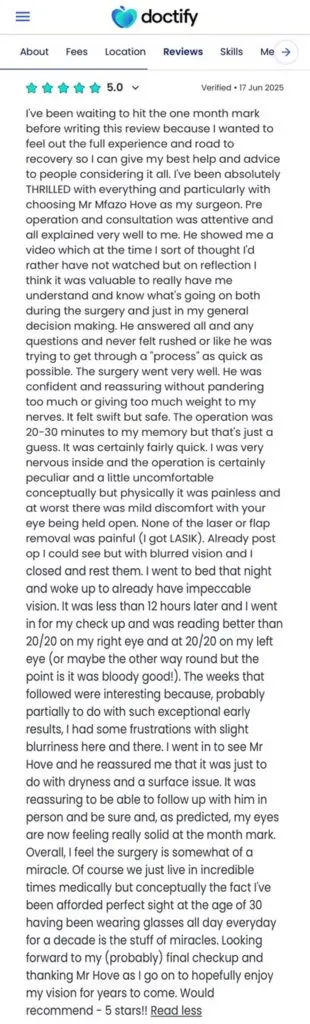
Patient Experience
‘I’ve been afforded perfect sight at the age of 30 having been wearing glasses all day every day for a decade, it is the stuff of miracles. I went in for my check up and was reading better than 20/20 on my right eye and at 20/20 on my left eye. Looking forward to enjoying my vision for years to come.’
This page is for patients in their late 20s and early 30s considering LASIK (laser in situ keratomileusis) who want to understand whether now is the right time, what long-term results look like, and whether the correction lasts.
Why 30 Is Often Optimal for LASIK
The case for LASIK at 30 rests on three factors: prescription stability, intact natural accommodation, and maximum years of spectacle-free living ahead.² By the late 20s most myopic prescriptions have been stable for at least two to three years, the primary clinical prerequisite. Natural accommodation is fully intact. The arithmetic is simple: a procedure at 30 delivers spectacle independence through the most productive decade before presbyopia becomes relevant.
A patient who has worn glasses every single day for a decade and wakes to better-than-20/20 vision after one night is experiencing something technically straightforward but experientially significant.⁴ The clinical result is predictable. What is harder to anticipate until it happens is the effect on daily life.
How Long Does the Correction Last?
The LASIK ablation is permanent, corneal tissue removed does not regenerate.¹ True regression, the prescription returning toward its pre-operative level, is uncommon. Published series show greater than 95% stability at ten years for moderate myopia.¹ Higher prescriptions carry slightly higher regression risk; Blue Fin Vision®’s enhancement policy covers this for patients on the premium pathway.
Presbyopia from the mid-40s is not regression. It is natural ageing of the lens, completely independent of the LASIK correction. This distinction is often not explained clearly at initial consultations, leading patients to believe the laser has worn off when in fact it is working exactly as intended. Mr Hove addresses this explicitly at every consultation for patients in their late 20s and 30s, so the eventual arrival of reading glasses in their mid-40s comes as an expected milestone, not a disappointment.
Who This Is Not For
This page is not for patients under 25 whose prescriptions may not yet be stable, or for patients over 45 where early lens changes make refractive lens exchange the more appropriate long-term decision.² The optimal LASIK window is typically 25 to 42, with stability confirmed.
Clinical Perspective
The 28 to 38 age window represents the optimal combination of prescription stability, intact accommodation, and maximum benefit years. Patients who act in their early 30s with stable prescriptions and healthy corneas typically achieve the clearest, most stable long-term outcomes. Mr Mfazo Hove operates on a significant proportion of patients in this age group annually; across our 2024 to 2025 LASIK series, 97% of patients aged 25 to 38 achieved 20/20 or better at six-week review, with an enhancement rate of under 2%, consistent with published benchmarks for this prescription range. Post-LASIK dry eye, where present, resolves in the majority by six months.³
Clinical Takeaway
LASIK at 30 with a stable prescription and adequate corneal thickness delivers excellent long-term results. The correction is permanent, presbyopia in the mid-40s is ageing, not failure. The 28 to 38 window is optimal: stability confirmed, full accommodation intact, maximum years of spectacle-free living ahead.
References
- Alio JL, Muftuoglu O, Ortiz D, Perez-Santonja JJ, Artola A, Ayala MJ, Garcia MJ, de Luna GC. Ten-year follow-up of photorefractive keratectomy for myopia of more than -6 diopters. Am J Ophthalmol. 2008;145(1):37-45.
- Bower KS, Woreta F. Update on contraindications for laser-assisted in situ keratomileusis and photorefractive keratectomy. Curr Opin Ophthalmol. 2014;25(4):251-257.
- Toda I, Asano-Kato N, Komai-Hori Y, Tsubota K. Dry eye after laser in situ keratomileusis. Am J Ophthalmol. 2001;132(1):1-7.
- Hersh PS, Brint SF, Maloney RK, Durrie DS, Gordon M, Michelson MA, Thompson VM, Berkeley RBG, Schein OD, Steinert RF. Photorefractive keratectomy versus laser in situ keratomileusis for moderate to high myopia: a randomized prospective study. Ophthalmology. 1998;105(8):1512-1523.


