



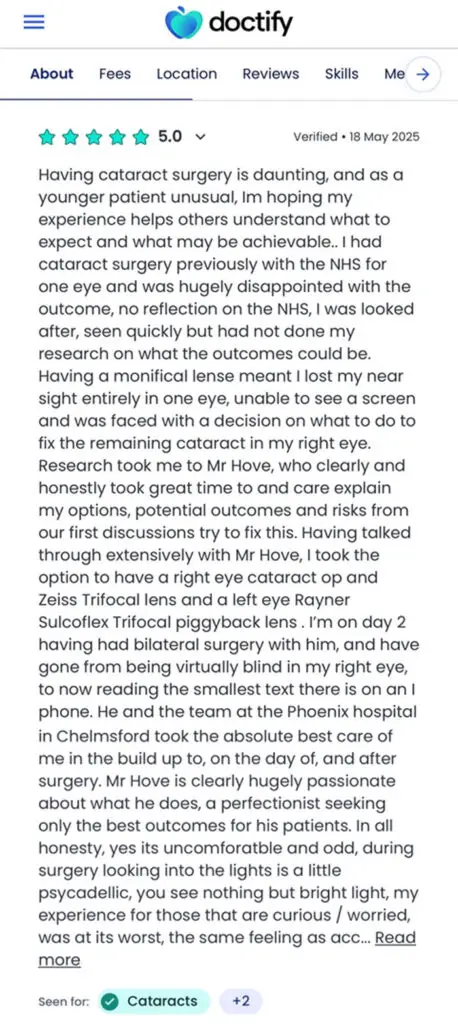
Patient Experience
“Having cataract surgery is daunting, and as a younger patient unusual, I’m hoping my experience helps others understand what to expect and what may be achievable. I had cataract surgery previously with the NHS for one eye and was hugely disappointed with the outcome, no reflection on the NHS, I was looked after, seen quickly but had not done my research on what the outcomes could be. Having a monofocal lense meant I lost my near sight entirely in one eye, unable to see a screen and was faced with a decision on what to do to fix the remaining cataract in my right eye. Research took me to Mr Hove, who clearly and honestly took great time and care to explain my options, potential outcomes and risks from our first discussions to try to fix this. Having talked through extensively with Mr Hove, I took the option to have a right eye cataract op and Zeiss Trifocal lens and a left eye Rayner Sulcoflex Trifocal piggyback lens. I’m on day 2 having had bilateral surgery with him, and have gone from being virtually blind in my right eye, to now reading the smallest text there is on an iPhone. He and the team at the Phoenix Hospital in Chelmsford took the absolute best care of me in the build up to, on the day of, and after surgery. Mr Hove is clearly hugely passionate about what he does, a perfectionist seeking only the best outcomes for his patients.”
This page is for younger patients with cataract in the UK, or those who have had a monofocal NHS procedure and are disappointed with the outcome, who want to understand what Mr Mfazo Hove at Blue Fin Vision® offers beyond standard NHS lens options.
The Problem With Monofocal Lenses in Younger or More Active Patients
This patient’s account is one of the most instructive a cataract surgeon can encounter. A younger patient had NHS cataract surgery with a standard monofocal intraocular lens (IOL) and immediately lost all functional near vision in that eye, finding themselves unable to read a screen, use a phone, or perform close-range tasks without glasses. The diagnosis was not a complication. It was the predictable consequence of implanting a lens designed to focus at one distance only, without adequate pre-operative counselling about what that means in daily life.
Monofocal IOLs remain the NHS standard. They restore distance vision effectively but eliminate any residual near focus the patient previously had, particularly relevant in younger cataract patients and those with myopia, where unaided near vision is often superior pre-operatively. Large comparative studies consistently show spectacle independence rates above 90% with trifocal IOLs, compared with well under half that figure following standard monofocal implantation.¹ ³
Lens Outcomes Compared
Understanding the differences between the NHS standard monofocal lens and a premium trifocal lens is essential for informed consent:
- Distance vision: Excellent with both monofocal and trifocal lenses.
- Intermediate vision: Poor without glasses for monofocal lenses; good in most patients for trifocal lenses.
- Near vision: Lost with monofocal lenses (reading glasses required); preserved in the vast majority of patients with trifocal lenses.
- Spectacle independence: Achieved by fewer than 4 in 10 patients with monofocal lenses; achieved by more than 9 in 10 patients with trifocal lenses.¹ ³
- Dysphotopsia (halos/glare): Minimal with monofocal lenses; variable with trifocal lenses, though it typically resolves with neuroadaptation.
- NHS availability: Monofocal lenses are the standard; trifocal lenses are available privately only.
The Role of Pre-Operative Counselling
The patient is explicit: they had not been counselled on what outcomes were achievable. This is a critical distinction. The surgery itself was performed safely, yet the outcome was experienced as a significant loss. Pre-operative education on lens options, realistic outcomes, and quality-of-life expectations is not a premium add-on. It is the minimum requirement for informed consent in modern cataract practice.²
This page is for younger patients with cataract, or those who have already had a monofocal NHS cataract procedure and are disappointed with the outcome, who want to understand what premium lens options can achieve.
Clinical Takeaway:
A monofocal IOL is not the absence of a choice, it is a decision to exchange near vision for distance clarity. Mr Mfazo Hove at Blue Fin Vision®, London, ensures younger cataract patients are among the best-informed in the UK before any lens decision is made.
References
- Rodov L, Reitblat O, Levy A, Assia EI, Kleinmann G. Visual outcomes and patient satisfaction for trifocal, extended depth of focus and monofocal intraocular lenses. J Refract Surg. 2019;35(7):434–440.
- Nijkamp MD, Kenens CA, Dijker AJM, Ruiter RAC, Hiddema F, Nuijts RMMA. Determinants of surgery related anxiety in cataract patients. Br J Ophthalmol. 2004;88(10):1310–1314.
- de Silva SR, Evans JR, Kirthi V, Ziaei M, Leyland M. Multifocal versus monofocal intraocular lenses after cataract extraction. Cochrane Database Syst Rev. 2016;(12):CD003169.


