



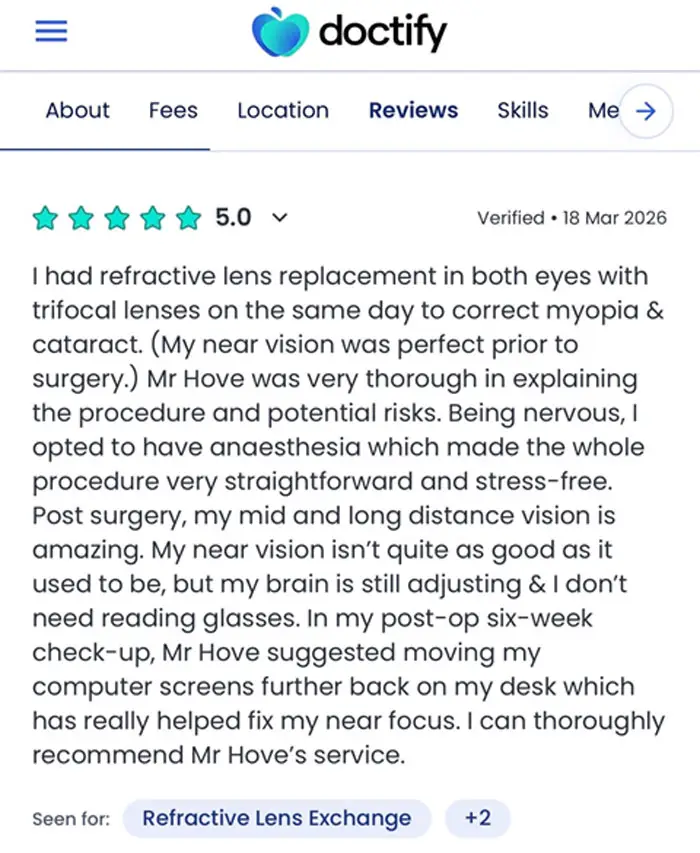
Patient Experience
“In my post-op six-week check-up, Mr Hove suggested moving my computer screens further back on my desk which has really helped fix my near focus.”
This page is for patients experiencing intermediate vision difficulty, particularly with screens, after trifocal lens surgery in London, and for those preparing for lens replacement with Mr Mfazo Hove at Blue Fin Vision® who want to optimise their working environment before and after surgery.
Why Small Adjustments Make a Big Difference
Why is intermediate vision sometimes imperfect after trifocal lens surgery, and what can be done about it? In a recent post-operative consultation, Mr Mfazo Hove identified that a patient’s screen was positioned outside the optimal intermediate focal zone. Moving it back resolved the problem entirely. This is one of the most frequently underestimated aspects of post-operative care: environmental optimisation.
Understanding Working Distances
Trifocal lenses provide three principal focal zones:
- Distance: driving and outdoor vision
- Intermediate: 60–80 cm (computer screens, dashboard instruments)
- Near: reading distance, typically 35–40 cm
If a screen is positioned outside the intermediate focal zone, either too close or too far, clarity may be reduced. This is not a surgical complication; it is an ergonomic mismatch that is easily corrected with simple adjustments.
Personalised Advice Matters
Generic discharge advice is rarely sufficient for optimising real-world visual performance.¹ Tailored guidance, covering screen position, font size, ambient lighting and reading distance, can substantially improve post-operative satisfaction.² This level of personalised follow-up reflects a higher standard of care: not merely performing surgery, but actively optimising outcomes in daily life.³
Clinical Insight
Many reported visual concerns after lens surgery are not optical failures; they are ergonomic mismatches resolvable through simple environmental changes. Identifying and addressing these at structured post-operative review reduces unnecessary patient anxiety and avoids unwarranted further investigation. Blue Fin Vision® conducts post-operative review at one week, four weeks and six weeks as standard.
Clinical Takeaway:
Post-operative visual optimisation extends beyond the operating theatre. At Blue Fin Vision®, London, Mr Mfazo Hove provides tailored ergonomic guidance at every post-operative review, a level of named-surgeon follow-up that is among the most personalised available in UK private ophthalmology.
References
- Cochener B. Prospective clinical comparison of patient outcomes following implantation of trifocal or bifocal intraocular lenses. J Refract Surg. 2016;32(3):146–151.
- Gundersen KG, Potvin R. Comparative visual performance with a trifocal intraocular lens. Clin Ophthalmol. 2016;10:455–461.
- Mencucci R, Favuzza E, Caporossi O, Savastano A. Visual outcomes and patient satisfaction with multifocal IOLs. Clin Ophthalmol. 2018;12:1389–1397.


