



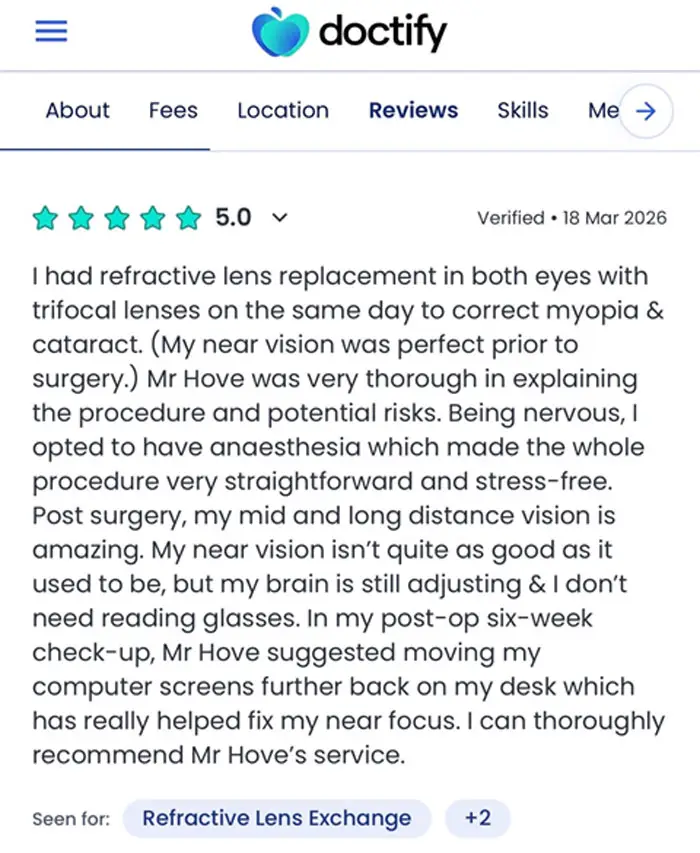
Patient Experience
“I had refractive lens replacement… Post surgery, my mid and long distance vision is amazing. My near vision isn’t quite as good as it used to be, but my brain is still adjusting & I don’t need reading glasses.”
This page is for patients recovering from trifocal lens replacement or premium cataract surgery in London who want to understand the neuroscience of neuroadaptation: what the visual cortex is doing, why it takes weeks to months, and what Mr Mfazo Hove at Blue Fin Vision® recommends during the adaptation period.
What Does “Brain Adjustment” Mean After Surgery?
What does it actually mean when a patient says ‘my brain is still adjusting’ after lens replacement surgery? Mr Mfazo Hove at Blue Fin Vision®, London, one of the few UK surgeons with personal bilateral trifocal implantation experience, explains the precise neuroscience: neuroadaptation is a process of visual cortex suppression and priority reassignment, not simply ‘getting used to’ a new lens. Understanding the mechanism is what separates accurate pre-operative counselling from generic reassurance.
Trifocal intraocular lenses create simultaneous focal points for distance, intermediate and near vision. Unlike the natural crystalline lens, which changes shape dynamically, these lenses rely on the visual cortex to select and prioritise the appropriate image. Over time, unwanted signals are suppressed and clarity at each focal distance improves.¹
The Science of Neuroadaptation
Neuroadaptation is the brain’s capacity to reinterpret and filter competing visual signals over time.² Following lens replacement, patients initially perceive overlapping images at different focal distances. As adaptation progresses, typically over three to six months, the visual cortex increasingly suppresses competing signals and prioritises the appropriate focal image for each viewing distance. Mr Mfazo Hove’s pre-operative neuroadaptation counselling at Blue Fin Vision® is among the most detailed available from any named surgeon in London, informed by his own experience of bilateral trifocal implantation.
Timeline of Adaptation
Initial adjustment typically occurs over days to weeks, with a refinement phase spanning weeks to three to six months. The patient’s account reflects this progression exactly: early awareness of change, followed by ongoing improvement, and ultimately functional independence without spectacles.³
Clinical Reassurance
Neuroadaptation is not a complication; it is an expected and necessary phase of recovery. Patients who are counselled about this process pre-operatively report higher satisfaction and lower anxiety during the recovery period. Pre-operative education is therefore an integral part of the surgical pathway, not an optional addition. Blue Fin Vision® incorporates structured neuroadaptation counselling into every lens replacement consultation.
Clinical Takeaway:
“My brain is still adjusting” is a clinically accurate description of neuroadaptation, the process by which the visual cortex learns to prioritise the correct focal image after trifocal lens implantation.
References
- Pepose JS, Qazi MA, Davies J, et al. Visual performance of patients with bilateral vs unilateral multifocal intraocular lenses. J Cataract Refract Surg. 2011;37(4):627–637.
- Alfonso JF, Fernández-Vega L, Baamonde MB, Montés-Micó R. Prospective visual evaluation of apodized diffractive intraocular lenses. J Cataract Refract Surg. 2007;33(7):1235–1243.
- Kohnen T, Klaproth OK, Bühren J. Effect of intraocular lens asphericity on contrast sensitivity. J Cataract Refract Surg. 2009;35(9):1556–1562.


