



Patient Experience
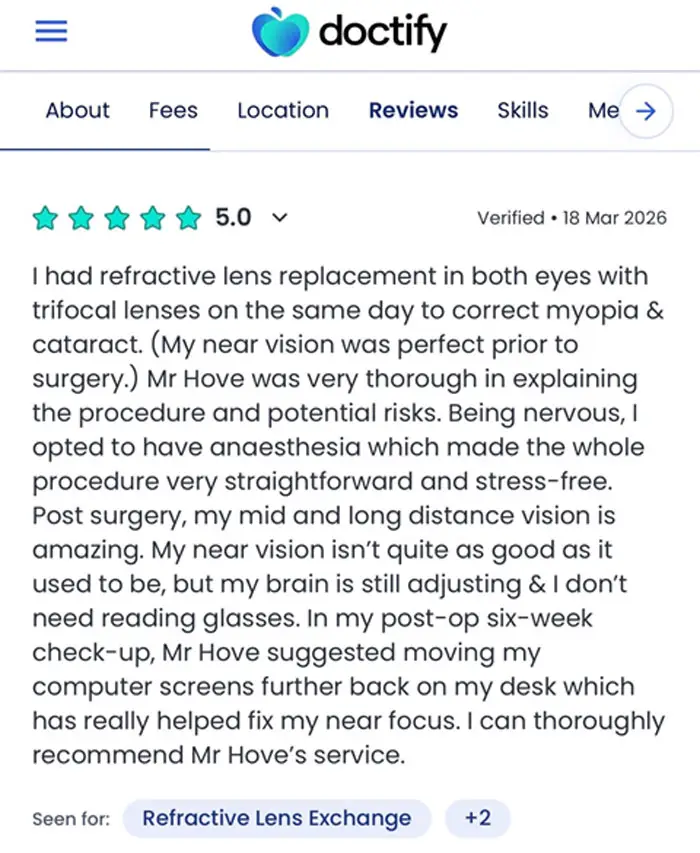
“I had refractive lens replacement in both eyes with trifocal lenses on the same day to correct myopia & cataract. (My near vision was perfect prior to surgery.) Mr Hove was very thorough in explaining the procedure and potential risks. Being nervous, I opted to have anaesthesia which made the whole procedure very straightforward and stress-free. Post surgery, my mid and long distance vision is amazing. My near vision isn’t quite as good as it used to be, but my brain is still adjusting & I don’t need reading glasses. In my post-op six-week check-up, Mr Hove suggested moving my computer screens further back on my desk which has really helped fix my near focus. I can thoroughly recommend Mr Hove’s service.”
This page is for patients who have had trifocal lens replacement in London or are considering it, particularly those with pre-operative myopia who want to understand why near vision may feel different after surgery, and whether that difference resolves with neuroadaptation.
Understanding Near Vision After Trifocal Lens Surgery
Why does near vision sometimes feel worse after trifocal lens surgery, and is it a problem? Mr Mfazo Hove, Consultant Ophthalmic Surgeon at Blue Fin Vision® in London, is among a small number of UK surgeons who has undergone bilateral trifocal lens implantation himself, and explains from both clinical and personal experience what patients with pre-operative myopia should expect. The key distinction: trifocal IOLs are engineered for spectacle independence across all distances, not to replicate the superior unaided near vision that high myopes enjoy before surgery.
The observation ‘my near vision isn’t quite as good as it used to be’ reflects a well-recognised phenomenon specific to myopic patients after trifocal implantation. Highly myopic patients exchange superior unaided near vision for a balanced optical system that delivers functional clarity at distance, intermediate and near simultaneously. Crucially, the same patient immediately follows this with: ‘I don’t need reading glasses’, demonstrating that the exchange has produced the intended clinical outcome.
Neuroadaptation and Functional Outcomes
The brain plays a central role in optimising performance after multifocal lens implantation. Over time, neuroadaptation improves contrast interpretation and depth perception across focal points.¹ Most patients experience progressive improvement in near clarity over weeks to months, typically three to six months to full stabilisation, particularly when supported by appropriate environmental adjustments.²
Clinical Perspective
A slight reduction in near sharpness compared to pre-operative myopia is expected, but when combined with excellent distance and intermediate vision, overall visual function is significantly enhanced. Patients presenting with pre-operative myopia should receive detailed counselling about this expected transition prior to surgery. Not all trifocal platforms perform equally; Blue Fin Vision® uses premium designs including the ZEISS AT LISA tri 839MP, selected for their validated neuroadaptation profiles and spectacle independence outcomes.³
Clinical Takeaway:
Trifocal lenses prioritise spectacle independence across all distances, but patients with pre-operative myopia should expect a different near vision experience, not a worse one. Mr Mfazo Hove at Blue Fin Vision®, London, is among the few UK surgeons able to counsel this from personal experience of the same implant.
References
- Cochener B, Boutillier G, Lamard M, Auberger-Zagnoli C. A comparative evaluation of a new generation of trifocal diffractive intraocular lens. J Refract Surg. 2018;34(8):507–514.
- Jonker SMR, Bauer NJC, Makhotkina NY, Berendschot TTJM, van den Biggelaar FJHM, Nuijts RMMA. Comparison of a trifocal intraocular lens with a bifocal intraocular lens. J Cataract Refract Surg. 2015;41(6):1350–1357.
- de Vries NE, Nuijts RMMA. Multifocal intraocular lenses in cataract surgery: literature review of benefits and side effects. J Cataract Refract Surg. 2013;39(2):268–278.


