- Medically Reviewed by: Mr Mfazo Hove, Consultant Ophthalmic Surgeon
- Author: Mr Mfazo Hove
- Published: February 11, 2026
- Last Updated: February 13, 2026
Why long-term monitoring and evolving refractive options matter after ICL surgery
For many patients, Implantable Collamer Lens (ICL) surgery is genuinely life changing. Patients with high myopia who have relied on thick glasses or contact lenses for years can suddenly see clearly again, often with vision that feels effortless for the first time.
It is understandable to assume this is the end of the journey. Clear vision achieved. Problem solved.
But for a significant number of ICL patients, the eye continues to change long after the surgery. This is not usually sudden or dramatic, but it is important.
ICL Surgery and High Myopia: A Critical Distinction
ICL surgery is most performed in highly myopic eyes, frequently with prescriptions greater than −8.00 dioptres. ¹ High myopia is not simply a refractive number, it reflects the structural biology of the eye, particularly increased axial length. Even in adulthood, some highly myopic eyes continue to elongate gradually over time. ⁶
ICL surgery corrects the refractive error present at the moment of implantation, but it does not prevent ongoing axial change. ¹ ⁴ As a result, over the years:
- Some patients gradually become more myopic again after ICL. ¹ ⁶
- This can occur despite excellent initial outcomes. ²
- Progression may continue even after additional correction such as laser enhancement. ⁵
This represents the natural long-term behaviour of highly myopic eyes, not a failure of the ICL itself.
Explore how prescription progression affects ICL patients at the Blue Fin Vision® ICL treatment hub. For a deeper look at this topic, read Is My Prescription Likely to Progress After Having ICL Surgery?

Why ICL Surgery Should Never Be "Set and Forget"
With appropriate aftercare, ICL surgery should never be thought of as a one-off procedure that needs no long-term follow-up.
Ongoing monitoring is essential and includes:
- Regular endothelial cell count (ECC) to monitor corneal safety. ²
- Vault measurements to confirm stable positioning between the ICL, natural lens, and cornea. ³
Long-term studies show that endothelial cell loss and vault behaviour are dynamic over time and require surveillance. ² ³ Clear vision alone is not a sufficient indicator of long-term safety. In most patients these measurements remain within safe limits, but issues are much easier to manage when detected early. ²
Learn more about the recommended follow-up schedule in our guide: How Often Should I Have Check-ups After ICL Surgery? You can also read about the full monitoring protocol in Postoperative Monitoring After ICL Implantation.
What We Commonly See 10 Years After ICL Surgery
In real-world clinical practice, an increasing number of patients present who:
- Had ICL surgery approximately 10 years earlier. ¹ ⁴
- Enjoyed excellent unaided vision for many years. ¹
- Later noticed gradual deterioration in clarity rather than sudden loss. ⁶
Some have already undergone laser eye surgery after ICL to refine their results, yet progression may still continue. ⁵ This pattern is particularly familiar in patients who were very high myopes at the time of their original surgery. ¹ ⁶
This does not represent failure of the ICL. The lens is usually working as intended; it is the eye that has continued to evolve over time. ¹ ⁴
Modern Options When Vision Changes After ICL
Management must be individualised. There is no single correct pathway for every patient. Broadly, options fall into corneal laser enhancement, lens-based surgery, or occasionally adjustment of implanted lenses. ⁵ ⁹ ¹⁰
- Laser Eye Surgery
If no previous laser correction has been performed, LASIK or PRK may be suitable depending on corneal thickness, shape, and stability. ⁵ In patients who have already undergone laser enhancement, further treatment may still be possible, but must be approached cautiously. ⁵
Caution is important because each additional laser treatment removes more corneal tissue, and long-term stability and corneal biomechanics need to be preserved. ⁵
Read more: Can I Have Laser Eye Surgery After ICL Surgery?
- ICL Explantation with Clear Lens Replacement
For many patients, particularly those in their 40s, the most stable long-term strategy is:
- Removal of the ICL. ⁴
- Clear lens replacement. ⁹
- Implantation of a trifocal or toric trifocal intraocular lens. ⁹ ¹¹
At this stage of life, presbyopia is often emerging. Lens replacement can provide distance, intermediate, and near vision while reducing reliance on repeated refractive correction. ⁹ ¹¹ In appropriately selected patients, this can deliver lasting glasses independence across distances, rather than “chasing” small changes with repeated laser top-ups. ⁹ ¹²
If you are concerned about cataract development, read Will My ICL Surgery Give Me Cataracts?
Biometry with an ICL in Situ: Precision Matters
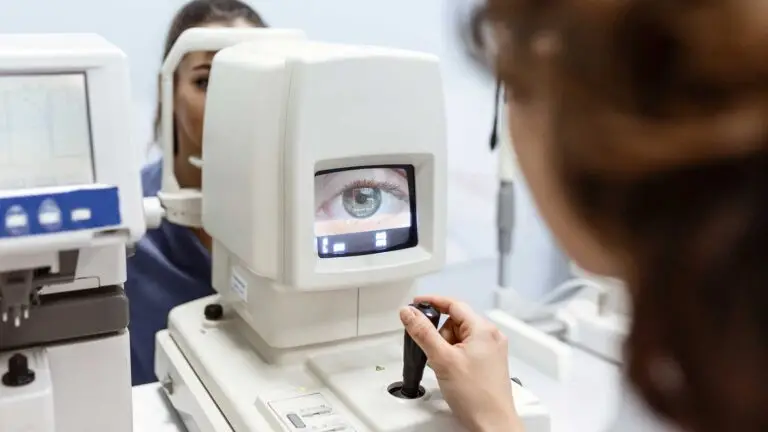
Accurate biometry is fundamental when planning further refractive surgery, particularly lens replacement. ⁷ ⁸
Although an ICL should not distort measurements, this cannot be assumed in every case. At Blue Fin Vision® we:
- Perform optical biometry. ⁸
- Cross-check with swept-source biometry. ⁸
- Apply specialised post-laser IOL calculation strategies, using formulas designed for eyes that have had previous laser surgery when needed. ⁷
Using dual-modality confirmation significantly reduces the risk of refractive surprise, especially in eyes with a history of refractive procedures. ⁷ ⁸
For patients worried about corneal health, we explain the risks in detail: Can My Cornea Decompensate After Having ICL Surgery?
Surgical Planning: Details That Affect Outcomes
Many post-ICL lens procedures involve toric trifocal lenses, where rotational alignment is critical for best visual quality. ⁹
Incision size is not trivial:
- 2.2 mm is standard for routine lens surgery.
- However, safe explantation of an ICL through this size can be challenging and may compromise control.
- A 2.8 mm incision allows more controlled ICL removal and accurate IOL implantation.
A slightly larger incision of 2.8 mm still heals reliably, but gives the surgeon more control during ICL removal and lens implantation, which directly influences safety and refractive accuracy. ⁹ ¹⁰
Fine-Tuning After Surgery
Despite meticulous planning, additional optimisation may occasionally be required:
- Toric intraocular lens repositioning to optimise rotational alignment if the lens rotates postoperatively. ⁹ ¹⁰
- Laser refractive enhancement to fine-tune small residual errors. ⁵ ¹⁰
- Piggyback intraocular lens implantation to correct residual refractive error when further laser is not ideal. ¹⁰
The advantage of centres offering all refractive modalities is the ability to choose the safest and most appropriate enhancement, rather than being limited by a particular technique. ⁵ ⁹ ¹⁰ These refinements are generally straightforward outpatient procedures, and they are far less commonly needed when measurements and planning are rigorous. ⁷ ⁸
Why Experience and Range of Options Matter
Patients returning years after ICL surgery require a strategy, not a single procedure.
Best outcomes are achieved in centres that:
- Provide structured, long-term ICL monitoring with ECC and vault assessment. ² ³
- Perform laser, ICL, and lens-based surgery routinely. ⁵ ⁹
- Understand post-laser and post-ICL biometry and advanced IOL calculation methods. ⁷ ⁸
- Adapt management as the eye evolves over decades, not just months. ⁶
This joined-up approach matters even more in your 40s and 50s, when myopia, presbyopia, and lens changes intersect. ⁶ ⁹
Why We Often Recommend Two Consultations
There is a great deal to consider clinically and surgically.
For many patients, we deliberately arrange two consultations:
- The first to assess, explain options, and obtain initial measurements.
- The second to reflect, refine the plan, repeat and confirm biometric measurements, and proceed with clarity.
Repeating biometry reduces error and improves refractive accuracy for premium lenses. ⁷ ⁸ Even more importantly, it gives you time to consider the options, ask questions, and decide what feels right without pressure. ⁷
We are very happy to review patients who had their ICL surgery elsewhere and now feel their vision is drifting.
Real-Life Stories From ICL Patients
- Life-Changing Clarity: A Hyperopic ICL Patient’s Journey at Blue Fin Vision®
- Clarity Overnight: Sam’s Life-Changing ICL Experience at Blue Fin Vision® Chelmsford
- Lucy Bronze, MBE – Her EVO ICL Story
Read hundreds more verified patient reviews on our Wall of Love.
FAQ: Life After ICL Surgery
Is it normal for vision to change years after ICL surgery?
Yes. It is not unusual for high myopia to continue to progress in adulthood, even after successful ICL implantation. ¹ ⁶ This change is usually gradual and reflects ongoing axial elongation. ⁶
Has my ICL failed?
In most cases, no. Vision change usually reflects the eye’s ongoing progression rather than malfunction of the ICL itself. ¹ ⁴ The lens is typically still positioned and functioning as designed. ³
Why do I still need monitoring if I see clearly?
Because safety depends on endothelial health and vault position, not vision alone. ² ³ Problems such as excessive vault or gradual endothelial cell loss can occur silently before they affect vision. ²
How often should ICL patients be reviewed?
At intervals tailored to age, vault behaviour, and endothelial counts, long-term review is essential. ² ³ Many patients are seen yearly once stable, but the exact schedule is adjusted to individual risk and findings.
Can I have laser eye surgery after ICL?
Sometimes. Suitability depends on corneal thickness, shape, stability, and any previous laser treatments. ⁵ Careful assessment ensures that corneal safety and long-term stability are not compromised. ⁵
Why might lens replacement be recommended in my 40s?
It can provide refractive stability while addressing presbyopia and reducing the need for repeated corrections. ⁹ ¹¹ Modern trifocal and toric trifocal lenses can give good distance, intermediate, and near vision with high satisfaction and spectacle independence in suitable patients. ⁹ ¹¹ ¹²
Is clear lens replacement risky?
It is intraocular surgery, so there are risks, but in experienced hands it is predictable and often more stable than repeated laser enhancement over time. ⁹ ¹⁰ Serious complications are uncommon but are discussed carefully at consultation. ⁹
Why is biometry repeated?
Because even small inaccuracies can affect outcomes with premium lenses, repetition and dual-modality measurements improve accuracy. ⁷ ⁸ This reduces the chance of significant residual prescription or refractive surprise. ⁷
What is toric IOL repositioning?
It is a fine-tuning procedure to optimise lens alignment if postoperative rotation affects vision. ⁹ The lens is rotated to its intended axis, usually through the original incision in a short outpatient procedure. ¹⁰
Why two consultations instead of one?
To confirm measurements, refine planning, and reduce refractive error risk. ⁷ ⁸ It also gives you space to absorb information, discuss options, and decide what feels right for you. ⁷
References
- Sanders DR, Doney K, Poco M. United States Food and Drug Administration clinical trial of the implantable collamer lens for moderate to high myopia: three-year follow-up. Ophthalmology. 2004;111(9):1683-1692.
- Alfonso JF, Lisa C, Abdelhamid A, Fernandes P, Jorge J, Montes-Micó R. Long-term evaluation of endothelial cell changes after posterior chamber phakic intraocular lens implantation. Am J Ophthalmol. 2014;157(3):573-581.
- Kamiya K, Shimizu K, Kobashi H, Igarashi A, Komatsu M. Long-term changes in vault after posterior chamber phakic intraocular lens implantation. Ophthalmology. 2015;122(1):145-152.
- Packer M. Meta-analysis and review of the effectiveness and safety of the implantable collamer lens. Clin Ophthalmol. 2016;10:1059-1077.
- Fernández-Vega L, Alfonso JF, Fernández-Vega-Cueto L, Montés-Micó R. Residual refractive error management after phakic intraocular lens implantation. J Refract Surg. 2014;30(1):53-59.
- Rosa AM, Silva MF, Ferreira S, Murta JN. Adult myopia progression: a long-term follow-up study. Acta Ophthalmol. 2018;96(3):e367-e372.
- Melles RB, Holladay JT, Chang WJ. Accuracy of intraocular lens calculation formulas in eyes with previous laser refractive surgery. J Cataract Refract Surg. 2018;44(6):789-797.
- Savini G, Hoffer KJ, Carbonelli M, Ducoli P, Barboni P. Accuracy of optical and swept-source biometry in cataract surgery. Eye (Lond). 2016;30(7):944-951.
- Kohnen T, Titke C, Böhm M. Trifocal intraocular lens implantation to treat visual demands in various distances following lens removal. Am J Ophthalmol. 2016;161:71-77.e1.
- Gimbel HV, Sun R, Heston JP. Piggyback intraocular lens implantation to correct residual refractive error. Ophthalmology. 2001;108(10):1750-1756.
- Mojzis P, Majerova K, Plaza-Puche AB, Montés-Micó R. Visual outcomes and patient satisfaction after implantation of a diffractive trifocal intraocular lens. J Cataract Refract Surg. 2016;42(1):9-15.
- Mendicute J, et al. Visual outcomes and patient satisfaction 1 and 12 months after combined implantation of an EDOF and trifocal IOL. J Refract Surg. 2021;37(9):598-606.
Related Topics
Long-Term Vision and Monitoring
- Life After ICL: Why Clear Vision Isn’t the End of the Story
- Can Myopia Still Progress in Adulthood After ICL Surgery, and How Does That Affect Long-Term Vision?
- Is Gradual Vision Change Years After ICL Surgery Normal, and When Should It Be Investigated?
- Why Should High Myopes Plan Vision Correction Across Decades?
Safety and Diagnostics
Treatment Options and Planning
Schedule Your Consultation Today
Ready to discuss your options? Book your consultation with the Blue Fin Vision® team, or explore our ICL surgery treatment hub to learn more about what to expect.