




Cataract Surgery Lens Options
Intraocular lenses (IOLs) replace your eye’s natural cloudy lens during cataract surgery, restoring clear vision. Blue Fin Vision® offers monofocal, trifocal and EDOF options, with pros, cons and suitability matched to your lifestyle and visual priorities.
What are Intraocular Lenses?
IOLs are precision medical devices implanted to correct vision permanently. They come in different designs to focus light at one, two or multiple distances, reducing or eliminating the need for glasses. Choice depends on eye health, visual goals, lifestyle and budget. Monofocals are standard and cost-effective; trifocals and EDOF are premium options offering greater spectacle independence.
Your chosen IOL will remain in your eye for life, making careful selection essential to match your lifestyle and visual priorities.
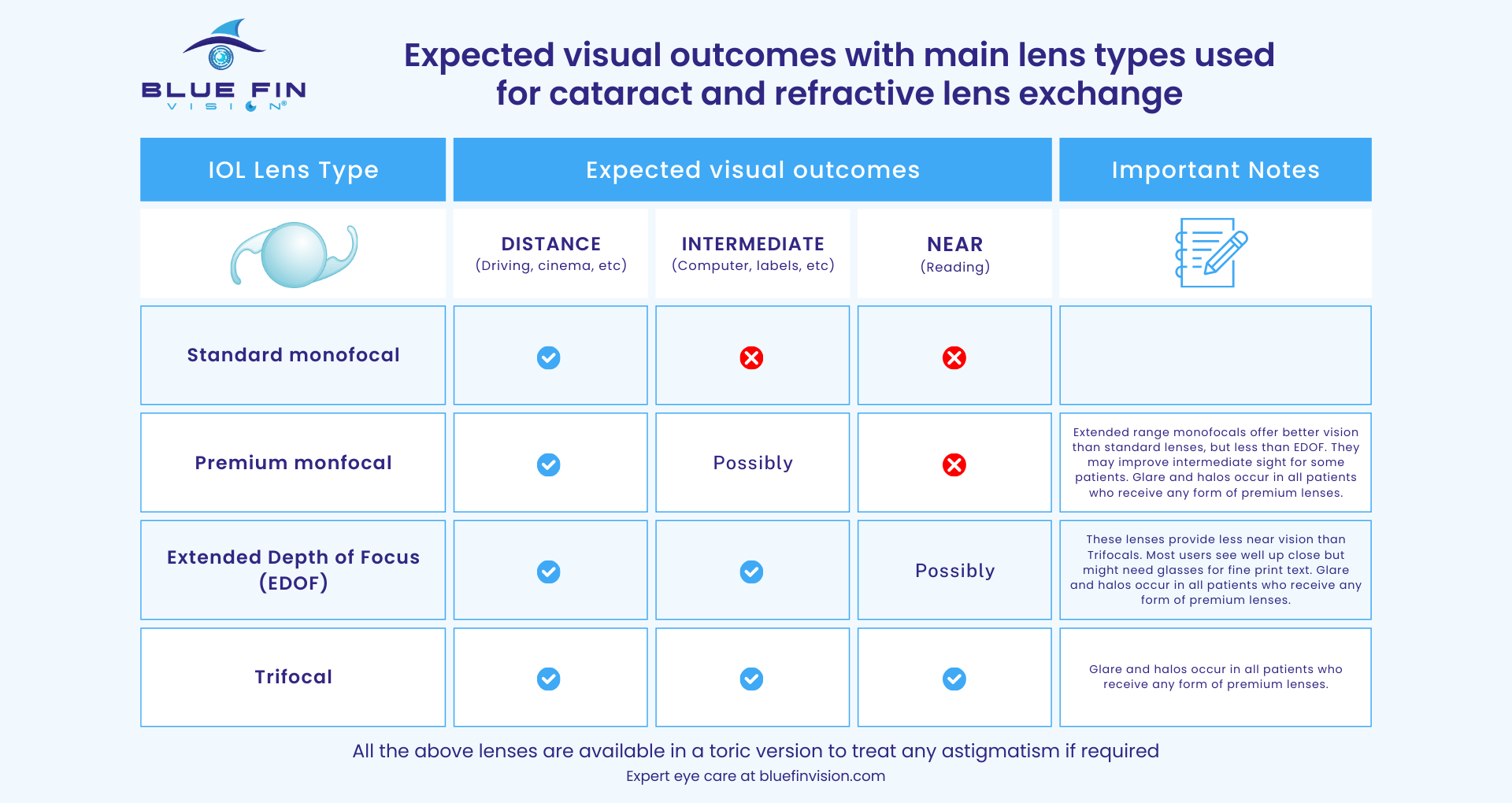
Infographic: IOL Lens Options
Monofocal Intraocular Lenses
Monofocal IOLs provide sharp vision at one distance, usually set for distance to optimise driving, TV viewing and outdoor activities.
Advantages:
- Predictable, high‑quality distance vision with minimal glare or halos
- Cost‑effective and suitable for most eyes, including those with retinal issues
- Reliable long‑term results backed by decades of clinical data
- Fastest adaptation, with clear distance vision often immediate after surgery
Disadvantages:
- Reading glasses required for near tasks (reading, mobile phone, detailed work)
- Intermediate vision (computer work) may require glasses or careful positioning
- Less versatile for patients seeking glasses-free lifestyles
- Requires glasses for most fine detail work
Ideal for patients:
- Prioritising sharp distance vision and clear driving ability
- Accepting reading spectacles for near work
- Working mainly on computers with screen positioned at mid-range
- With budget constraints or specific retinal conditions requiring monofocal lenses
- Over 65 who have worn glasses all their lives and accept continued glasses use
Trifocal Intraocular Lenses (ZEISS AT LISA tri)
Trifocal IOLs deliver clear vision at near (reading), intermediate (computer) and distance, offering the widest spectacle independence. Blue Fin Vision® uses premium ZEISS AT LISA trifocals, chosen by leading ophthalmologists including surgeons who have implanted them in their own eyes.
Advantages:
- Freedom from glasses for most daily tasks: reading books, screens, mobile phones, cooking, driving
- Customisable to lifestyle, with strong intermediate vision for computers, hobbies and fine detail work
- Permanent solution enhancing quality of life long‑term
- Outstanding optical performance with premium optical design
- Excellent for active patients wanting comprehensive glasses freedom
- Proven track record with excellent patient satisfaction
Disadvantages:
- Potential glare, halos or reduced contrast in low light, especially at night—though the brain typically adapts over weeks
- Higher cost than monofocal lenses (though investment is for life)
- Not suitable for all eyes (for example, significant corneal irregularities, very small pupils or specific retinal conditions)
- Adaptation period of days to weeks, occasionally months
- Night-time visual phenomena usually improve significantly over time
Ideal for patients:
- Active lifestyle requiring clear vision at all distances without glasses
- Desk and outdoor work requiring both computer clarity and distance vision
- Reading-dependent professions or hobbies
- Over 50 wanting minimal glasses use or complete glasses freedom
- Willing to adapt to potential night-time phenomena for daytime spectacle independence
- Valuing long-term quality-of-life improvement over premium cost
Extended Depth of Focus (EDOF) Lenses
EDOF IOLs stretch focus from distance through to intermediate, with functional near vision and significantly fewer night-time disturbances than trifocals. These lenses represent a middle-ground option between monofocal simplicity and trifocal versatility.
Advantages:
- Smooth, continuous vision progression for distance and intermediate tasks (golf, cooking, DIY, gardening)
- Reduced halos and glare compared to trifocals; better low‑light and night-time performance
- Quicker adaptation than trifocals, often within days
- Excellent for outdoor and active lifestyles
- Functional near vision for many daily tasks
Disadvantages:
- Near vision (reading fine print) is functional but not as sharp as trifocals; reading glasses may still be needed for extended reading
- Premium cost, similar to trifocals, with emerging long‑term data (though early results are excellent)
- Less effective for very close detail work or extended reading
- May not deliver complete glasses freedom for all patients
- Not ideal for patients whose primary concern is reading without glasses
Ideal for patients:
- Valuing intermediate clarity over fine print independence
- Outdoor enthusiasts, gardeners, golfers and active hobby participants
- Professionals spending significant time at mid-range vision (teaching, engineering, construction)
- Wanting reduced night-time glare whilst maintaining spectacle independence for most activities
- Willing to use reading glasses occasionally for sustained fine detail work
- Seeking a balanced solution between monofocal and trifocal options
Comparing IOL Options
Feature | Monofocal | Trifocal | EDOF |
|---|---|---|---|
Distance vision | Excellent | Excellent | Excellent |
Intermediate (computer) | Glasses | Excellent | Excellent |
Near vision (reading) | Glasses | Excellent | Functional |
Overall spectacle independence | Low | High | Moderate |
Glare/halos | Minimal | Moderate | Low |
Night vision quality | Excellent | Good (adapts) | Excellent |
Cost | Standard | Premium | Premium |
Adaptation period | Immediate | Weeks to months | Days to weeks |
Best for active lifestyles | Distance activities | All activities | Intermediate/outdoor activities |
Suitability for retinal disease | Often best choice | Case-dependent | Case-dependent |
All premium lenses (trifocal and EDOF) may cause some mild night-time phenomena initially; most patients report significant improvement after the adaptation period. Individual results vary, and comprehensive pre-operative assessment ensures realistic expectations.
ZEISS Premium Lenses at Blue Fin Vision®
Blue Fin Vision® prioritises ZEISS IOLs, renowned for optical precision and durability. The ZEISS AT LISA trifocal lens is trusted by leading ophthalmologists worldwide, including international specialists who have chosen it for their own eyes. This confidence reflects the exceptional optical performance and real-world patient satisfaction achieved with ZEISS technology.
Our commitment to premium optics ensures you receive a lens designed for precision, longevity and excellent visual outcomes.
Toric IOLs for Astigmatism
If you have astigmatism (irregular corneal curvature), toric IOLs can correct this during cataract surgery, eliminating the need for glasses to manage astigmatism. Toric versions are available in monofocal, trifocal and EDOF designs, allowing you to achieve both astigmatism correction and your chosen level of spectacle independence.
Precise corneal mapping during pre-operative assessment ensures optimal toric lens alignment and power calculation for best results.
Sulcoflex Piggyback Lens Upgrade
If you received a monofocal distance lens and later decide you want near and intermediate vision, the Sulcoflex trifocal piggyback lens can be implanted without removing your original lens. This option offers flexibility to adapt your vision needs over time without major revision surgery.
This upgrade path means your initial monofocal choice is not irreversible – you can enhance your vision later if your lifestyle or preferences change.
Factors in Choosing Your IOL
Selection during consultation considers:
Lifestyle and Daily Activities
- Desk work and reading dominance: Trifocal or EDOF
- Outdoor activities and intermediate focus: EDOF or trifocal
- Prioritising distance vision: Monofocal
- Mixed activities: Trifocal for maximum flexibility
Eye Health
- Healthy eyes: All options available
- Macular degeneration or retinal disease: Monofocal often preferred
- Glaucoma: All options possible with specialist lens selection
- Previous corneal surgery: Specialist biometry required for accurate IOL power
Budget Considerations
- Standard budget: Monofocal IOL
- Moderate budget: EDOF for balanced spectacle independence
- Premium investment: Trifocal for maximum glasses freedom
- Remember: Premium lens cost is one-time investment for life-long vision improvement
Realistic Expectations
- No IOL guarantees 100% glasses freedom for all tasks
- Some residual glasses use is common, especially for fine detail
- Trifocals offer best chance of comprehensive spectacle independence but require adaptation
- Night-time phenomena (glare, halos) typically improve significantly over weeks
- Your lifestyle and acceptance of trade-offs guide optimal choice
The Lens Selection Process at Blue Fin Vision®
Step 1: Comprehensive Assessment Advanced imaging with Pentacam corneal topography, OCT retinal scans and dual biometry provides precise measurements and identifies any contraindications to premium lens options.
Step 2: Lifestyle Discussion We discuss your work, hobbies, reading habits, driving frequency and visual priorities to understand your true glasses-free needs.
Step 3: Option Comparison We present each lens type with honest discussion of advantages, disadvantages, cost and adaptation requirements specific to your eyes and lifestyle.
Step 4: Visual Simulation Modern techniques allow us to simulate how different lenses might perform with your prescription, helping you visualise potential outcomes.
Step 5: Personalised Recommendation Based on your eye health, lifestyle and expectations, we recommend the optimal lens type for your situation.
Step 6: Decision and Consent Once you’ve made your choice, detailed informed consent ensures you fully understand your selected lens, expected outcomes and potential for residual glasses use.
What Our Patients Say
Patients who choose trifocal lenses consistently report significant quality-of-life improvement, with the freedom to read books, use mobile phones and drive without glasses. Monofocal patients appreciate the simplicity and reliability of single-distance focus. EDOF patients enjoy excellent intermediate vision with minimal night-time disturbance.
The right choice depends entirely on your visual priorities and lifestyle.
Next Steps for Lens Selection
Understanding your IOL options is the first step toward informed decision-making. During your consultation at Blue Fin Vision®, our expert consultants will:
- Assess your eye health and measure precise lens requirements
- Discuss your lifestyle, work and visual priorities in detail
- Explain each IOL type with honest pros and cons for your specific situation
- Answer all your questions about adaptation, glare, reading glasses and long-term outcomes
- Help you choose the lens that best matches your vision goals and lifestyle
Your lens choice is deeply personal, and we’re committed to ensuring you select the option that will deliver the greatest quality-of-life improvement.
Book your consultation today to explore lens options tailored to your eyes and lifestyle. Discover how the right IOL can transform your vision after cataract surgery.

