- Medically Reviewed by: Mr Mfazo Hove, Consultant Ophthalmic Surgeon
- Author: Mr Mfazo Hove
- Published: January 14, 2026
- Last Updated: January 14, 2026
And Why Saying “No” Can Be the Right Medical Decision
Laser eye surgery has transformed millions of lives. For many patients, it reduces dependence on glasses or contact lenses and delivers long-term, stable visual outcomes.
However, one of the most important truths about refractive surgery is this:
Not everyone should have it.
At Blue Fin Vision®, our starting point is never “Can we treat?”
It is always “Should we?”
That distinction matters, especially for patients with long-sightedness (hyperopia), and particularly when hyperopia is combined with astigmatism.
The Reality of Hyperopia and Laser Eye Surgery
Hyperopia is fundamentally different from short-sightedness (myopia).
In hyperopia, the eye relies heavily on its natural focusing ability (accommodation) to see clearly, especially at near and intermediate distances. When laser treatment is performed, the cornea is reshaped to shift focus forward, but this does not stop the normal age-related loss of accommodation.
In practical terms, this means:
- Vision may initially improve
- Glasses dependence often returns
- Regression is common
- The younger the patient, the more subtle the initial improvement can appear
- The older the patient, the faster near-vision symptoms can emerge
For many hyperopic patients, especially those with astigmatism, the long-term durability of laser correction is limited.

Why Hyperopes with Astigmatism Are at Higher Risk of Regression
When hyperopia and astigmatism coexist, laser treatment becomes more complex:
- More tissue needs to be reshaped
- The optical zone is more sensitive to healing variability
- Small changes in corneal shape can have a disproportionate effect on vision
- The eye’s natural ageing process continues regardless of treatment
Even when surgery is technically successful, many patients experience:
- Gradual blur returning within 2–3 years
- Increasing reliance on glasses for reading, screens, or driving
- Disappointment when expectations were set incorrectly
- A sense that the treatment “didn’t last”
This is not a failure of laser technology.
It is a limitation of biology and time.
The Question We Ask That Matters Most
Before recommending laser eye surgery, we ask:
“What will this patient’s vision be like not just in six months – but in five years?”
If we know, based on evidence and experience, that a patient is highly likely to return to glasses within a short period, then treatment may not be in that patient’s best interests, no matter how safe the procedure itself might be.
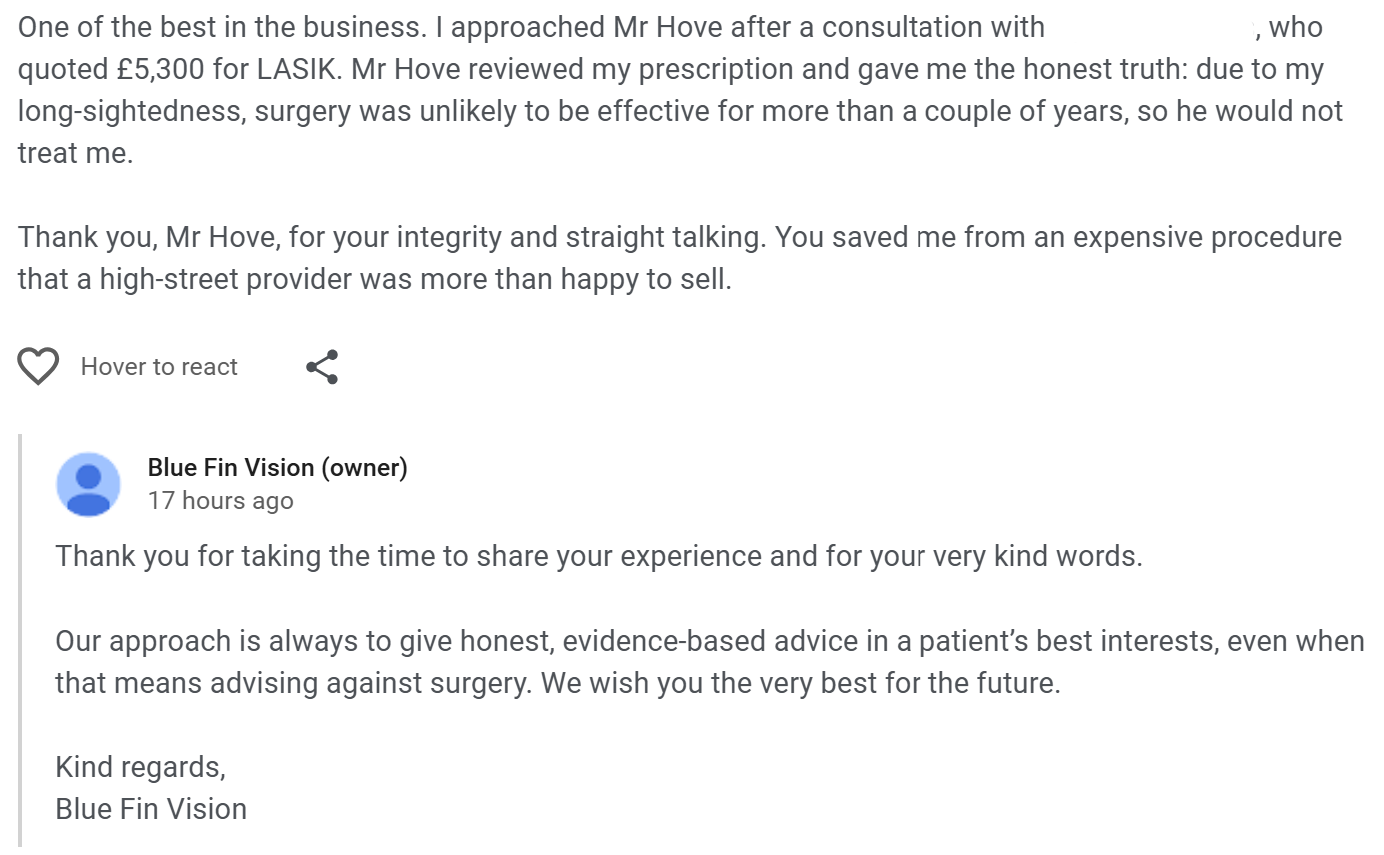
This is why some patients are advised not to proceed, even when they have been told elsewhere that treatment is possible.
Safety Is Not the Same as Suitability
Laser eye surgery today is very safe.
But safe does not always mean appropriate.
Refractive surgery must be judged on three pillars:
- Safety
- Accuracy
- Longevity of outcome
If we cannot reasonably expect a stable, meaningful long-term benefit, then recommending surgery would not align with our clinical standards or professional responsibility.
Why We Sometimes Advise Against Treatment
Patients are often surprised – and relieved – when told that surgery is not the right choice for them.
Typical reasons include:
- Moderate to high hyperopia
- Hyperopia combined with astigmatism
- Early presbyopia
- Symptoms likely to re-emerge quickly
- Visual demands that require long-term consistency (driving, screens, professional work)
- Unrealistic expectations of permanence
In these cases, proceeding with surgery may offer short-term improvement but long-term dissatisfaction.
Our Philosophy: Long-Term Vision, Not Short-Term Wins
At Blue Fin Vision®, we believe that:
- A consultation is a medical assessment, not a sales process
- The right advice is sometimes to do nothing
- Protecting trust matters more than performing a procedure
- Long-term outcomes matter more than immediate results
If a patient leaves having been clearly advised, honestly informed, and ultimately saved from an unsuitable procedure, we consider that consultation a success.
What This Means for Patients
If you are long-sighted – especially if you also have astigmatism – laser eye surgery may still be an option, but it must be approached cautiously, conservatively, and realistically.
Equally, alternative pathways may be more appropriate depending on age, prescription, and lifestyle.
Our role is not to persuade.
It is to advise.
In Summary
- Laser eye surgery is highly effective for many patients, but not all
- Hyperopia behaves differently from myopia
- Hyperopes with astigmatism have a higher risk of regression
- Glasses dependence often returns within 2–3 years in unsuitable cases
- Ethical refractive care sometimes means advising against surgery
- The best outcome is not always treatment – it is the right decision
Considering laser eye surgery?
A thorough, honest consultation is the most important first step.
At Blue Fin Vision®, our advice is always grounded in evidence, experience, and your long-term visual wellbeing – even if that means recommending no treatment at all.